

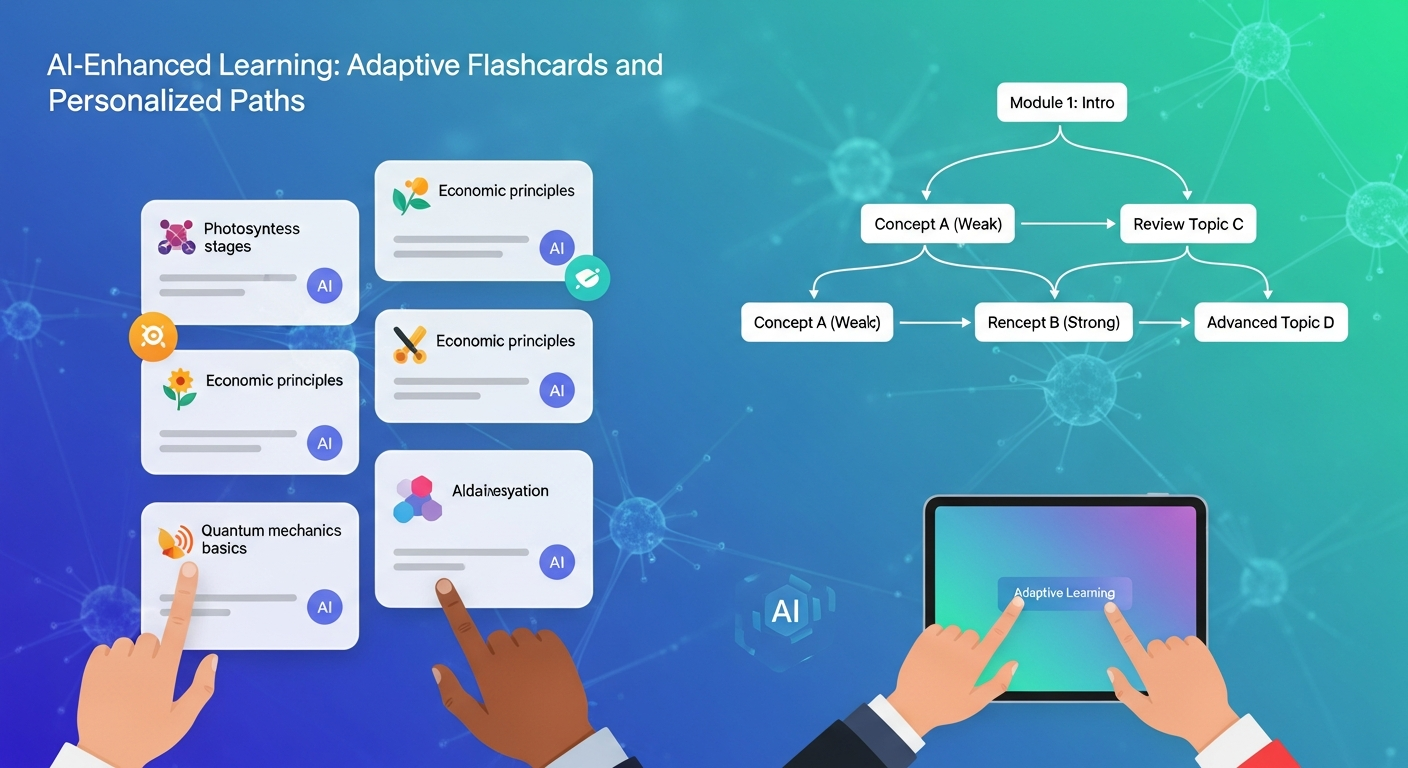
How AI-Authored Flashcards and Adaptive Learning Paths Drive Engagement
In today's fast-paced corporate environment, the efficacy of Learning & Development (L&D) programs is under constant scrutiny. Vice Presidents, Directors, and Managers of L&D across industries from Compliance to Pharma, Banking to Retail, face a universal challenge: how to cultivate engaged learners and ensure lasting knowledge retention. Traditional training methods often fall short, leading to disinterest, high dropout rates, and a disconnect between learning and on-the-job performance. Enter Artificial Intelligence (AI) – a transformative force poised to revolutionize how employees interact with educational content, particularly through AI-authored flashcards and intelligent adaptive learning paths.
The imperative for effective training is higher than ever, especially in sectors with stringent regulatory requirements like Finance and Healthcare, or those driven by rapid innovation such as Tech and Oil & Gas. The ability to quickly and effectively upskill or reskill employees is not just a competitive advantage; it's a necessity for survival. This article delves into how AI, through personalized content and dynamic learning journeys, is reshaping corporate education, making it more engaging, efficient, and ultimately, more impactful.
The Evolving Landscape of Corporate Learning
The days of static, one-size-fits-all training modules are rapidly fading. Modern learners, accustomed to personalized digital experiences in their personal lives, expect the same level of tailored interaction from their professional development. The demand for flexible, on-demand, and highly relevant learning experiences has never been greater. Forward-thinking organizations are embracing advanced learning management software to meet these evolving needs.
A robust Microlearning LMS is becoming the bedrock of contemporary L&D strategies. These platforms, especially when powered by AI, offer a dynamic environment where learning is not just consumed but actively shaped by the learner's interactions. The shift from passive consumption to active engagement is crucial for industries where complex information – be it compliance regulations, sales techniques, or critical safety protocols – must be not only understood but also retained and applied.
The Power of AI-Authored Flashcards: Beyond Rote Memorization
What makes AI-generated flashcards more effective than traditional ones? This is a question frequently posed by L&D professionals evaluating new tools. The answer lies in AI's capacity to analyze vast amounts of learning content, identify core concepts, and then intelligently generate questions and answers that are precisely tailored to the learning objective. Unlike manually created flashcards, an AI Powered Authoring Tool can extract nuanced details, create scenario-based questions, and even infer relationships between different pieces of information to produce a truly comprehensive and challenging set of study aids.
For organizations utilizing a learning content management system, the ability to rapidly generate high-quality, relevant flashcards is a game-changer. It significantly reduces the burden on L&D teams, allowing them to focus on broader strategic initiatives rather than painstaking content creation. Furthermore, these AI-driven flashcards often incorporate spaced repetition algorithms, ensuring that learners revisit information at optimal intervals for maximum long-term retention – a critical factor for subjects like compliance training or critical product knowledge in retail.
Key Benefits of AI-Authored Flashcards for Engagement:
- Personalized Content Delivery: Each flashcard set can be dynamically adapted to a learner's existing knowledge gaps, ensuring they focus on what they don't know rather than repeating what they do.
- Increased Knowledge Retention: Leveraging advanced cognitive science, AI schedules review sessions, reinforcing learning just before knowledge decay sets in.
- Reduced Cognitive Overload: Flashcards inherently present information in bite-sized chunks, aligning perfectly with Microlearning LMS principles and preventing learners from feeling overwhelmed.
- Time-Saving for Content Developers: AI drastically cuts down the time and resources required to develop effective study materials, making an LMS more efficient.
- Direct Applicability: Particularly valuable for Risk-focused Training in sectors like banking or healthcare, where understanding complex terms and procedures is paramount.
Adaptive Learning Paths: The GPS for Skill Development
How can artificial intelligence tailor learning paths for individual employees? This is another pivotal question for L&D leaders seeking to maximize the return on their training investment. The answer lies in AI's ability to act as an intelligent navigator, assessing a learner's current capabilities, past performance, job role, and future career aspirations to forge a truly unique educational journey.
Adaptive Learning systems powered by AI dynamically adjust the sequence, difficulty, and type of content presented to each individual. If an employee demonstrates proficiency in a certain area, the system skips redundant modules. Conversely, if they struggle, it provides additional resources, different explanations, or targeted practice. This level of personalization transforms a generic learning management system into a powerful, individualized development tool. For enterprise learning management, this means ensuring every employee gets precisely the training they need, when they need it, optimizing both individual growth and organizational efficiency.
Driving Engagement with Adaptive Learning Paths:
- Enhanced Relevance: Learners are more engaged when the content directly pertains to their job function and development needs, avoiding the frustration of irrelevant training.
- Optimized Efficiency: By eliminating redundant modules, adaptive paths save valuable employee time and organizational resources, making the overall learning management solutions more attractive.
- Clear Progress Tracking: Learners can visually track their advancement along their personalized path, fostering a sense of accomplishment and motivating continued engagement, especially when integrated into a Gamified LMS.
- Improved Performance: By addressing specific skill gaps, adaptive paths directly contribute to enhanced job performance and faster skill acquisition across all industries.
Synergistic Power: AI Flashcards + Adaptive Paths in Action
The true magic happens when AI-authored flashcards and adaptive learning paths are integrated within a comprehensive Microlearning LMS. Imagine a new hire in the banking sector using a modern lms learning management system. Their adaptive learning path immediately assesses their prior knowledge of financial regulations and directs them to specific modules. As they complete each module, AI-authored flashcards appear, reinforcing key terms, scenarios, and compliance rules specific to their role.
What are the practical applications of AI in enterprise learning management systems? The possibilities are vast. From personalized onboarding that accelerates time-to-competency for sales teams, to continuous professional development that keeps healthcare professionals updated on the latest protocols, this combination ensures that learning is not a static event but a continuous, dynamic process. It significantly bolsters Risk-focused Training by ensuring critical information is not just covered, but truly mastered, across all levels of an organization. This integrated approach, supported by a sophisticated learning management software, ensures that knowledge gaps are rapidly identified and addressed, leading to better decision-making and reduced operational risks.
The Tangible ROI for L&D Leaders
For L&D leaders, the adoption of AI-authored flashcards and adaptive learning paths translates into significant, measurable benefits. A cloud based learning management system equipped with these AI capabilities offers an unprecedented return on investment:
- Improved Engagement & Completion Rates: Personalized, relevant content inherently captures and holds learner attention, leading to higher completion rates.
- Superior Knowledge Retention & Skill Transfer: AI's intelligent repetition and targeted content ensure that learning sticks and can be applied in real-world scenarios.
- Reduced Training Costs: By optimizing learning paths and automating content creation, organizations save on development time, instructor fees, and lost productivity from unnecessary training.
- Enhanced Compliance & Risk Mitigation: In regulated industries, deep understanding of policies and procedures, reinforced by AI-driven methods, significantly reduces human error and non-compliance risks.
- Greater Employee Satisfaction & Productivity: Learners appreciate training that respects their time and directly contributes to their professional growth, leading to a more engaged and productive workforce.
Implementing such advanced learning management solutions means investing in an LCMS that is not just a repository of content but an intelligent engine for growth.
Conclusion
The future of corporate learning is undeniably intelligent, personalized, and highly engaging. AI-authored flashcards and adaptive learning paths are not mere technological novelties; they are essential tools for any L&D professional aiming to create impactful, measurable, and truly engaging training programs. By harnessing the power of AI within a modern MaxLearn LMS, organizations can move beyond traditional, often ineffective, training models. They can instead foster a culture of continuous learning where every employee feels supported, challenged, and empowered to reach their full potential, ultimately driving business success across all industries. Embracing these innovations means stepping into an era where learning is not just a requirement, but a truly dynamic and rewarding experience.


