

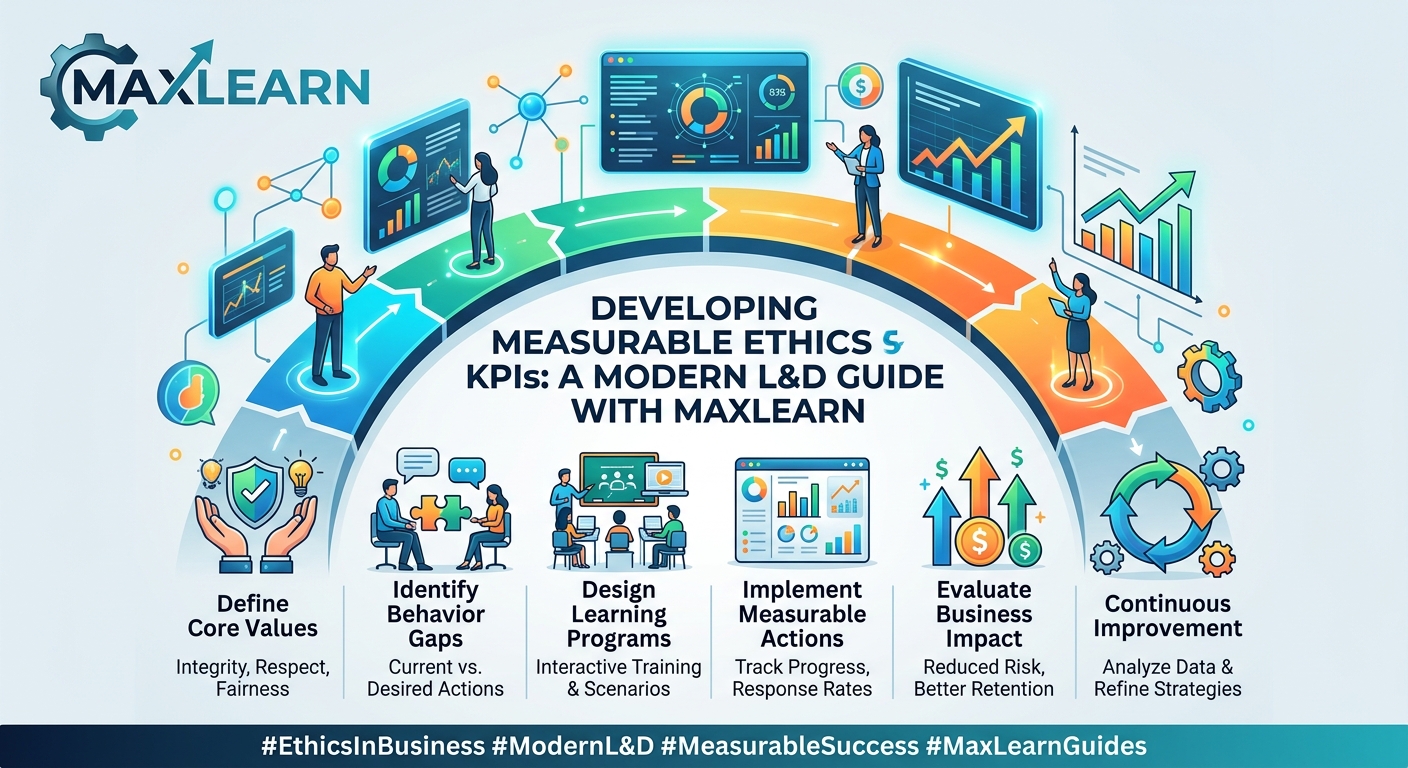
Developing Measurable Ethics KPIs: A Modern L&D Guide with MaxLearn
In today's rapidly evolving business landscape, the call for ethical conduct has never been louder. From safeguarding brand reputation and ensuring regulatory compliance to attracting top talent and fostering long-term stakeholder trust, ethics is no longer a peripheral concern but a core strategic imperative. For L&D leaders – Vice Presidents, Directors, and Senior Managers – the challenge isn't just about delivering ethics training, but about proving its tangible impact. How do you move beyond mere completion rates to truly measure the cultivation of an ethical culture? This guide delves into developing measurable Ethics Key Performance Indicators (KPIs) and demonstrates how Microlearning LMS MaxLearn can be your indispensable partner in this journey.
The Imperative of Ethical Conduct Across Industries
The spotlight on corporate ethics has intensified across all sectors, making robust ethical frameworks and demonstrable accountability non-negotiable. Consider the critical role ethics plays in:
- Compliance: Adhering to intricate legal and industry regulations, avoiding hefty fines and legal repercussions.
- Sales: Building customer trust and loyalty through transparent and honest practices.
- Banking & Finance: Upholding integrity in transactions, managing conflicts of interest, and ensuring data security.
- Insurance: Fair claims processing and ethical sales of complex financial products.
- Retail: Supply chain ethics, fair labor practices, and transparent consumer dealings.
- Pharma & Health care: Patient safety, data privacy, and ethical research and development.
- Hospitality: Employee treatment, guest privacy, and responsible business operations.
- Oil and Gas & Mining: Environmental responsibility, community engagement, and safety protocols.
In each of these segments, a lapse in ethics can trigger catastrophic consequences, ranging from financial penalties and market value erosion to severe reputational damage and loss of public trust. This underscores the urgency for L&D to shift from reactive compliance to proactive cultural cultivation, backed by measurable results.
The L&D Conundrum: Measuring the Immeasurable
L&D professionals have long grappled with the challenge of measuring the impact of 'soft skills' training, and ethics is perhaps the epitome of this dilemma. Traditional metrics often focus on:
- Training completion rates
- Quiz scores
- Participant feedback on training quality
While these provide some insights into engagement and immediate recall, they fall short of demonstrating behavioral change, cultural shift, or business impact. The true goal is to foster an environment where ethical considerations are instinctively integrated into daily decision-making. To achieve this, L&D needs a strategic approach to developing Ethics KPIs that transcend basic compliance checkboxes and provide meaningful, actionable insights.
Crafting Measurable Ethics KPIs: A Strategic Approach for L&D
Developing effective Ethics KPIs requires a systematic, thoughtful process. Here’s how L&D leaders can approach it:
Step 1: Define Your Organization's Core Ethical Principles and Values
Before you can measure ethics, you must clearly define what it means within your specific organizational context. This involves:
- Articulating core values (e.g., integrity, transparency, respect, accountability).
- Translating these values into clear ethical principles relevant to your industry and operations.
- Engaging leadership to ensure alignment and commitment.
Step 2: Identify Key Ethical Behaviors and Indicators
Ethical principles are abstract; KPIs need to be tied to observable behaviors. For each principle, identify specific actions and outcomes that demonstrate adherence. For example:
- Principle: Transparency. Behavior: Open communication about potential conflicts of interest. Indicator: Number of reported conflicts of interest (could indicate a culture of openness, not necessarily more conflicts).
- Principle: Accountability. Behavior: Taking responsibility for mistakes. Indicator: Resolution rates for internal ethical complaints.
- Principle: Respect. Behavior: Inclusive decision-making. Indicator: Employee feedback scores on perceived fairness and respect.
Step 3: Choose Your Metrics: Quantitative and Qualitative
A balanced approach combining both types of metrics offers the most comprehensive view:
- Quantitative Metrics:
- Ethics hotline utilization and resolution rates.
- Number of reported policy violations (and severity).
- Completion rates for specific ethics training modules.
- Scores from anonymous ethics culture surveys (e.g., employees' comfort level reporting issues).
- Employee turnover rates (ethics can impact retention).
- Qualitative Metrics:
- Feedback from leadership and managers on observed ethical conduct.
- Results from ethical dilemma simulations or case study discussions.
- Peer review observations related to ethical decision-making.
- Exit interview data highlighting ethical culture perceptions.
Step 4: Establish Baselines and Set Targets
Once metrics are identified, gather baseline data. This provides a starting point against which future progress can be measured. Set realistic, measurable, achievable, relevant, and time-bound (SMART) targets for improvement.
Step 5: Integrate Ethics KPIs into Performance Management
For ethics to be truly embedded, it must be part of ongoing performance evaluations. Discussing ethical conduct during performance reviews reinforces its importance and helps identify areas for further development. This integration elevates ethics from a mere compliance exercise to a fundamental aspect of professional excellence.
MaxLearn: Empowering L&D to Drive and Measure Ethical Excellence
Implementing and tracking these sophisticated Ethics KPIs requires a robust learning management system (LMS) that goes beyond basic content delivery. This is where MaxLearn excels, offering a comprehensive suite of features perfectly suited for modern ethical training and measurement:
MaxLearn for Ethical Training Delivery and Tracking
- Microlearning LMS: Deliver ethics content in bite-sized, digestible modules. This ensures consistent engagement and better retention of complex ethical concepts, making it easier to reinforce principles regularly.
- Gamified LMS: Transform ethics training from a dry obligation into an engaging experience. Use scenarios, quizzes, and leaderboards to challenge employees to make ethical choices in simulated environments, fostering active learning and better decision-making skills.
- Adaptive Learning Paths: Tailor ethics training to specific roles, departments, or individual risk profiles. An employee in finance might require different ethical scenarios than one in sales or HR. MaxLearn’s adaptive capabilities ensure relevance and maximize impact.
- AI Powered Authoring Tool: Rapidly create and update dynamic ethical scenarios, case studies, and compliance modules. This ensures your ethics training remains current with evolving regulations and business challenges, without extensive development time.
- Risk-focused Training: Pinpoint areas of high ethical risk within your organization and deploy targeted training. MaxLearn allows you to focus resources where they're most needed, mitigating potential compliance breaches and fostering a proactive ethical posture.
Beyond delivery, MaxLearn’s powerful analytics and reporting features provide the data L&D leaders need to track their chosen Ethics KPIs. Whether you're monitoring completion rates, assessing understanding through scenario-based quizzes, or analyzing engagement with interactive ethical dilemmas, MaxLearn offers the insights to measure progress and demonstrate ROI. It's an enterprise learning management solution designed for comprehensive tracking and a robust learning content management system that supports diverse formats and continuous updates.
Integrating AI-Driven Insights for Enhanced Ethics Management
As L&D leaders, you're constantly seeking innovative ways to deepen the impact of your programs and ensure they are future-proof. Leveraging intelligent systems can provide unprecedented clarity and efficiency in fostering an ethical culture.
How can L&D leaders ensure their ethics training truly resonates with employees across various departments and seniority levels?
Modern learning management software, like MaxLearn, addresses this by offering highly personalized learning experiences. Through sophisticated analytics, the platform can identify knowledge gaps and preferred learning styles, then deliver tailored content. This ensures that a senior manager receives training relevant to their decision-making scope, while a frontline employee gets scenarios pertinent to their daily interactions. By understanding individual engagement patterns and performance on specific ethical scenarios, L&D can continuously refine content to maximize relevance and impact across the entire organization. This personalized approach fosters a stronger connection to ethical principles, making them feel less like rules and more like ingrained values.
What strategies can global organizations employ to maintain consistent ethical standards while respecting diverse cultural norms?
For organizations operating across different regions, maintaining a universal ethical standard while acknowledging cultural nuances is crucial. A cloud based learning management system like MaxLearn provides the flexibility to localize content without diluting core ethical messages. This means translating modules, adapting case studies to local contexts, and incorporating region-specific regulatory information, all while ensuring the overarching ethical principles remain consistent. The platform's ability to manage multiple language versions and custom content pathways allows L&D to deploy globally consistent yet locally relevant ethics training, ensuring that ethical behavior is understood and applied appropriately, regardless of geographic location.
Beyond basic compliance, how can L&D proactively foster a deeply ingrained ethical culture that drives business value?
Moving beyond mere compliance to a truly ethical culture requires a shift from reactive to proactive strategies. With an advanced learning management system, L&D can continuously monitor engagement with ethical content, track performance in simulated ethical dilemmas, and identify emerging risk areas before they become critical issues. By leveraging data from the learning management system, leaders can pinpoint departments or roles that might benefit from additional training, launch targeted microlearning campaigns, and reinforce ethical decision-making through ongoing, scenario-based practice. This continuous engagement and data-driven iteration transform ethics from a periodic check-box exercise into a living, breathing aspect of the company’s strategic advantage and daily operations, demonstrably driving long-term business value through enhanced trust and reduced risk.
Conclusion: The Future of Ethical L&D is Measurable
In the complex and often unpredictable landscape of modern business, an unshakeable ethical foundation is paramount. For L&D leaders, the ability to not just deliver ethics training but to truly measure its impact on culture and behavior is a significant competitive differentiator. By strategically developing and tracking Ethics KPIs, and by leveraging the advanced capabilities of a platform like MaxLearn, you can move beyond anecdotal evidence to demonstrate concrete progress in fostering a robust ethical environment.
Embrace the future of ethical leadership. Explore how MaxLearn can transform your organization's approach to ethics training and measurement, turning ethical principles into measurable performance and a core driver of business success. Discover the power of a comprehensive learning management system that empowers your L&D strategy.