

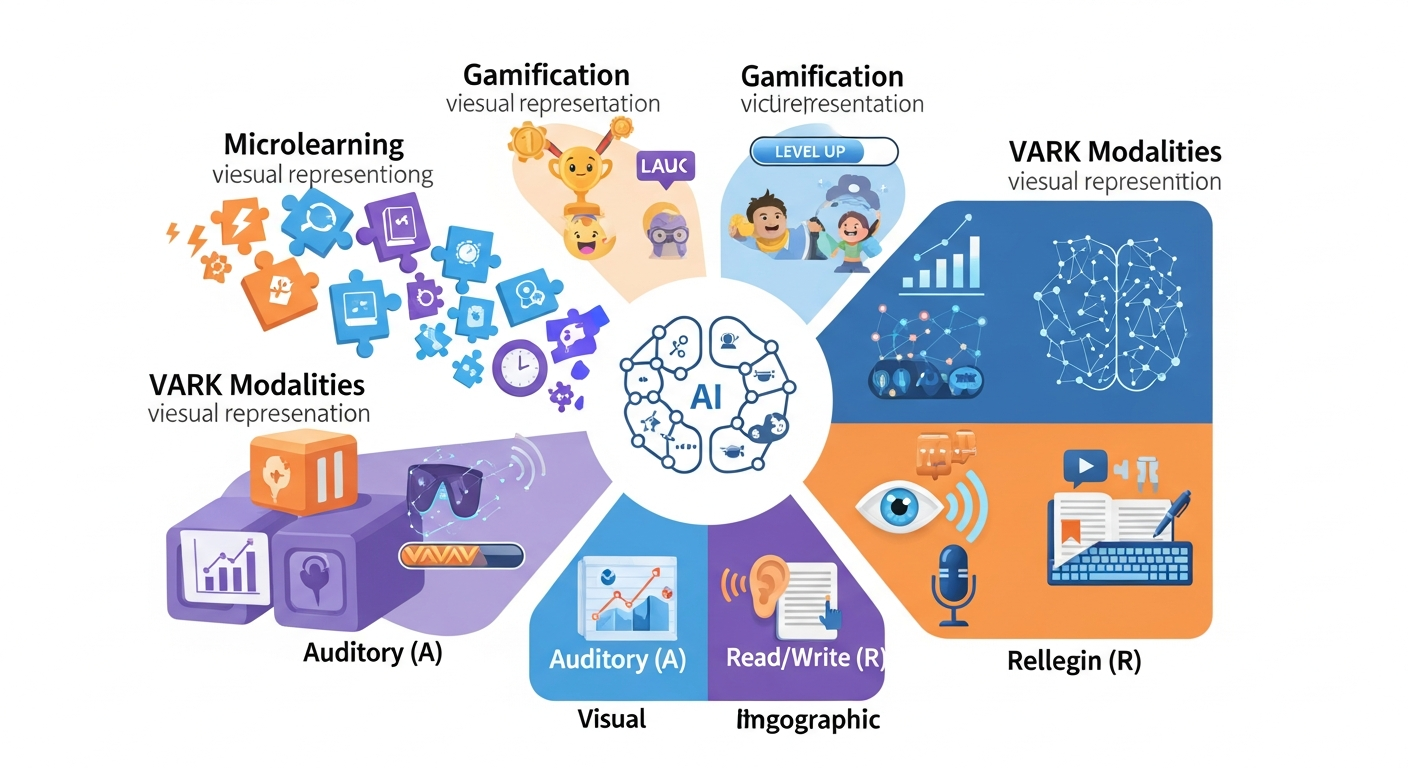
What Makes Microlearning Effective? The Role of Gamification, AI, and VARK Modalities
In today's fast-paced corporate environment, the traditional approach to employee training often falls short. Vice Presidents, Directors, and Managers of Learning & Development face the perennial challenge of delivering impactful, retention-boosting training in a world of shrinking attention spans and diverse workforce needs. Whether in Compliance, Sales, Banking, Finance, Insurance, Retail, Pharma, Health care, Hospitality, Oil and Gas, or Mining, the demand for efficient and engaging learning solutions is paramount. This is where microlearning shines, but its true effectiveness is unlocked when combined with strategic elements like gamification, artificial intelligence, and a deep understanding of VARK learning modalities.
The Microlearning Advantage: Why Bite-Sized Works
Microlearning, characterized by short, focused learning modules, has emerged as a powerful methodology for modern corporate training. Its appeal lies in its ability to deliver knowledge in digestible, relevant chunks, making it easier for busy professionals to absorb and retain information. Rather than lengthy courses that disrupt workflows, microlearning modules can be completed in minutes, fitting seamlessly into the workday. This approach significantly boosts engagement and knowledge retention, a critical factor for any Microlearning LMS.
However, simply breaking content into smaller pieces isn't enough. To truly maximize impact and drive behavioral change, a robust microlearning strategy must incorporate advanced pedagogical techniques and technological innovations. This is where gamification, AI, and an awareness of VARK modalities elevate microlearning from merely efficient to truly transformative.
Engaging Minds: The Power of Gamification in Microlearning
For L&D leaders seeking to capture and sustain learner interest, gamification is a game-changer. By integrating elements like points, badges, leaderboards, challenges, and rewards into learning modules, gamification transforms mundane training into an exciting and competitive experience. This isn't just about making learning fun; it's about leveraging intrinsic human motivators to drive deeper engagement and better outcomes.
- Increased Engagement: Gamified elements motivate learners to start and complete modules, turning learning into a desired activity rather than a chore.
- Enhanced Retention: The challenge and reward structure, combined with immediate feedback, helps embed knowledge more deeply.
- Motivation and Competition: Leaderboards foster healthy competition, encouraging learners to strive for mastery.
- Measurable Progress: Points and badges provide clear indicators of progress, boosting learner confidence and commitment.
A sophisticated Gamified LMS ensures that these interactive elements are seamlessly integrated into the learning journey, making corporate training an experience employees look forward to, whether for compliance updates or complex sales strategies.
Intelligent Journeys: AI's Transformative Role
Artificial Intelligence (AI) is rapidly revolutionizing the learning landscape, and its impact on microlearning is profound. AI enables an unprecedented level of personalization and efficiency, addressing a core challenge for enterprise learning management – delivering relevant content to diverse learners at scale.
What is personalized learning in microlearning?
Personalized learning, powered by AI, tailors the learning path and content to an individual's unique needs, preferences, prior knowledge, and performance. In a microlearning context, this means an AI-driven Microlearning LMS can recommend specific bite-sized modules based on a learner's role, their proficiency gaps identified through assessments, or even their recent performance data. This ensures that every minute spent on training is relevant and productive, accelerating skill development in areas like banking regulations or pharmaceutical sales techniques.
AI's capabilities extend to creating dynamic and responsive learning experiences through Adaptive Learning. An intelligent system can adjust the difficulty, sequence, and type of content in real-time based on how a learner interacts with the material. If a learner excels in a particular topic, the system might fast-track them to more advanced content; if they struggle, it can provide additional resources or remedial modules. This ensures optimal challenge and support for every individual.
How does AI facilitate content creation for microlearning?
AI significantly streamlines the creation and curation of microlearning content. AI-powered tools can analyze vast amounts of data to identify knowledge gaps, suggest relevant topics, and even assist in generating preliminary content outlines or quizzes. An AI Powered Authoring Tool can dramatically reduce the time and resources required to develop high-quality, targeted microlearning modules, allowing L&D teams to keep pace with evolving training needs, from new healthcare protocols to complex financial product knowledge.
Furthermore, AI provides advanced analytics, offering insights into learner behavior, content effectiveness, and potential areas for improvement. This data-driven approach allows L&D leaders to continuously refine their training strategies, ensuring maximum return on investment for their learning management software.
Reaching Every Learner: Harnessing VARK Modalities
Understanding and catering to different learning styles is crucial for effective knowledge transfer. The VARK model categorizes learners into four primary modalities: Visual, Auditory, Read/Write, and Kinesthetic. A truly effective microlearning strategy, especially within a modern Microlearning LMS, recognizes these differences and provides content in formats that resonate with each style.
- Visual (V): These learners absorb information best through seeing. Microlearning for visual learners incorporates infographics, short animated videos, diagrams, flowcharts, and clear visual demonstrations.
- Auditory (A): Auditory learners prefer to hear information. Podcasts, audio explanations, narrated simulations, and short discussions are ideal microlearning formats for them.
- Read/Write (R): These individuals thrive on text-based information. They benefit from concise articles, summaries, bulleted lists, fact sheets, and text-based quizzes.
- Kinesthetic (K): Kinesthetic learners learn by doing. Interactive simulations, scenario-based activities, hands-on (even virtual) tasks, role-playing, and practical exercises are highly effective for this group.
By offering a diverse range of content formats within a Microlearning LMS, L&D departments can ensure that every employee, regardless of their preferred learning style, can engage with and master the material. This multi-modal approach significantly enhances comprehension and retention across the workforce.
Can a learning system adapt to different learning styles?
Yes, an advanced learning content management system, particularly one leveraging AI, can adapt to different learning styles. By analyzing a learner's interactions and performance across various content formats, the system can infer their preferred VARK modality. It can then prioritize and recommend microlearning modules presented in their preferred format, or offer the same core content in multiple formats, allowing the learner to choose. This intelligent customization ensures that learning is always delivered in the most effective way for each individual, from compliance training to specialized skills in oil and gas operations.
Synergy for Superior Learning Outcomes
The true power of microlearning emerges when gamification, AI, and VARK modalities are integrated within a comprehensive learning management system. Imagine a scenario: an employee in the financial sector needs to complete mandatory Risk-focused Training. An AI-powered Microlearning LMS assesses their prior knowledge and role, then delivers a personalized sequence of bite-sized modules. These modules are gamified with points and leaderboards, encouraging completion. Furthermore, the content itself is presented in various formats – a visual infographic, an auditory explanation, a concise text summary, and an interactive case study – to cater to their specific VARK preferences.
This synergy creates a dynamic, engaging, and highly effective learning environment. It’s a powerful solution for industries like Healthcare, ensuring medical professionals stay updated with new procedures, or for Retail, equipping sales teams with the latest product knowledge. This holistic approach to corporate training, enabled by a modern Microlearning LMS, addresses the diverse needs of a global workforce and drives tangible business results. It’s what transforms a simple learning management system into an indispensable tool for organizational growth.
Conclusion: Empowering Your Workforce with Modern Learning
For L&D Vice Presidents, Directors, and Managers, the goal is clear: deliver high-impact training that boosts performance, ensures compliance, and fosters continuous learning. The effectiveness of microlearning is undeniable, but its full potential is realized through the strategic integration of gamification, artificial intelligence, and a deep understanding of VARK learning modalities. These elements collectively create an adaptive, engaging, and personalized learning experience that resonates with every employee.
Investing in a sophisticated learning management software that incorporates these advanced features is no longer a luxury but a necessity for any forward-thinking enterprise. Platforms like MaxLearn LMS are at the forefront of this evolution, providing a cloud based learning management system that empowers organizations across all segments to cultivate a highly skilled, engaged, and adaptive workforce. Embrace the future of enterprise learning management and unlock unparalleled growth for your organization.
.jpg)


