

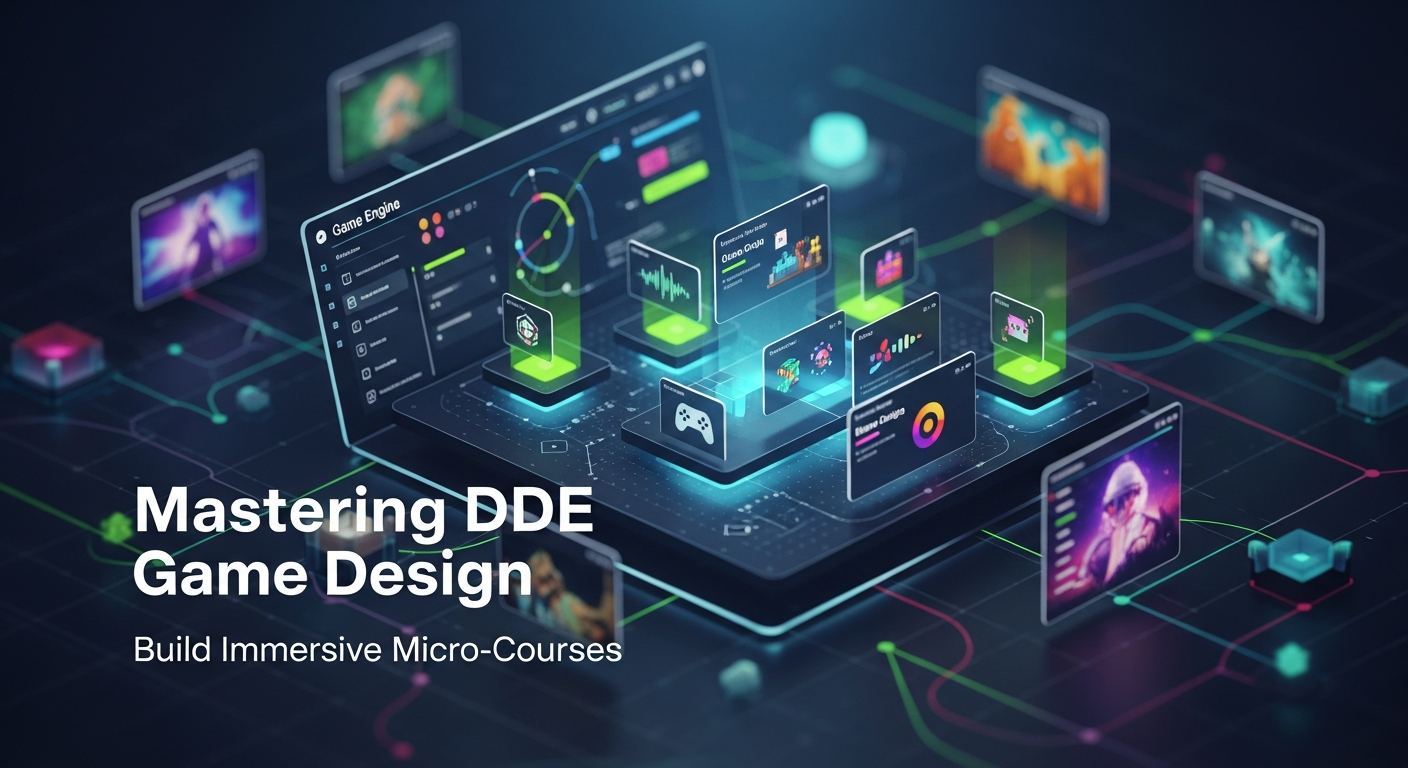
Mastering DDE Game Design: How to Build Immersive Micro-Courses
In today’s fast-evolving corporate landscape, the traditional approach to learning and development is no longer sufficient. L&D leaders, VPs, Directors, Senior Managers, and Managers across diverse sectors like Compliance, Sales, Banking, Finance, Insurance, Retail, Pharma, Health care, Hospitality, Oil and Gas, and Mining face the urgent challenge of delivering engaging, effective, and efficient training. The solution lies in merging innovative instructional design with cutting-edge technology: mastering DDE (Discovery, Design, Engage) game design to build immersive micro-courses. This approach promises not just knowledge transfer, but genuine skill acquisition and behavioral change, transforming passive learners into active participants.
Understanding the DDE Framework for Next-Gen Learning
The DDE framework provides a structured yet flexible methodology for creating impactful learning experiences. It shifts the focus from merely presenting information to crafting environments where learners actively discover, interact, and apply knowledge.
Discovery Phase: Unearthing Strategic Learning Needs
The foundation of any successful micro-course lies in a thorough Discovery phase. This involves meticulously identifying the precise learning gaps, desired performance outcomes, and the unique characteristics of your target audience. Rather than guessing, L&D professionals must conduct detailed needs assessments, stakeholder interviews, and performance analyses to pinpoint the critical skills and knowledge required. Understanding learner preferences, existing knowledge levels, and the context in which they'll apply their learning is paramount. This initial deep dive allows for the creation of truly relevant content and helps in designing Adaptive Learning pathways that cater to individual needs, making every learning moment count.
Design Phase: Crafting Engaging and Interactive Experiences
Once needs are identified, the Design phase transforms raw content into captivating micro-courses. This is where the "game design" aspect of DDE truly shines. Micro-courses, by nature, are short, focused modules addressing a single learning objective. When combined with game design principles, they become powerful tools for engagement. Consider incorporating elements like points, badges, leaderboards, progress bars, challenges, and narrative-driven scenarios. The goal is to make learning feel less like a chore and more like an achievement. Leveraging a Gamified LMS can significantly enhance this experience, providing the infrastructure to support interactive elements. Furthermore, an AI Powered Authoring Tool can streamline content creation, suggest engaging activities, and even help in structuring the micro-course for maximum impact and adherence to learning objectives, ensuring content is concise and impactful, whether for sales training or compliance.
Engage Phase: Sustaining Momentum and Measuring Impact
The Engage phase is about ensuring sustained learner interest and measuring the true impact of your micro-courses. It involves strategic deployment, continuous feedback mechanisms, and opportunities for reinforcement. A robust Microlearning LMS is crucial here, providing easy access to modules, tracking progress, and delivering timely reminders or follow-up content. Engagement isn't just about initial participation; it's about fostering long-term retention and application of knowledge. This phase also allows for the integration of Risk-focused Training, where micro-courses can simulate real-world scenarios, allowing learners to practice critical decision-making in a safe environment. Post-course evaluations, performance metrics, and peer discussions all contribute to closing the learning loop and demonstrating ROI.
Why Micro-Courses are the Ideal Vehicle for DDE
Micro-courses are perfectly aligned with the DDE framework's emphasis on targeted engagement. Their inherent brevity ensures high completion rates and immediate applicability. In industries like Banking, Pharma, or Oil & Gas, where complex information needs to be consumed and applied quickly, micro-courses deliver knowledge in digestible chunks. For Compliance training, they simplify intricate regulations into manageable, interactive modules. In Sales, micro-courses can deliver just-in-time product knowledge or objection-handling strategies. This modularity not only fits modern attention spans but also facilitates quick updates and personalization, keeping content fresh and relevant across all segments and industries.
Leveraging Intelligent Systems for Hyper-Personalized Immersive Learning
The integration of advanced technology, particularly artificial intelligence, is revolutionizing how we approach DDE game design, enabling unprecedented levels of immersion and effectiveness in micro-courses.
How can advanced algorithms personalize the learning journey within micro-courses?
Intelligent algorithms can analyze a learner's past performance, preferences, and even emotional responses to content. This data allows for dynamic content curation, tailoring the sequence of modules, the difficulty of challenges, and the type of feedback provided. For instance, if a learner struggles with a concept, the system can automatically suggest supplementary micro-modules or different game-based activities. This ensures that each learner receives a unique, optimal path to mastery, making the experience deeply personal and highly efficient. Such systems move beyond one-size-fits-all training, adapting in real-time to individual cognitive styles and progress.
What are the implications of intelligent systems for delivering localized and contextually relevant micro-training across diverse global teams?
Intelligent systems are invaluable for organizations operating globally. They can process and adapt content for specific cultural nuances, linguistic variations, and regional regulatory requirements, whether in Healthcare, Retail, or Mining. For example, a compliance micro-course can automatically adjust legal examples to reflect the local jurisdiction, or a sales training module can integrate region-specific market scenarios. This capability ensures that micro-courses resonate deeply with employees regardless of their geographic location, fostering a sense of relevance and increasing the likelihood of knowledge retention and application in their specific operational context.
How do machine learning insights contribute to maximizing the effectiveness and retention of knowledge from short-form training modules?
Machine learning excels at identifying patterns in vast datasets of learner interactions. By analyzing engagement metrics, completion rates, assessment scores, and even the time spent on specific segments, these insights can pinpoint areas where content is less effective or where learners consistently struggle. This data then informs iterative improvements to the micro-course design, content, and game mechanics. Predictive analytics can even forecast potential learning gaps before they fully manifest, allowing L&D teams to proactively intervene. This continuous optimization loop ensures that micro-courses evolve to become increasingly effective, leading to superior knowledge retention and measurable improvements in performance.
Practical Roadmap for Implementing DDE Micro-Courses
Embarking on the journey of DDE game design for micro-courses requires a strategic approach. Here’s a roadmap for L&D leaders:
Step 1: Define Clear, Measurable Objectives
Before any design begins, articulate precise, measurable learning objectives for each micro-course. What specific skill will be acquired? What behavior will change? This clarity is the bedrock of effective game design and ensures alignment with business goals.
Step 2: Architect Game Mechanics and Narrative
Think beyond simple quizzes. Develop engaging narratives, create challenges that reflect real-world scenarios, and integrate game mechanics (points, levels, badges, leaderboards) that motivate progress. Ensure these elements directly support the learning objectives, fostering a sense of achievement.
Step 3: Select and Leverage the Right Technology Stack
A robust technological foundation is non-negotiable. This involves utilizing a comprehensive LMS. An advanced Learning content management system and specialized learning management software provide the backbone for deploying and tracking micro-courses. Look for comprehensive learning management solutions that offer an intuitive learning management system, particularly an lms learning management system that is a cloud based learning management system. For larger organizations, an enterprise learning management system or an integrated LCMS like MaxLearn LMS can be instrumental in managing, delivering, and analyzing your DDE-driven micro-courses effectively.
Step 4: Implement Iterative Feedback and Optimization
Launch small, gather feedback, and iterate. Use analytics from your LMS to understand learner engagement and performance. Continuously refine your micro-courses based on data and learner input to ensure ongoing relevance and maximum impact.
Conclusion: The Future of Engaging Professional Development
Mastering DDE game design for immersive micro-courses is no longer a luxury but a strategic imperative for L&D leaders aiming to future-proof their workforce. By meticulously discovering needs, creatively designing engaging experiences, and intelligently leveraging technology for sustained engagement, organizations can unlock unparalleled potential in employee development. Embracing this dynamic framework, particularly with the power of intelligent systems, will transform how your teams learn, grow, and contribute, driving business success across every industry and segment.
.jpg)


