

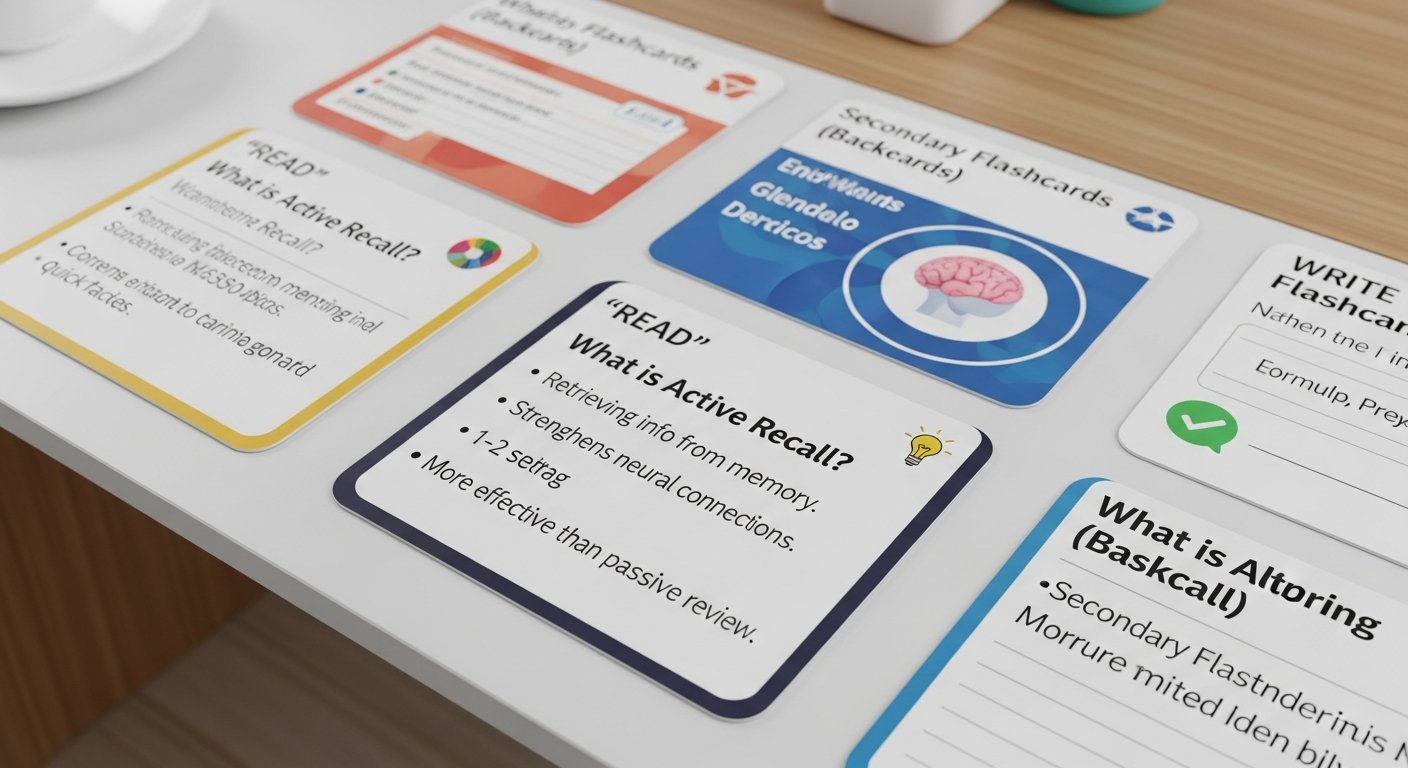
How to Design Microlearning Flashcards for Read/Write Learning Preferences
In today's dynamic corporate landscape, Learning & Development (L&D) leaders face the continuous challenge of equipping their teams with essential knowledge and skills efficiently. From mastering complex compliance regulations in banking to understanding new product lines in retail, or critical safety protocols in mining, the need for effective, memorable training is paramount. Traditional long-form courses often struggle to keep pace with the demands of busy professionals. This is where microlearning, particularly through well-designed flashcards, offers a powerful solution, especially for individuals with a read/write learning preference.
As VPs, Directors, and Senior Managers in L&D, your goal is to maximize learning retention and application. This article delves into the art and science of crafting microlearning flashcards that resonate deeply with read/write learners, leveraging their natural inclination towards textual information to boost engagement and recall across industries like Pharma, Healthcare, Oil & Gas, and Hospitality.
Understanding the Read/Write Learning Preference
Read/write learners thrive on information presented in text. They learn best through reading notes, articles, textbooks, and by actively writing things down, making lists, and taking extensive notes. For these individuals, the written word is not just a medium; it's a primary pathway to understanding and internalizing new concepts.
In the corporate world, this preference is prevalent. Professionals in roles requiring detailed documentation, policy adherence, or analytical reporting – common in finance, insurance, and legal departments – often naturally gravitate towards read/write methods. They appreciate clear, structured textual information and benefit significantly from opportunities to process and produce written content themselves. However, merely providing text isn't enough; the format and interaction must be optimized for maximum impact.
The Power of Microlearning Flashcards
Microlearning, characterized by short, focused learning units, perfectly aligns with the fast-paced schedules of modern employees. When delivered via flashcards, it becomes an exceptionally potent tool. Flashcards strip down complex topics into bite-sized, digestible pieces, making learning less intimidating and more manageable.
For read/write learners, microlearning flashcards offer several advantages:
- Focused Information: Each flashcard can target a single concept, definition, or fact, preventing cognitive overload.
- Active Recall: The very nature of a flashcard encourages active retrieval practice – a highly effective memory-building technique.
- Repetition and Reinforcement: Flashcards facilitate spaced repetition, allowing learners to revisit information at optimal intervals for long-term retention.
- Portability and Flexibility: Learners can engage with flashcards anytime, anywhere, fitting learning seamlessly into their workday, whether it's during a commute or between meetings.
This approach transforms learning from a scheduled event into an integrated, continuous process, crucial for `enterprise learning management` and `risk-focused training` initiatives across all segments.
Designing Effective Flashcards for Read/Write Learners
To truly harness the power of flashcards for read/write learners, careful design is crucial. It goes beyond merely putting text on a card.
Concise and Clear Text
The front of the flashcard should pose a question or present a prompt that requires a specific, factual answer or explanation. The back should provide that answer concisely. Avoid jargon where possible, or define it clearly. For instance, in compliance training for banking, a card might ask "What is a Suspicious Activity Report (SAR)?" and the back provides a clear, brief definition.
Structured Information Delivery
Read/write learners appreciate order. Use bullet points, numbered lists, and short paragraphs on the answer side to break down information. This makes it easier to scan, comprehend, and recall. For example, when teaching sales methodologies, list the key steps of a sales process rather than embedding them in a dense paragraph.
Active Recall Prompts
Design questions that demand more than a 'yes' or 'no'. Use prompts like "Explain...", "Describe...", "List the key components of...", or "What are the implications of..." This encourages learners to formulate answers in their minds or even verbally, strengthening neural pathways. A `Microlearning LMS` can facilitate this interactive element.
Elaborative Rehearsal Opportunities
Encourage learners to actively write down their answers or explanations before flipping the card. This active production of information is a cornerstone for read/write learners. Provide a space (physical or digital) for them to jot down notes or self-assess their understanding. A robust `LMS` can offer features for learners to input their responses.
Contextual Examples and Scenarios
Connect theoretical knowledge to practical application. On the answer side, include brief, real-world examples or mini-scenarios relevant to the learner's industry and role. For healthcare professionals, a card on patient privacy might include a scenario about sharing information, helping them apply HIPAA rules. This practical context significantly enhances retention and applicability of the `learning content management system` content.
Integrating Advanced Technology for Flashcard Learning
Leveraging cutting-edge technology, particularly artificial intelligence, can supercharge the effectiveness of microlearning flashcards for read/write learners.
How can we ensure flashcards are tailored to individual learning progress and knowledge gaps?
Advanced learning platforms utilize AI to personalize the flashcard experience. Instead of a one-size-fits-all approach, an intelligent system can track each learner's performance, identifying areas of weakness and strength. It then dynamically adjusts the sequence and frequency of flashcard delivery, ensuring that challenging concepts are revisited more often until mastered. This concept is at the heart of Adaptive Learning, making the learning journey highly efficient and effective for every individual. A `cloud based learning management system` offers the scalability needed for such personalization.
What's the most efficient way to generate large volumes of high-quality flashcards, especially for complex topics like compliance or financial regulations?
Manually creating flashcards for extensive training modules can be time-consuming. Modern solutions incorporate AI-driven tools that can assist in content creation. By processing existing documentation, policies, or course materials, an AI Powered Authoring Tool can automatically suggest questions, answers, and even relevant scenarios, significantly accelerating the development process. This is particularly valuable for industries with frequently updated content, such as financial services or pharma, where a `learning management software` needs to adapt quickly.
How can we measure the effectiveness of our flashcard programs and continuously improve them?
Measuring the impact of training is crucial for L&D leaders. AI within a sophisticated `learning management system` can collect and analyze vast amounts of data on learner interactions with flashcards. It can identify common areas of difficulty, predict potential knowledge gaps, and provide insights into which flashcards are most effective. This data-driven approach allows for continuous optimization of the flashcard content and delivery strategy, ensuring that your `learning management solutions` are always performing at their peak. Such analytics can inform targeted `risk-focused training` improvements.
The Role of a Robust Learning Platform
Implementing an effective microlearning flashcard strategy for read/write learners requires more than just good design; it demands a powerful underlying `LMS`. A dedicated Microlearning LMS can host, deliver, and track the progress of your flashcard modules.
Features to look for include:
- Content Management: An advanced `LCMS` allows for easy creation, organization, and updating of flashcard sets.
- Analytics and Reporting: Comprehensive dashboards to monitor learner engagement, performance, and completion rates.
- Spaced Repetition Algorithms: Built-in systems to automatically schedule review sessions based on proven memory science.
- Gamification: Incorporating elements like points, badges, and leaderboards through a Gamified LMS can boost motivation and engagement for read/write learners.
A well-chosen `lms learning management system` like MaxLearn LMS provides the infrastructure necessary to scale your microlearning initiatives across your entire organization, ensuring consistent, high-quality training delivery and measurable results.
Conclusion
Designing microlearning flashcards specifically for read/write learning preferences is a strategic imperative for L&D professionals seeking to enhance knowledge retention and application across diverse industries. By focusing on concise, structured text, active recall prompts, elaborative rehearsal, and contextual examples, you can create highly effective learning tools. Furthermore, by integrating AI-driven personalization, content generation, and performance analytics within a robust `learning management system`, you can elevate your training programs to new heights of efficiency and impact. Embrace this tailored approach to unlock the full potential of your workforce and drive continuous organizational growth.
.jpg)


