

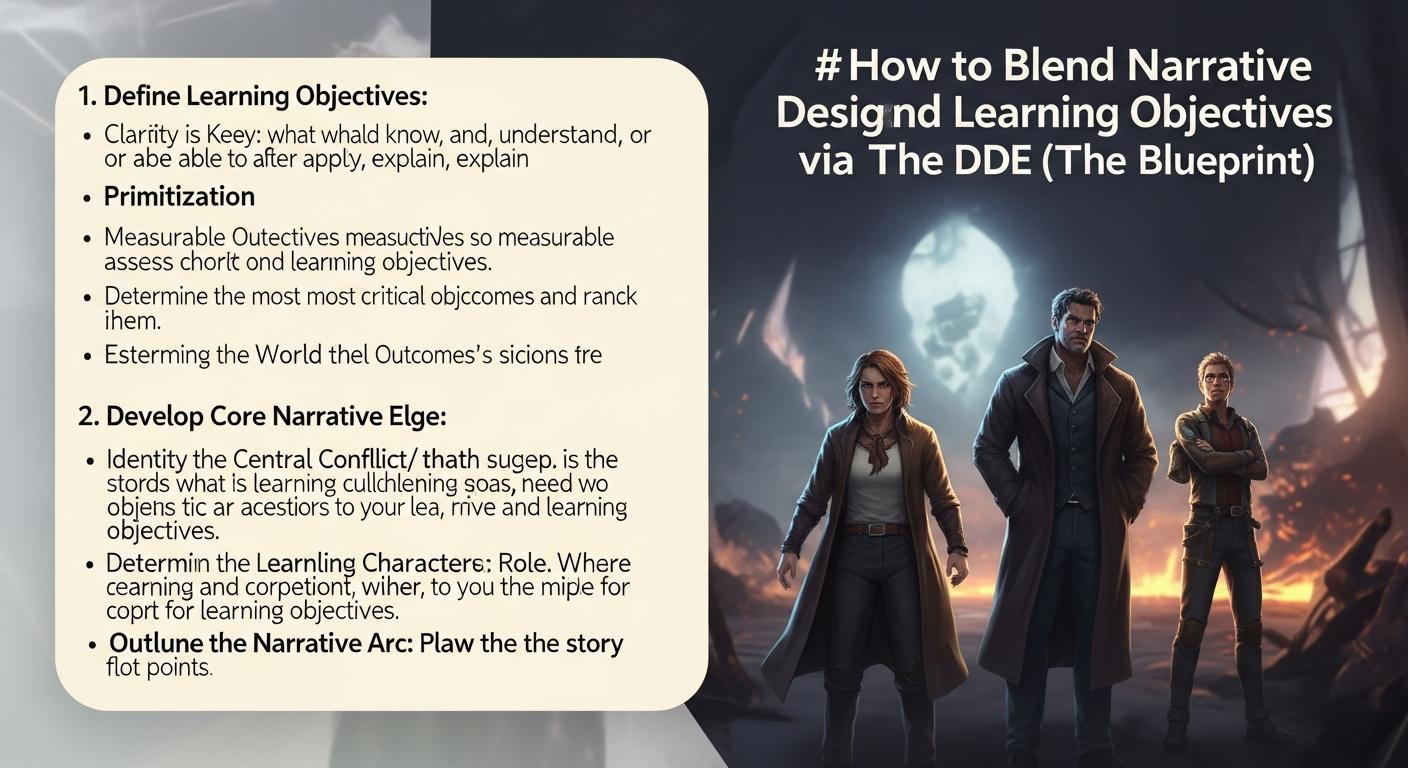
How to Blend Narrative Design and Learning Objectives via the DDE Framework
In the dynamic landscape of corporate learning and development, engagement remains the holy grail. L&D leaders, VPs, and Directors constantly seek innovative ways to transform mundane training into memorable experiences that drive real behavioral change and business outcomes. Enter narrative design – the art of weaving compelling stories into educational content. But how do you systematically integrate storytelling without losing sight of crucial learning objectives? The answer lies in the robust Define, Design, Evaluate (DDE) framework.
This article will guide you through leveraging the DDE framework to seamlessly blend narrative design with your learning objectives, ensuring your training initiatives are not just informative but truly transformative. We’ll explore how a powerful LMS can serve as the backbone for delivering these engaging experiences across diverse industries from banking to healthcare.
Understanding the DDE Framework for L&D Excellence
The DDE framework provides a structured approach to developing effective learning solutions. While often associated with broader instructional design, its principles are perfectly suited for integrating complex elements like narrative design.
Define: Laying the Story's Foundation with Clear Objectives
The 'Define' phase is where precision meets purpose. Before crafting any story, it's paramount to clearly articulate what learners need to know, feel, and be able to do. This involves identifying specific, measurable, achievable, relevant, and time-bound (SMART) learning objectives.
- Business Goals: What overarching organizational challenges are you addressing?
- Audience Analysis: Who are your learners? What are their existing knowledge gaps, motivations, and pain points? This is crucial for tailoring a relatable narrative.
- Performance Outcomes: What specific behaviors or skills should change as a result of the training?
When approaching this phase through a narrative lens, you're essentially asking: "What is the core conflict or challenge our protagonist (the learner) needs to overcome?" or "What critical decisions must they make?" This initial exploration helps shape the narrative arc while firmly grounding it in your learning objectives. A robust `learning management system` can help track and analyze these foundational elements.
Design: Weaving the Narrative into the Learning Journey
With clear objectives defined, the 'Design' phase brings the learning experience to life. This is where narrative design truly shines. Instead of presenting facts in isolation, you create a journey, a challenge, or a scenario that immerses the learner.
- Character Development: Create relatable characters or avatars that learners can identify with or embody.
- Plot & Conflict: Design a storyline that presents challenges, dilemmas, or critical incidents directly related to the learning objectives. For example, in compliance training, a narrative might involve navigating ethical quandaries.
- Interactive Choices: Integrate decision points that influence the story's progression and demonstrate the consequences of different choices. This is where a Gamified LMS can be incredibly powerful.
- Feedback & Reflection: Design opportunities for learners to receive feedback on their decisions within the narrative and reflect on their choices.
This phase is about transforming passive consumption into active participation. "How can I ensure my learning content management system supports dynamic, personalized learning paths?" Many organizations leverage an advanced `LCMS` to streamline the development and deployment of these rich, interactive narratives.
Evaluate: Measuring the Story's Impact and Learning Outcomes
The 'Evaluate' phase is critical for assessing the effectiveness of your narrative-driven learning. It's not just about completion rates; it's about measuring actual learning, behavioral change, and ROI. Did the story resonate? Did it achieve the defined learning objectives?
- Formative Evaluation: Gather feedback during the design process to refine the narrative and instructional elements.
- Summative Evaluation: Assess learning post-training through quizzes, simulations, performance observations, and business metrics.
- Learner Feedback: Collect qualitative data on engagement, relevance, and perceived value of the narrative.
This iterative process ensures that the narrative serves the learning objectives effectively. A modern `lms learning management system` provides comprehensive analytics to track learner progress, engagement, and performance data, making evaluation more robust.
Why Narrative Design Matters in Corporate Learning
Why go through the effort of crafting narratives? The benefits are profound and directly impact business success:
- Enhanced Engagement: Stories capture attention and maintain interest far more effectively than bullet points or dry lectures.
- Improved Retention: Information delivered within a narrative context is more memorable and easier to recall. Our brains are wired for stories.
- Emotional Connection: Narratives evoke empathy and allow learners to connect with content on a deeper, emotional level, which is vital for topics like ethics, customer service, or leadership.
- Applicability & Transfer: By presenting information in realistic scenarios, learners can better understand how to apply new skills and knowledge in their actual job roles. This is particularly effective in Risk-focused Training, where understanding consequences is key.
"Explore the benefits of integrating storytelling with a modern `learning management software` for enterprise training." The synergy dramatically improves learning efficacy across all segments, from sales to healthcare.
Integrating Narrative Design with DDE: A Practical Approach
Phase 1: Defining Objectives with a Storytelling Lens
Instead of just listing objectives, envision the learner's journey. What transformation do you want them to undergo? In a sales context, for instance, an objective might be "to effectively handle customer objections." The narrative lens would ask: "What kind of customer interaction presents the most challenging objections, and what journey does our sales representative take to overcome them?" This approach helps define the scope and emotional core of your narrative.
Phase 2: Designing the Learning Journey as a Narrative
This phase involves mapping your learning objectives to specific narrative beats. For example, a learning objective about understanding financial regulations could become a storyline where a junior banker must navigate a complex client request while adhering to strict compliance rules. Each decision point, each piece of feedback, and each new piece of information becomes part of the evolving story. Utilizing an Adaptive Learning approach within this narrative allows the story to branch based on learner choices, creating a personalized path. An `AI Powered Authoring Tool` can significantly accelerate the creation of such intricate, branching scenarios.
Phase 3: Evaluating Narrative Impact and Learning Outcomes
Evaluation should consider both the narrative's effectiveness and the learning objectives. Did the story feel compelling? Did learners successfully apply the learned principles within the narrative? Did their performance metrics improve post-training? Combining qualitative feedback on the narrative experience with quantitative data from an `enterprise learning management` platform provides a holistic view. MaxLearn LMS offers advanced analytical capabilities to track both engagement and performance.
Real-World Applications and Industry Specific Examples
- Compliance (Banking, Pharma, Healthcare): Instead of policy documents, create interactive scenarios where employees make ethical decisions or identify red flags. A "choose your own adventure" style `Microlearning LMS` module can simulate real-world dilemmas, helping employees understand the human impact of compliance breaches.
- Sales (Retail, Oil & Gas): Use stories to simulate customer interactions, negotiation tactics, and product pitching. Learners can play different roles, receive instant feedback, and see the impact of their communication styles, all within a safe, narrative environment.
- Finance (Banking, Insurance): Narrate case studies of market fluctuations, investment decisions, or fraud prevention. Learners become analysts or investigators, solving problems embedded in the story.
- Hospitality (Retail, Hospitality): Develop scenarios around guest experience, conflict resolution, or service excellence, allowing employees to practice soft skills within a simulated customer journey.
"How can global teams access consistent yet culturally relevant narrative training?" A `cloud based learning management system` is essential for delivering these rich, story-driven courses to a geographically dispersed workforce, ensuring consistency while allowing for localized content where necessary. MaxLearn LMS excels in this regard, offering comprehensive `learning management solutions` for global enterprises.
Leveraging Technology: The Role of an Advanced Learning Platform
Successfully blending narrative design and DDE requires more than just good ideas; it demands robust technological support. A cutting-edge `learning management system` is the engine that drives engaging, story-driven learning experiences.
- An LMS provides the infrastructure to host, deliver, and track narrative-rich content, ensuring seamless access for all learners.
- For dynamic, story-based learning, a Gamified LMS integrates game mechanics like points, badges, and leaderboards directly into the narrative, boosting motivation and competition.
- Adaptive Learning features within a modern learning platform enable narratives to branch and personalize based on learner choices and performance, making each story unique to the individual.
- An AI Powered Authoring Tool can dramatically simplify the creation of complex, branching narratives, generating scenarios, characters, and dialogue that align with learning objectives. This significantly reduces development time and costs for intricate story lines.
- For high-stakes sectors, integrating Risk-focused Training into a narrative provides a safe space for learners to practice critical decision-making without real-world consequences, enhancing preparedness and reducing organizational exposure.
MaxLearn LMS offers a comprehensive suite of features, including a powerful `learning content management system` that supports all these functionalities. "Where can I find an `enterprise learning management system` for narrative-driven courses?" Platforms like MaxLearn LMS are specifically designed to empower L&D professionals to create and deploy truly impactful, story-led training.
Conclusion
The convergence of narrative design and the DDE framework represents a powerful paradigm shift in corporate learning. By defining clear objectives, designing compelling stories, and rigorously evaluating their impact, L&D leaders can create training experiences that not only educate but also deeply engage and inspire. The result is enhanced retention, improved performance, and a more skilled, motivated workforce ready to tackle complex challenges across any industry. Embrace the power of storytelling with a robust `learning management system` like MaxLearn LMS, and transform your training into an unforgettable journey.
.jpg)


