

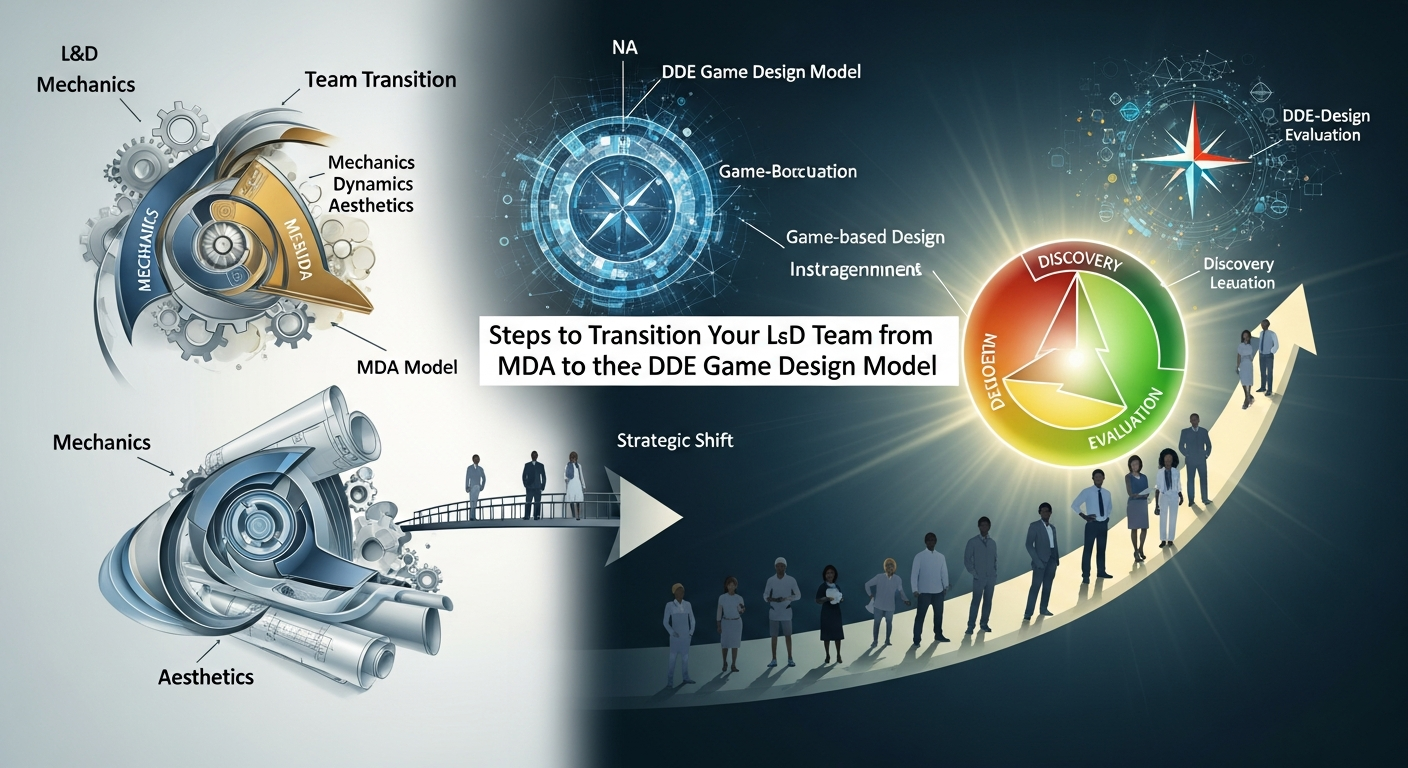
Steps to Transition Your L&D Team from MDA to the DDE Game Design Model
In today's fast-evolving corporate landscape, the effectiveness of your Learning & Development (L&D) initiatives directly impacts organizational success. For VPs, Directors, and Senior Managers in L&D across industries like Compliance, Sales, Banking, Finance, Insurance, Retail, Pharma, Health care, Hospitality, Oil and Gas, and Mining, the challenge is clear: how do we create learning experiences that truly engage, motivate, and deliver measurable performance improvements? The traditional MDA (Mechanics, Dynamics, Aesthetics) model of game design, while foundational, often prioritizes the designer’s perspective. A more potent, learner-centric approach is emerging: the DDE (Desire, Design, Experience) game design model. This article outlines a strategic roadmap for transitioning your L&D team to this transformative framework, ensuring your training programs are not just informative, but inherently captivating and results-driven.
Understanding the Shift: From MDA's Components to DDE's Learner Focus
The MDA framework views games through three lenses: Mechanics (the rules and components), Dynamics (how mechanics interact over time), and Aesthetics (the emotional responses evoked in players). While valuable for analyzing existing games, it often leads L&D teams to build from the ground up, focusing on features before deeply understanding the learner's needs.
The DDE model flips this perspective, placing the learner at the absolute center:
- Desire: What do learners truly want to achieve, learn, or experience? What are their motivations, pain points, and performance gaps? This is the starting point, driven by deep empathy and understanding.
- Design: How can we intentionally craft learning interactions, content, and structures that directly fulfill those desires? This involves selecting appropriate game elements, instructional strategies, and technological solutions.
- Experience: What specific, measurable, and impactful experience do we want to create for the learner? This is about the outcome – the feelings, skills acquired, and behaviors changed.
Transitioning to DDE means moving beyond simply adding badges and leaderboards to an existing course. It's about fundamentally rethinking how learning is conceived and delivered, ensuring every element serves a specific learner desire and contributes to a powerful, memorable experience.
Key Steps for a Successful Transition to DDE in L&D
Step 1: Cultivate a Learner-Centric Mindset and Uncover Desires
The cornerstone of DDE is understanding your learners' intrinsic motivations. Your team must move from asking "What do we need to teach?" to "What do our learners desire to learn, and why?"
- Conduct Deep Learner Research: Utilize surveys, interviews, focus groups, and performance data to uncover knowledge gaps, skill deficiencies, career aspirations, and what truly motivates your workforce. For instance, in sales, the desire might be to close more deals faster; in compliance, it could be to avoid penalties and understand complex regulations clearly.
- Map Desires to Business Outcomes: Link learner desires directly to strategic objectives. How does fulfilling a learner's desire for improved communication skills translate into better customer service or higher sales?
- Embrace Persona Development: Create detailed learner personas to represent different segments of your audience, making their desires tangible and actionable for your design team.
Step 2: Redefine "Design" with Purpose and Strategic Integration
Once desires are identified, the design phase focuses on intentionally crafting the learning journey. This isn't about haphazardly throwing game elements into a course; it's about strategic integration.
- Instructional Design for Engagement: Equip your instructional designers with game design principles. How can narrative, challenges, progression, and feedback loops be woven into the core learning management system content to address specific desires?
- Leverage Technology Wisely: Explore platforms like a Gamified LMS that inherently support DDE principles, allowing for dynamic learning paths, immediate feedback, and interactive elements. Consider how an Adaptive Learning system can tailor content based on individual progress and preferences, directly addressing diverse learner desires.
- Empower Content Creation: An AI Powered Authoring Tool can significantly streamline the creation of engaging, relevant content, freeing up your team to focus on the strategic design of the overall experience rather than manual content generation.
Step 3: Craft Immersive Learning Experiences
The "Experience" is the culmination – how learners interact with and internalize the designed content. This is where game mechanics come alive to deliver on the initial desires.
- Implement Meaningful Gamification: Focus on mechanics that drive intrinsic motivation. Think about progress bars, unlockable content, choice-based scenarios, collaborative challenges, and meaningful rewards that reinforce learning objectives.
- Emphasize Feedback and Progress: Learners desire to know where they stand and how they're improving. Design systems that provide continuous, constructive feedback and clear indicators of progress. This is crucial for Risk-focused Training, where understanding consequences and mastery is paramount.
- Deliver via Microlearning LMS: Short, focused learning bursts delivered through a robust LMS can perfectly align with the DDE model. Each micro-module can be designed to address a specific desire and deliver a digestible, impactful experience. Platforms like MaxLearn LMS exemplify how a modern cloud based learning management system can facilitate this.
Step 4: Empower Your Team with New Skills and Tools
A successful transition requires investing in your team's capabilities and providing the right learning management software.
- Game Design Training: Provide workshops and courses on core game design principles, behavioral psychology, and experiential learning methodologies.
- Technology Proficiency: Ensure your team is proficient with your chosen learning management solutions, including advanced features of your enterprise learning management system and any integrated LCMS tools. The ability to effectively use a modern lms learning management system is non-negotiable.
- Cross-functional Collaboration: Foster collaboration between L&D, IT, and even marketing teams to leverage diverse skill sets in content creation and platform deployment.
Step 5: Iterate and Optimize Based on Data
The DDE model is not a one-and-done process. It's cyclical and relies heavily on continuous improvement.
- Gather Feedback Continuously: Implement robust feedback mechanisms within your learning experiences.
- Analyze Learning Analytics: Utilize the data from your LMS to understand engagement levels, completion rates, knowledge retention, and most importantly, the impact on performance. Is the experience fulfilling the initial desires?
- A/B Testing and Refinement: Experiment with different game mechanics, content presentations, and motivational strategies. Use data to refine and optimize your designs, ensuring maximum impact.
Intelligent Systems and the Future of Learning
As L&D leaders, you're constantly seeking ways to innovate. Intelligent systems are poised to play a pivotal role in optimizing the DDE model.
How can intelligent systems enhance personalized learning paths and content discovery?
Sophisticated algorithms within a modern LMS can analyze a learner's past performance, preferences, and even emotional responses to content. This allows for dynamic adjustments to learning journeys, presenting the most relevant and impactful content at the precise moment it's needed. Such systems can recommend modules, exercises, or resources that align perfectly with individual learning styles and desired outcomes, significantly boosting engagement and effectiveness.
What's the impact of location-aware learning tools on workforce development in distributed teams?
For geographically dispersed workforces, including those in global industries like Oil & Gas or Banking, learning tools that understand context and location can deliver hyper-relevant training. Imagine compliance training modules automatically appearing for employees entering a specific region with unique regulations, or on-the-job training simulations triggered by proximity to particular equipment. This ensures that learning is not just personalized but contextually appropriate, directly addressing immediate performance needs wherever the learner is.
How do advanced algorithms assist in generating highly relevant and engaging learning experiences?
Beyond personalization, advanced algorithms can contribute to the creation process itself. They can analyze vast amounts of data to identify effective narrative structures, optimal challenge levels, and even predict which game mechanics will resonate most with different learner demographics. By automating aspects of content generation or suggesting improvements based on learner data, these systems empower L&D teams to focus more on the strategic and creative elements of designing truly desirable and impactful learning experiences, making the most of their learning content management system.
Conclusion
Transitioning your L&D team from the MDA to the DDE game design model is more than a methodological shift; it's a strategic imperative for organizations aiming for peak performance and engaged employees. By prioritizing learner desires, meticulously designing experiences, and leveraging cutting-edge tools and insights – including those from intelligent systems – L&D leaders can unlock unprecedented levels of engagement, knowledge retention, and measurable business impact. Embrace this evolution, empower your team, and transform your learning programs into truly desirable, expertly designed, and profoundly experienced journeys that drive success across every segment of your enterprise.
.jpg)


