

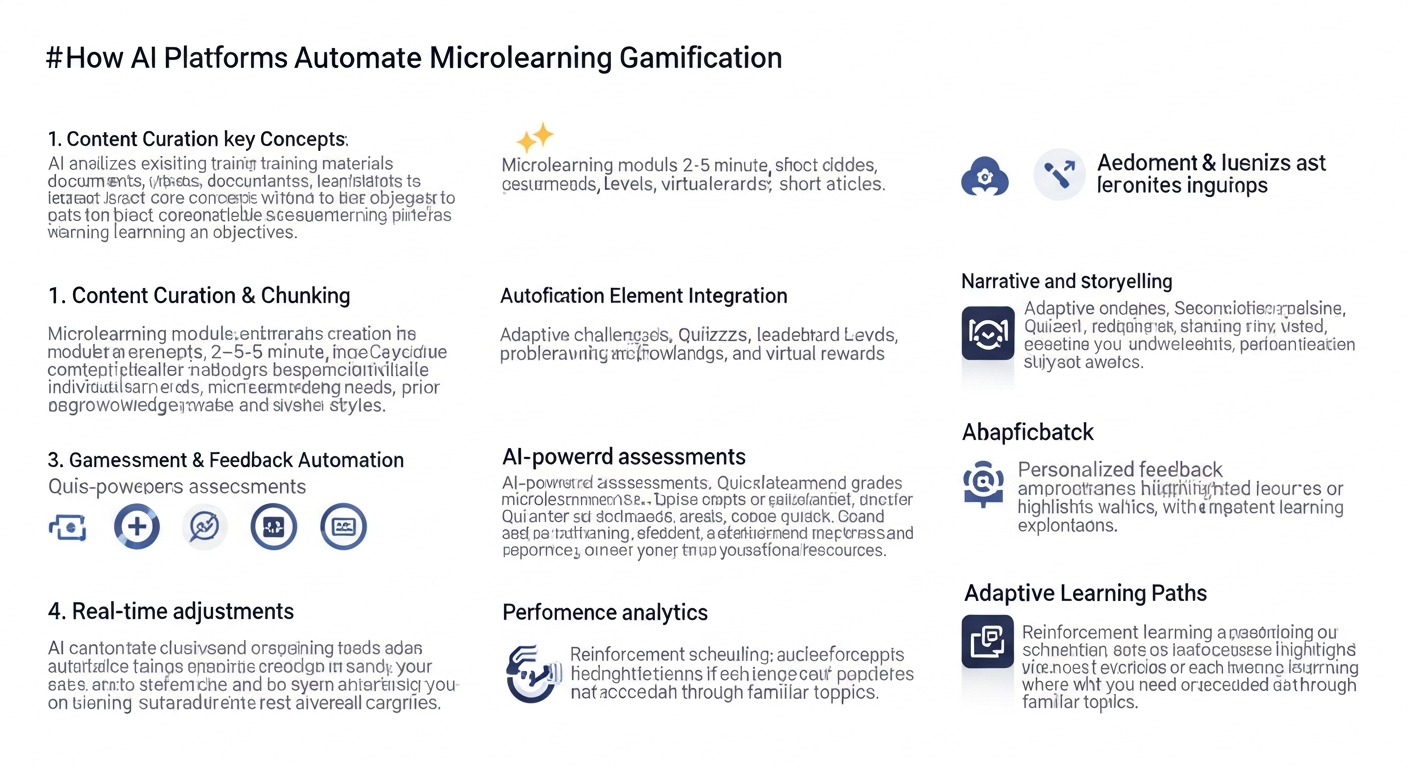
How AI Platforms Revolutionize Microlearning Gamification for Modern L&D
In today's fast-paced corporate environment, effective learning and development (L&D) is not just an advantage—it's a necessity. Organizations across banking, finance, healthcare, retail, and beyond face the dual challenge of upskilling employees rapidly while maintaining engagement and knowledge retention. Traditional long-form training often falls short, leading to information overload and dwindling motivation. This is where the powerful combination of microlearning and gamification steps in, and with the advent of artificial intelligence (AI), their synergy reaches unprecedented levels.
For Vice Presidents, Directors, and Senior Managers in L&D, understanding how AI platforms automate microlearning gamification is no longer a luxury; it's a strategic imperative for building a resilient, knowledgeable workforce. This article explores how AI transforms these methodologies, delivering personalized, engaging, and highly effective training experiences.
The Power Duo: Microlearning and Gamification
Microlearning delivers learning content in small, digestible chunks, typically lasting 3-7 minutes. It's designed for quick consumption, immediate application, and fits seamlessly into busy work schedules. Think of it as focused bursts of knowledge that can be accessed anytime, anywhere.
Gamification, on the other hand, applies game-design elements and game principles in non-game contexts. This includes points, badges, leaderboards, progress bars, challenges, and rewards to drive engagement, motivate learners, and foster a sense of achievement. When combined, microlearning and gamification create an enjoyable, low-pressure, yet highly effective learning environment.
But how does one scale such an intricate, personalized system across an entire enterprise? This is precisely where AI platforms offer a game-changing solution.
AI's Transformative Role in Personalizing Microlearning Content
Dynamic Content Curation and Delivery
Many L&D leaders ask, "How can artificial intelligence enhance learning engagement?" The answer lies in AI's ability to analyze vast amounts of data. An advanced Microlearning LMS leverages AI to understand individual learner profiles, including their role, current skill gaps, past performance, learning style, and even their preferred content formats (video, text, interactive quizzes). Based on this analysis, AI algorithms can dynamically curate and deliver the most relevant microlearning modules to each employee.
- Automated Content Tagging and Organization: AI can process and tag existing learning content, breaking it down into micro-modules and organizing it for easy retrieval based on specific competencies or job roles.
- Real-time Recommendation Engines: Similar to how streaming services suggest movies, AI recommends the next best micro-module or challenge based on a learner's progress and areas needing improvement. This ensures learning is always pertinent and never overwhelming.
Adaptive Learning Pathways
Another common query is, "How does machine learning create adaptive learning paths?" AI is the engine behind true Adaptive Learning. Instead of a one-size-fits-all curriculum, AI-powered platforms can build personalized learning journeys for each employee. If a learner struggles with a particular concept, the AI can automatically assign remedial micro-modules or different types of content to reinforce understanding. Conversely, if a learner demonstrates mastery, the AI can fast-track them to more advanced topics, preventing boredom and maintaining motivation.
This dynamic adjustment ensures that every minute spent on the learning management system is productive and contributes directly to skill development, maximizing the return on investment for enterprise learning management initiatives.
AI Automating Gamification Elements for Maximum Impact
Dynamic Challenges and Quizzes
Implementing gamification manually for hundreds or thousands of employees is a monumental task. AI automates this process by:
- Generating Personalized Quizzes: An AI Powered Authoring Tool can automatically generate quizzes and challenges based on the microlearning content consumed, tailoring questions to the learner's demonstrated strengths and weaknesses.
- Adaptive Difficulty Levels: AI dynamically adjusts the difficulty of challenges and games. If a learner consistently performs well, the difficulty increases to keep them engaged. If they struggle, the difficulty adjusts downwards to prevent frustration, ensuring a continuous flow state crucial for effective learning.
- Scenario-Based Simulations: Especially relevant in industries like banking or healthcare, AI can create realistic, scenario-based gamified simulations that test decision-making skills in a safe environment, offering immediate, contextual feedback.
Personalized Feedback and Rewards
"What are the benefits of using AI for personalized training?" One key benefit is individualized feedback. AI platforms provide immediate, constructive feedback that is specific to a learner's performance in a gamified activity. This goes beyond simple right or wrong answers, explaining *why* an answer was incorrect and pointing to relevant micro-modules for review.
Furthermore, AI can automate the allocation of virtual rewards (points, badges, virtual currency) based on progress, completion rates, and mastery. It can even predict optimal reward schedules to maintain engagement, ensuring learners remain motivated to climb leaderboards within a Gamified LMS.
Predictive Analytics for Engagement
AI's analytical capabilities allow L&D teams to understand engagement trends at a granular level. By analyzing patterns in learner behavior, such as time spent, completion rates, and participation in challenges, AI can predict which learners might be disengaging and trigger interventions, such as personalized reminders, new challenge recommendations, or even alerts for L&D managers. This proactive approach significantly boosts completion rates and sustained engagement across the learning content management system.
Unlocking Business Value: Benefits for L&D Leaders
For L&D VPs, Directors, and Managers, integrating AI-driven microlearning gamification offers profound strategic advantages:
- Increased Engagement & Retention: By making learning highly personalized and enjoyable, AI dramatically increases learner engagement, leading to better knowledge retention and application.
- Improved Performance & Skill Development: Targeted learning paths and immediate feedback help employees quickly close skill gaps, leading to measurable improvements in job performance. This is crucial for sectors like sales, where rapid skill acquisition directly impacts revenue, or in compliance, where precise knowledge is paramount.
- Scalability & Efficiency: AI automates many labor-intensive tasks—content curation, personalization, feedback, and gamification mechanics—allowing L&D teams to deliver high-quality, personalized training to thousands of employees without proportional increases in resources. This is the essence of an efficient cloud based learning management system.
- Data-Driven Insights: AI provides rich data on learning effectiveness, individual progress, and overall program impact. This enables L&D leaders to make informed decisions, continually optimize training programs, and demonstrate clear ROI to stakeholders.
Industry-Specific Applications and the Future of Learning
Consider the diverse needs across industries:
- Compliance Training: In banking, finance, pharma, and healthcare, Risk-focused Training is non-negotiable. AI-powered microlearning gamification can break down complex regulations into bite-sized, interactive modules, ensuring mastery and minimizing compliance risks. The LCMS becomes a critical tool for audit trails and proof of training.
- Sales Training: For retail and sales organizations, rapid onboarding and continuous product knowledge updates are vital. AI customizes training for different product lines or sales methodologies, while gamification motivates sales teams to engage with new content and practice their skills.
- Onboarding: In hospitality and other sectors with high turnover, AI streamlines onboarding, ensuring new hires quickly become productive by providing personalized modules on company culture, policies, and job-specific skills.
Many are asking, "What are the best platforms for AI-powered microlearning?" A robust learning management system (LMS) that integrates AI for personalization and gamification is key. Look for a solution like MaxLearn LMS that offers comprehensive features for microlearning delivery, strong gamification capabilities, and advanced analytics. Such learning management software isn't just a tool; it's a strategic partner for organizational growth.
Conclusion
The convergence of AI, microlearning, and gamification is reshaping the L&D landscape. For VPs, Directors, and Senior Managers, embracing these technologies means moving beyond traditional training to deliver dynamic, highly engaging, and demonstrably effective learning experiences. By automating personalization and gamification at scale, AI platforms not only enhance employee development but also drive measurable business outcomes, positioning your organization for future success in an ever-evolving world. Investing in a powerful Microlearning LMS equipped with these capabilities is an investment in your people and your future.
.jpg)


