

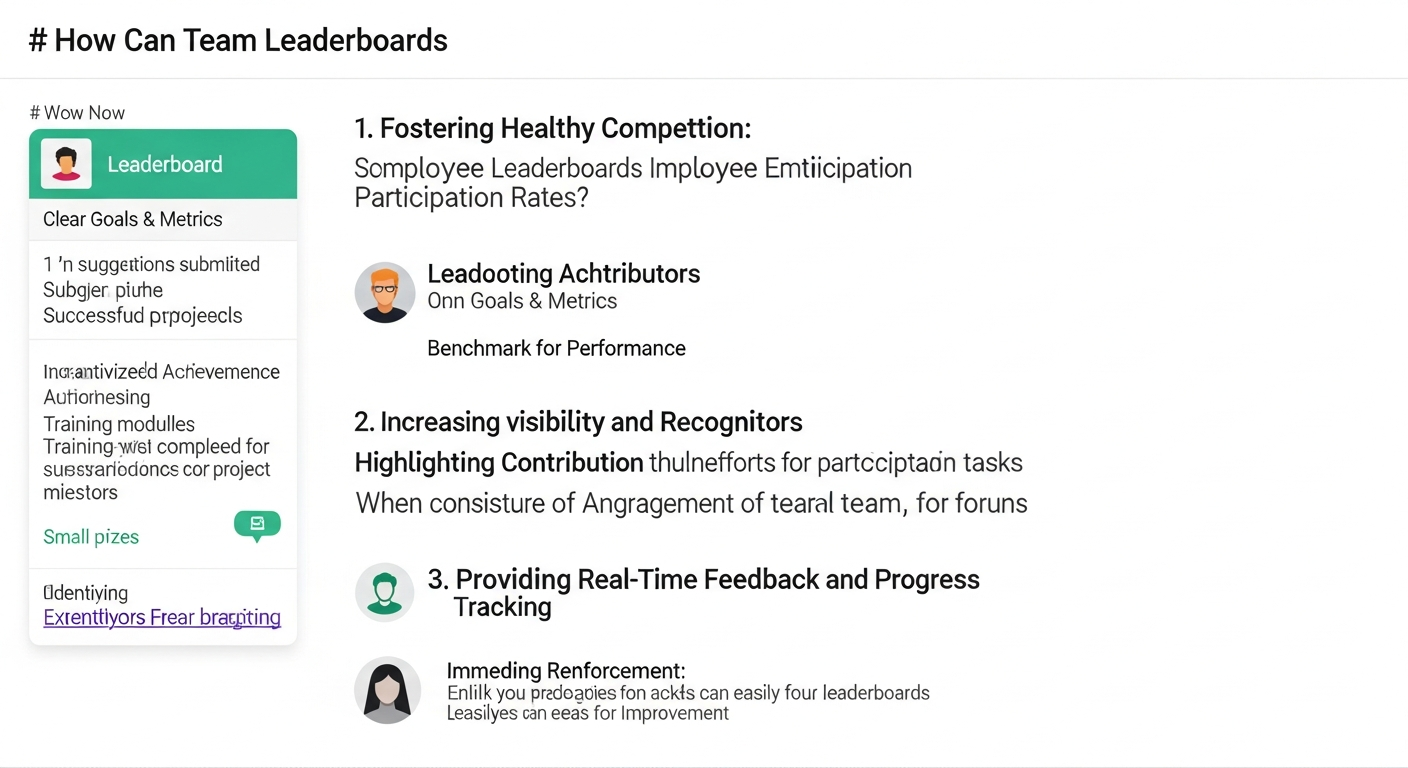
How Can Team Leaderboards Improve Employee Participation Rates in eLearning?
In today’s dynamic corporate landscape, continuous learning and development are not just beneficial but essential for organizational success. However, a persistent challenge for L&D leaders, VPs, Directors, and Senior Managers across industries like Compliance, Sales, Banking, Finance, Insurance, Retail, Pharma, Healthcare, Hospitality, Oil and Gas, and Mining remains: boosting employee participation rates in learning programs. Low engagement can lead to wasted resources, skill gaps, and ultimately, a less competitive workforce. While various strategies exist, one powerful, often underutilized tool is the strategic implementation of team leaderboards within an enterprise learning management system.
Team leaderboards, when designed thoughtfully, can transform passive learning into an active, engaging, and competitive experience, significantly elevating participation. This article delves into the psychology, benefits, and best practices for leveraging team leaderboards to supercharge your eLearning initiatives.
The Psychology Behind Gamification and Competition
Gamification, the application of game-design elements and game principles in non-game contexts, has proven to be incredibly effective in driving engagement. At its core, gamification taps into intrinsic human motivators such as achievement, recognition, competition, and social connection. Leaderboards are a prime example of a gamified element that leverages these psychological drivers.
Why Leaderboards Resonate with Employees
- The Drive for Achievement: Humans are inherently wired to strive for goals and feel a sense of accomplishment. Leaderboards provide clear objectives and a visible measure of progress.
- The Need for Recognition: Being acknowledged for effort and success is a powerful motivator. Leaderboards publicly celebrate top performers, fulfilling this fundamental need.
- Healthy Competition: A well-structured leaderboard fosters friendly rivalry, pushing individuals and teams to perform better and reach higher.
- Social Proof and Comparison: Seeing what peers are achieving can motivate others to improve. It creates a benchmark and encourages self-improvement.
- Belonging and Team Identity: Team leaderboards specifically enhance group cohesion. When individuals contribute to a team's ranking, it strengthens their sense of belonging and collective responsibility.
Tangible Benefits of Team Leaderboards
Beyond the psychological drivers, implementing team leaderboards within your Microlearning LMS can yield concrete benefits for your organization.
Boosting Engagement and Motivation
Perhaps the most immediate benefit is a noticeable spike in engagement. When employees see their efforts reflected in a ranking, even small learning modules become more compelling. This is particularly effective for critical training areas like compliance, where participation can often lag. A well-designed Gamified LMS transforms mundane tasks into exciting challenges, making learning more appealing.
Fostering Healthy Competition and Collaboration
Team leaderboards strike a crucial balance between individual achievement and group success. While individuals compete to contribute points, their ultimate goal is to elevate their team's standing. This encourages collaboration within teams as members might help each other understand complex topics or share strategies to earn more points. This synergy is invaluable, especially in sales training or project-based learning, where team performance directly impacts business outcomes.
Driving Performance and Skill Development
The desire to climb the ranks naturally encourages employees to engage more deeply with the learning content. This leads to a more thorough understanding and application of skills. For instance, in healthcare, competitive scenarios around patient safety protocols or new treatment methods can significantly improve comprehension and adherence. A robust learning content management system can track performance, allowing L&D managers to identify areas of strength and weakness.
Enhancing Data-Driven Insights
Leaderboards, especially when integrated into a sophisticated learning management software, provide a rich source of data. L&D professionals can analyze participation trends, module completion rates, and even quiz scores tied to leaderboard points. This allows for data-driven adjustments to course content, structure, and motivational strategies. An enterprise learning management solution with strong analytics capabilities is crucial for this.
Implementing Leaderboards Effectively with an LMS
To maximize the impact of team leaderboards, strategic implementation is key. It's not just about displaying names and scores; it's about creating an environment that genuinely motivates and educates.
Designing Fair and Meaningful Metrics
The metrics used for leaderboards must be transparent, fair, and directly aligned with learning objectives. Points could be awarded for:
- Module completion (especially for Adaptive Learning paths).
- Quiz or assessment scores.
- Active participation in discussions or simulations.
- Application of learned skills in real-world scenarios (e.g., in sales, banking, or customer service simulations).
- Completion of Risk-focused Training modules with high accuracy.
Ensure that the scoring system doesn't unfairly disadvantage certain roles or departments. A well-configured LCMS can automate much of this tracking.
Integrating with Learning Platforms
Seamless integration with your existing learning management system is paramount. The leaderboard should be easily accessible, intuitive to understand, and update in real-time. Whether it's a cloud based learning management system or an on-premise solution, the user experience should be smooth. A modern MaxLearn LMS offers built-in gamification features that make this integration effortless.
Strategies for Sustained Engagement
- Varying Challenges: Introduce different types of challenges and scoring methods to keep the competition fresh.
- Recognize Milestones: Celebrate not just the top spot but also significant improvements or milestones achieved by individuals or teams.
- Team Rotation: Periodically reshuffle teams to foster new collaborations and broaden networking opportunities.
- Meaningful Rewards: While recognition is often enough, small, meaningful rewards (e.g., gift cards, extra time off, professional development opportunities) can provide an added boost.
Intelligent Insights: Advanced Analytics for Optimizing Leaderboards
The power of leaderboards can be amplified significantly when combined with intelligent analytical capabilities. L&D leaders are increasingly asking how cutting-edge technology can refine their strategies.
Consider a multinational corporation deploying compliance training across various regions. A common question arises: "How can smart platforms help us understand participation trends across different geographical locations, pinpointing where engagement might be lagging or soaring?" Advanced analytical tools within a modern learning management system can segment leaderboard data by region, department, or even role, providing a granular view of performance. This helps identify specific areas needing intervention, whether it's cultural adaptation of content or additional local support.
Another crucial inquiry for L&D professionals focuses on personalization: "What methods can sophisticated systems employ to personalize learning paths for individuals, based on their engagement and performance on team leaderboards?" Leveraging the power of an AI Powered Authoring Tool within your LMS allows the platform to analyze individual learner data from leaderboard interactions. If a learner consistently struggles with certain types of questions or modules, the system can automatically recommend supplementary microlearning content, adaptive quizzes, or even peer coaching opportunities. This targeted approach ensures that competition doesn't leave anyone behind but rather elevates overall team proficiency.
Finally, L&D managers often seek practical strategies: "Beyond just showing rankings, how can learning management solutions leverage leaderboard data to suggest specific, actionable strategies for improving overall team participation and learning outcomes?" Intelligent dashboards can not only display rankings but also highlight patterns, such as which content types drive the most engagement, which teams are most collaborative, or what time of day sees peak activity. This predictive insight allows L&D to dynamically adjust training schedules, content delivery methods, or even gamification mechanics to continuously optimize participation rates across the board.
Real-World Impact Across Industries
- Sales: Team leaderboards can track completion of product knowledge modules, sales methodologies, or CRM proficiency, driving higher sales quotas.
- Healthcare: Nurses and medical staff can compete on completing crucial safety protocols, new equipment training, or ethical guidelines, leading to improved patient care.
- Banking & Finance: Employees can engage in modules on regulatory compliance, anti-money laundering (AML), or new financial products, mitigating risk and enhancing service.
- Retail: Teams can compete on product knowledge, customer service training, or seasonal sales strategies, directly impacting customer satisfaction and revenue.
- Pharma: Leaderboards for training on drug development, clinical trial protocols, or regulatory affairs can ensure high adherence and faster innovation.
Conclusion
Team leaderboards are far more than a simple ranking system; they are a sophisticated tool for driving engagement, fostering collaboration, and elevating learning outcomes across an organization. By tapping into fundamental human motivators and integrating seamlessly with a powerful learning management system, L&D leaders can transform lukewarm participation into a vibrant, competitive, and highly effective learning culture.
For Vice Presidents, Directors, and Senior Managers looking to revitalize their eLearning strategy and ensure every employee is an active participant in their growth journey, implementing well-designed team leaderboards is a clear path forward. Embrace the power of gamification within your learning management system and watch your employee participation rates soar.
.jpg)


