

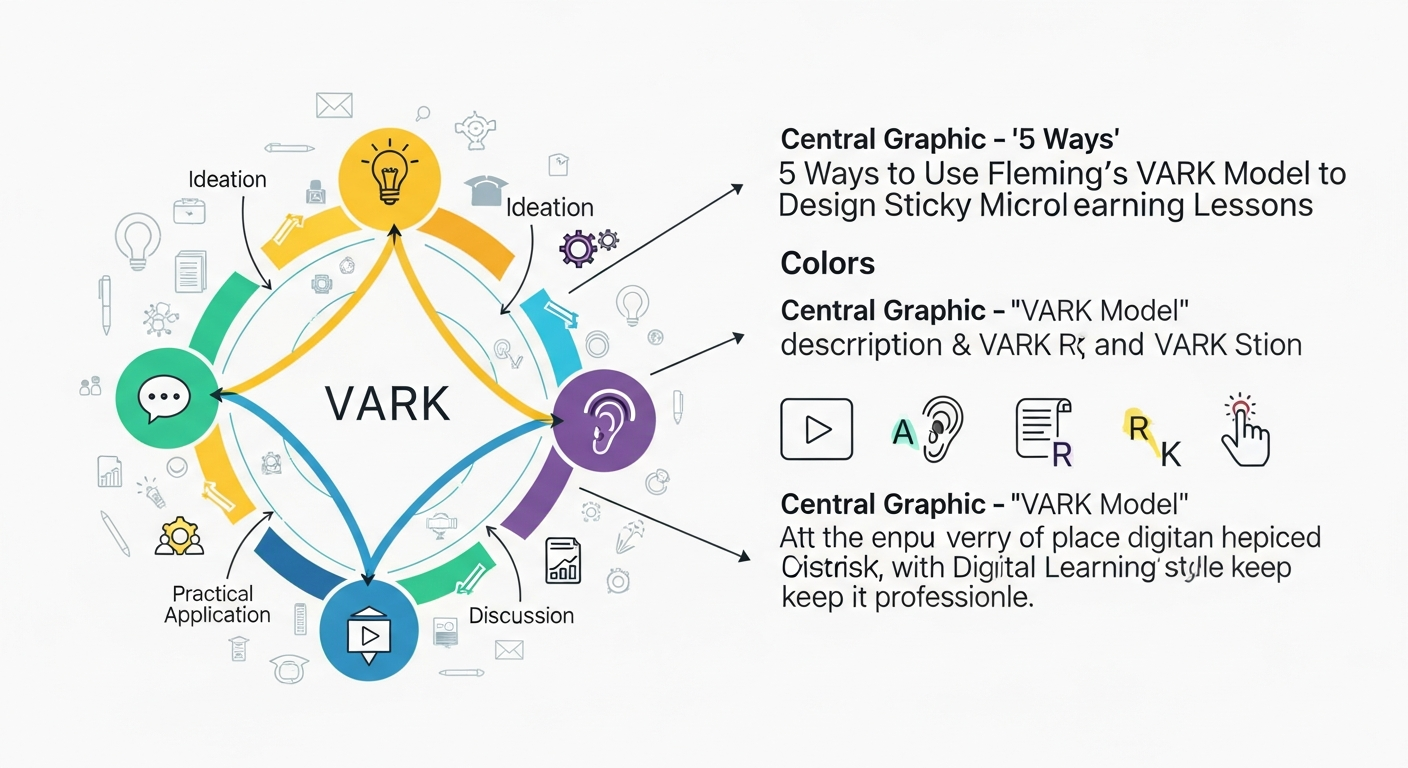
5 Ways to Use Fleming’s VARK Model to Design Sticky Microlearning Lessons
In today's fast-paced corporate environment, where employee time is a valuable commodity and information overload is rampant, L&D Vice Presidents, Directors, and Senior Managers face a significant challenge: how to design learning experiences that truly resonate, engage, and lead to lasting knowledge retention and skill application. Traditional, lengthy training modules often struggle to capture the attention of busy professionals, resulting in low completion rates and limited impact on business objectives. The goal isn't just to deliver content; it's to create "sticky" learning – insights that employees internalize and apply effortlessly.
Enter microlearning, a revolutionary approach characterized by its short, focused, and digestible modules. This methodology has swiftly become a cornerstone for corporate training across a spectrum of industries, including Compliance, Sales, Banking, Finance, Insurance, Retail, Pharma, Health care, Hospitality, Oil and Gas, and Mining. Its ability to provide just-in-time, relevant content addresses the critical need for efficiency and immediate applicability. However, merely breaking content into smaller chunks isn't enough. To truly unlock microlearning's potential, L&D leaders must cater to the diverse ways individuals learn. This is where Fleming’s VARK model—Visual, Auditory, Read/Write, and Kinesthetic—becomes an indispensable strategic tool.
By understanding and addressing these distinct learning preferences, you can transform your microlearning initiatives from simple content delivery into profoundly engaging and effective educational journeys. This article will explore five strategic ways to apply VARK principles to craft microlearning lessons that not only inform but also genuinely captivate and empower your workforce, fostering a culture of continuous learning and driving tangible business results.
Understanding the Synergy: VARK and Microlearning
The VARK model provides a framework for understanding how individuals prefer to interact with information. Visual learners process best through images, diagrams, charts, and videos. Auditory learners excel with spoken explanations, discussions, and audio narratives. Read/Write learners absorb information most effectively through text, notes, manuals, and written assignments. Kinesthetic learners thrive on hands-on experiences, practical exercises, simulations, and real-world application.
Microlearning, on the other hand, is built on the premise of delivering precise, bite-sized learning moments, typically lasting between 3 to 10 minutes. This format perfectly aligns with the modern learner's preference for on-demand access and minimal time commitment. The synergy between VARK and microlearning is profound: microlearning offers the agile, efficient delivery mechanism, while VARK provides the crucial personalization framework. When these two are strategically combined, they create a potent formula for enhancing engagement, improving knowledge retention, and maximizing the effectiveness of any LMS-driven training program.
1. Captivating Visual Learners with Dynamic Micro-Content
For Visual learners, clarity and impact often come through sight. Designing sticky microlearning for this group means prioritizing compelling visuals that explain complex concepts at a glance, eliminating the need for extensive reading. Go beyond static images to embrace dynamic and interactive visual elements.
- Infographics and Animated Explainers: Transform intricate data, complex processes, or detailed compliance regulations into vibrant infographics or concise animated videos. Imagine a two-minute animation explaining a new financial product in banking, a visual flow for a critical safety protocol in oil and gas, or a simplified visual guide for new retail POS software. These formats make abstract ideas immediately comprehensible.
- Short Video Demonstrations: "Show, don't just tell" is the mantra. For onboarding new employees in hospitality, a quick video demonstrating standard operating procedures is far more effective than a lengthy manual. In sales, a brief product feature demo or a visual walkthrough of a software interface is invaluable.
- Visual Summaries and Interactive Mind Maps: Conclude a micro-module with a succinct visual summary or an interactive mind map that visually connects key concepts. This allows Visual learners to quickly review and reinforce their understanding in a way that aligns with their natural processing style.
What's the most effective strategy for segmenting microlearning content by learning preference? By leading with strong, well-designed visuals, L&D teams can immediately engage a significant portion of their audience, ensuring initial understanding and piquing interest for deeper dives. This foundational visual appeal is key to making the learning experience instantly sticky.
2. Engaging Auditory Learners with Concise Audio Bites
Auditory learners thrive on the spoken word, finding clarity and meaning through listening. Integrating audio elements into your microlearning design can significantly boost engagement for this often-underserved group, offering flexibility and accessibility.
- Narrated Animations or Screencasts: Complement visuals with clear, professional narration. This approach is particularly effective for explaining nuanced concepts in finance, outlining new policies in compliance, or guiding learners through complex systems in pharma. The dual input reinforces the message for both visual and auditory preferences.
- Micro-Podcasts or Audio Explanations: Create short, focused audio clips (2-5 minutes) that delve into a specific concept, answer a common FAQ, or offer expert insights. These are perfect for busy professionals in industries like sales or health care who can listen during commutes, breaks, or while performing other tasks that don't require visual attention. A quick audio tip on handling customer objections for a sales team or an explanation of a medical term for healthcare providers can be instantly valuable.
- Interactive Audio Scenarios: Design scenarios where learners listen to a dialogue or a critical incident (e.g., a customer service call in retail or hospitality, a risk scenario in banking) and then make a decision, receiving immediate audio feedback or a narrated debrief. This simulates real-world interactions and develops critical listening and decision-making skills.
How can L&D departments ensure consistent training quality across diverse geographic locations and cultural contexts? Audio content is exceptionally versatile and inclusive, enabling consumption without requiring a screen, which is crucial for a globally distributed workforce or field employees with limited access to visual resources. It allows for consistent delivery of tone and emphasis that might be lost in text alone.
3. Empowering Read/Write Learners with Interactive Text
Read/Write learners excel when they can engage deeply with text—reading, taking notes, creating lists, and internalizing information through the written word. Microlearning content for this group should be well-structured, precise, and offer opportunities for active textual interaction.
- Interactive Quizzes and Knowledge Checks: Go beyond simple multiple-choice. Design quizzes that require short written answers, fill-in-the-blank exercises, or provide detailed, explanatory textual feedback for incorrect responses. This reinforces learning through explicit written confirmation.
- Downloadable Summaries and Worksheets: Offer brief, printable summaries, key term glossaries, or fill-in-the-blank worksheets for each micro-module. This encourages learners to actively engage with the content by writing, reinforcing memory and comprehension. For compliance training, providing concise policy excerpts with space for personal notes can be highly effective.
- Annotated Articles or Policy Snippets: For industries with heavy regulatory requirements like banking, finance, or pharma, provide short excerpts from policies, regulations, or research articles with interactive annotations that explain jargon, provide context, or link to further reading.
- Digital Flashcards with Explanations: Implement digital flashcards where learners can type out definitions, explanations, or steps in a process. This active recall and written articulation are highly effective for memorizing key terms, procedures, or critical facts.
What's the optimal way to measure the impact of VARK-aligned microlearning on business outcomes? By offering engaging textual content and structured opportunities for written interaction, L&D leaders can ensure that Read/Write learners deeply process and retain critical information. This meticulous approach often translates into demonstrable improvements in areas like adherence to complex operational procedures in mining, accurate financial reporting, or effective patient communication in healthcare.
4. Activating Kinesthetic Learners with Experiential Modules
Kinesthetic learners learn best by doing, experiencing, and interacting directly with the content. For these learners, microlearning must provide tangible opportunities for hands-on application, making a Gamified LMS an exceptionally powerful ally.
- Mini-Simulations and Role-Playing Scenarios: Develop short, focused interactive simulations where learners make decisions and immediately see the consequences. For sales teams, a quick role-play on handling a specific customer objection; for healthcare, a virtual scenario on triaging a common patient complaint; for compliance, a decision-tree simulation on ethical dilemmas.
- Click-and-Drag Activities: These simple yet effective interactive exercises can be used to categorize information, sequence steps in a process (e.g., a complex repair in oil and gas, a production line task in manufacturing), or match concepts to their definitions.
- Interactive Quizzes with Immediate Action: Design quizzes that go beyond multiple-choice by requiring learners to manipulate objects, solve puzzles, or perform tasks within a simulated environment. For instance, clicking on the correct part of a machine or navigating a virtual workspace.
- Practical Exercises and Challenges: Assign micro-challenges that require learners to apply what they’ve learned in a real-world context, followed by a brief reflection or peer review. This could be a short task to perform in their actual job role (e.g., verifying a specific document, practicing a customer greeting) and reporting back.
How can modern learning platforms automatically suggest content for different learning styles? By integrating rich interactive elements, an Adaptive Learning system within an enterprise learning management system can dynamically deliver activities tailored to kinesthetic preferences. This not only boosts engagement but also accelerates the development of practical skills critical for roles in retail, hospitality, or any hands-on operational function.
5. Blending Styles for Comprehensive Engagement
While individuals often have a dominant VARK preference, most learners benefit significantly from a blended approach that incorporates elements from all styles. The fifth and most comprehensive strategy is to intentionally combine Visual, Auditory, Read/Write, and Kinesthetic elements within your microlearning design to create a truly holistic and universally sticky experience.
- Multi-Modal Modules: Design a single micro-module that sequentially addresses different preferences. It could start with a compelling video (Visual/Auditory), follow with a concise text summary and a quick drag-and-drop quiz (Read/Write/Kinesthetic), and conclude with an interactive simulation (Kinesthetic). This ensures multiple entry points and reinforcement methods for every learner.
- Learner Choice and Personalization: Empower learners by offering choices within your cloud based learning management system. After an initial overview, they might choose to watch an explanatory video, read a detailed article, or engage with an interactive exercise to reinforce the concept. An AI Powered Authoring Tool can dramatically streamline the creation of such varied content, automatically suggesting optimal formats or generating initial drafts based on the topic.
- Adaptive Pathways: Employ an Adaptive Learning system that identifies a learner's preferred style (through an initial assessment or by tracking their engagement patterns) and then predominantly serves content in that style, while still offering supplementary options in other modes. This provides a highly personalized and efficient learning journey.
What measurable impact can personalized, VARK-aligned microlearning have on business objectives such as sales performance or compliance adherence? A sophisticated blended approach, robustly supported by a modern learning content management system or LCMS like MaxLearn LMS, ensures that all learners find engaging and effective ways to process and retain critical information. This holistic strategy is paramount for subjects requiring deep understanding and application, such as Risk-focused Training in banking and finance, complex technical procedures in pharma, or customer interaction protocols in hospitality.
The Future of Sticky Learning with Advanced Learning Management Solutions
Successfully implementing a VARK-aligned microlearning strategy goes beyond innovative content ideas; it demands the right technological infrastructure. Modern learning management software and learning content management system platforms are specifically engineered to facilitate this multi-modal, personalized approach to learning.
- An advanced lms learning management system provides intuitive tools for rich media integration, interactive module creation, and robust analytics. These analytics are crucial for tracking engagement across different content types and identifying which VARK-aligned approaches yield the best results for various learner segments.
- A powerful AI Powered Authoring Tool can dramatically reduce the time and resources required to create diverse content for each VARK style. It can automate content formatting, suggest optimal visual aids, or even generate initial text drafts for Read/Write learners, accelerating content development and deployment.
- The Adaptive Learning capabilities embedded within a comprehensive enterprise learning management system allow for truly personalized learning paths. This ensures that each employee receives content predominantly in their preferred style, leading to higher completion rates, deeper understanding, and a more efficient use of training time.
How can L&D leaders justify the investment in advanced learning technologies for VARK-based microlearning? The justification lies in the demonstrable improvements across all key performance indicators. From reducing costly compliance breaches in banking and insurance to accelerating product adoption in retail and sales, or improving patient safety and staff competency in healthcare, the impact is profound. By leveraging a sophisticated learning management system that supports VARK-aligned microlearning, L&D transforms training from a necessary expense into a strategic investment that drives organizational agility, competence, and sustained growth.
Conclusion
Designing truly sticky microlearning lessons is no longer about a generic, one-size-fits-all approach. By strategically applying Fleming’s VARK model, L&D Vice Presidents, Directors, and Managers can move beyond mere content delivery to craft deeply engaging, highly personalized, and exceptionally effective learning experiences. Embracing Visual, Auditory, Read/Write, and Kinesthetic methodologies within your microlearning strategy will lead to superior knowledge retention, greater skill application, and a more agile, competent, and engaged workforce across all industries and segments. Empower your teams with learning that truly sticks, fostering continuous development and driving your organization forward.
Discover how MaxLearn LMS can revolutionize your corporate training by supporting VARK-aligned microlearning, enhancing engagement, and fostering a dynamic culture of continuous growth and success.
.jpg)


