

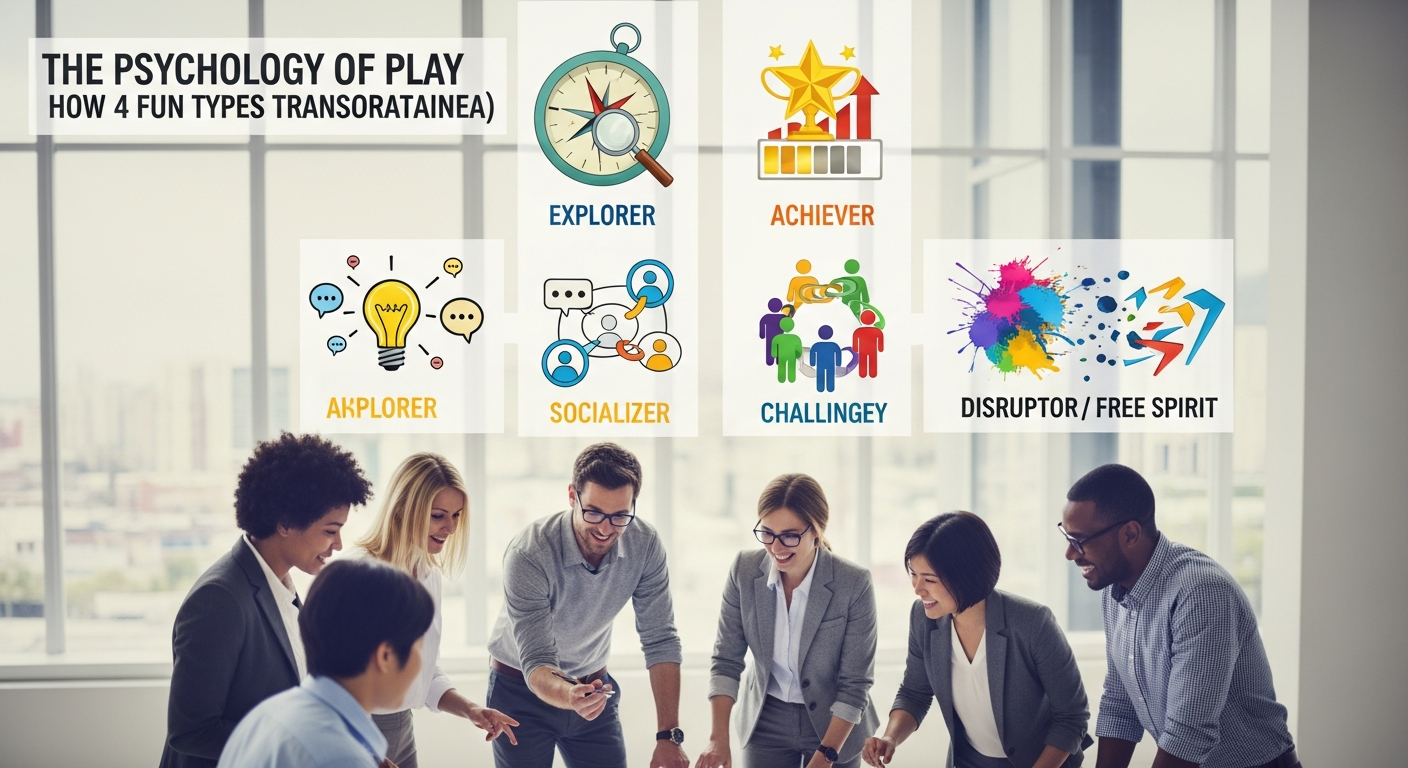
The Psychology of Play: How 4 Fun Types Transform Corporate Training
For too long, corporate training has been viewed as a necessary but often tedious chore. L&D leaders across industries – from Compliance to Sales, Banking to Healthcare, and Oil & Gas to Retail – constantly grapple with disengaged learners, low retention rates, and the challenge of proving training ROI. What if the solution wasn't more rigid structure, but more fun?
The science of play, long confined to childhood development, is now demonstrating its profound power in adult learning. Integrating the psychology of play into corporate training isn't just about making learning "less boring"; it's about fundamentally transforming how employees acquire skills, retain knowledge, and apply it in their roles. It's about tapping into intrinsic motivators that boost engagement, foster collaboration, and drive measurable performance improvements.
In this article, we'll explore four distinct types of play that, when strategically applied, can revolutionize your organization's learning landscape. We'll also examine how modern eLearning platforms, including a sophisticated learning management system, are making these playful approaches more accessible and effective than ever.
The Undeniable Science Behind Playful Learning
Neuroscience reveals that play activates the brain's reward system, releasing dopamine – a neurotransmitter associated with pleasure, motivation, and learning. This biological response makes learning experiences more enjoyable and, crucially, more memorable. When individuals are relaxed and engaged through play, their brains are more receptive to new information, making retention significantly higher than through traditional, passive methods.
Beyond the neurological benefits, play naturally fosters problem-solving, creativity, collaboration, and critical thinking – all essential skills in today's rapidly evolving corporate environment. By embracing play, L&D professionals can move beyond mere knowledge transfer to cultivate a culture of continuous learning and innovation.
The 4 Fun Types That Transform Corporate Training
1. Challenge & Competition: The Achiever's Playground
This type of play taps into our innate desire to overcome obstacles, achieve goals, and often, to prove ourselves against others. In corporate training, this manifests as gamified elements that introduce clear objectives, rules, and measurable outcomes.
- Application: Quizzes with leaderboards, timed simulations for sales pitches or compliance scenarios, escape-room-style challenges for team-building, or badge systems for skill mastery. For instance, in financial services, employees could compete to correctly identify and mitigate Risk-focused Training scenarios within a given time.
- Benefits: Drives motivation, encourages repeat engagement, provides immediate feedback, fosters a sense of accomplishment, and helps learners master content through repeated attempts. A robust Gamified LMS is essential for implementing these elements effectively, tracking progress, and celebrating achievements across the organization.
2. Exploration & Discovery: The Explorer's Journey
Exploratory play appeals to curiosity and the desire to uncover new information or pathways. It involves navigating new environments, experimenting with options, and learning from consequences in a safe, low-stakes setting.
- Application: Interactive simulations for operating complex machinery in manufacturing or oil & gas, virtual tours of new facilities, branching scenarios that allow learners to make decisions and see the outcomes in retail customer service or healthcare patient interaction, or digital sandboxes where employees can experiment with new software or processes.
- Benefits: Cultivates critical thinking, encourages proactive learning, builds confidence in applying knowledge, and provides experiential learning without real-world risk. Platforms offering Adaptive Learning are particularly effective here, guiding learners through personalized exploration paths based on their choices and performance.
3. Role-Playing & Performance: The Socializer's Stage
This type of play involves taking on roles, acting out scenarios, and interacting with others (or simulated others). It's crucial for developing soft skills, empathy, and practical application of knowledge in interpersonal contexts.
- Application: Scenario-based training for difficult customer service calls, negotiation role-plays for sales teams, simulated patient consultations for healthcare professionals, or practicing difficult conversations with virtual avatars for management training. Compliance training can also benefit from employees role-playing how to address ethical dilemmas.
- Benefits: Enhances communication skills, builds empathy, allows for practice in a safe environment, boosts confidence in real-world situations, and provides opportunities for immediate, constructive feedback. An AI Powered Authoring Tool can significantly enhance the creation of these sophisticated, interactive scenarios, making them more realistic and scalable.
4. Creativity & Expression: The Free Spirit's Canvas
Creative play encourages innovation, divergent thinking, and the expression of unique ideas. It's about building, designing, and solving problems in novel ways.
- Application: Collaborative design challenges for product development teams, serious games that require innovative solutions to industry-specific problems (e.g., optimizing supply chains in retail or logistics, developing new financial products), "what-if" scenarios for strategic planning, or even virtual collaborative whiteboards where teams brainstorm solutions to complex organizational issues.
- Benefits: Fosters innovation, encourages out-of-the-box thinking, builds team cohesion, develops problem-solving skills, and allows learners to apply theoretical knowledge in practical, creative ways. This type of play is excellent for developing future leaders and innovators within any organization.
Integrating Play with Modern eLearning Technologies
The good news for L&D professionals is that incorporating these types of play into corporate training doesn't require reinventing the wheel. Modern eLearning technologies, especially advanced learning content management systems, provide the infrastructure to design, deploy, and manage highly engaging, playful learning experiences.
A comprehensive MaxLearn LMS, for instance, offers features that seamlessly integrate gamification, microlearning, and personalized learning paths. Whether you're a Vice President or Director of L&D, understanding the capabilities of your chosen learning management software is crucial. These platforms facilitate everything from delivering bite-sized Microlearning LMS modules to tracking learner progress across complex simulations. A cloud based learning management system ensures accessibility for your global workforce, making sophisticated enterprise learning management a reality. The right learning management solutions (often referred to as an LCMS) can transform your entire training ecosystem.
Addressing Key L&D Challenges
How can learning and development departments measure the impact of playful training initiatives?
Measuring the effectiveness of playful training involves tracking key metrics such as completion rates, knowledge retention scores, time-to-competency, and, crucially, real-world application of learned skills. Modern lms learning management system platforms provide robust analytics dashboards that allow L&D managers to monitor engagement, learner progression through playful modules, and assess skill proficiency. Post-training surveys, performance reviews, and direct observation of behavioral changes in the workplace are also vital for quantifying ROI and demonstrating the tangible benefits of these engaging approaches.
What are the most effective strategies for deploying playful training across geographically dispersed teams?
For organizations with a global footprint, leveraging a cloud based learning management system is paramount. This ensures consistent access to playful content, regardless of location or device. Strategies include designing asynchronous games and challenges that accommodate different time zones, utilizing virtual collaboration tools for team-based playful activities, and localizing content to ensure cultural relevance. An AI Powered Authoring Tool can also assist in rapidly creating and adapting content for diverse regional requirements, making global deployment efficient and effective.
What specific technologies are proving most successful in enhancing learner engagement through playful elements?
Beyond traditional gamification features like points and badges, emerging technologies significantly boost engagement. Virtual Reality (VR) and Augmented Reality (AR) offer immersive exploratory play experiences, particularly in fields like healthcare or manufacturing for realistic simulations. Artificial intelligence (AI) is crucial for developing sophisticated Adaptive Learning paths and intelligent agents for role-playing scenarios, providing personalized feedback. Furthermore, the integration of social learning features within an LMS allows for collaborative playful activities, fostering a sense of community and shared accomplishment among learners.
The Future of Learning is Playful
Embracing the psychology of play is not a frivolous endeavor; it's a strategic imperative for any forward-thinking L&D department. By understanding and implementing the four fun types – Challenge & Competition, Exploration & Discovery, Role-Playing & Performance, and Creativity & Expression – organizations can unlock unprecedented levels of learner engagement, knowledge retention, and skill development.
Conclusion
The shift towards playful learning signifies a maturation in our understanding of adult education. It acknowledges that effective training isn't just about imparting information, but about creating experiences that motivate, challenge, and inspire. As L&D leaders, the opportunity to transform mundane training into dynamic, impactful learning journeys is within reach, powered by both psychological insights and advanced learning management solutions. By integrating these playful methodologies, you can cultivate a workforce that is not only competent but also genuinely excited about continuous growth and development.
.jpg)


