

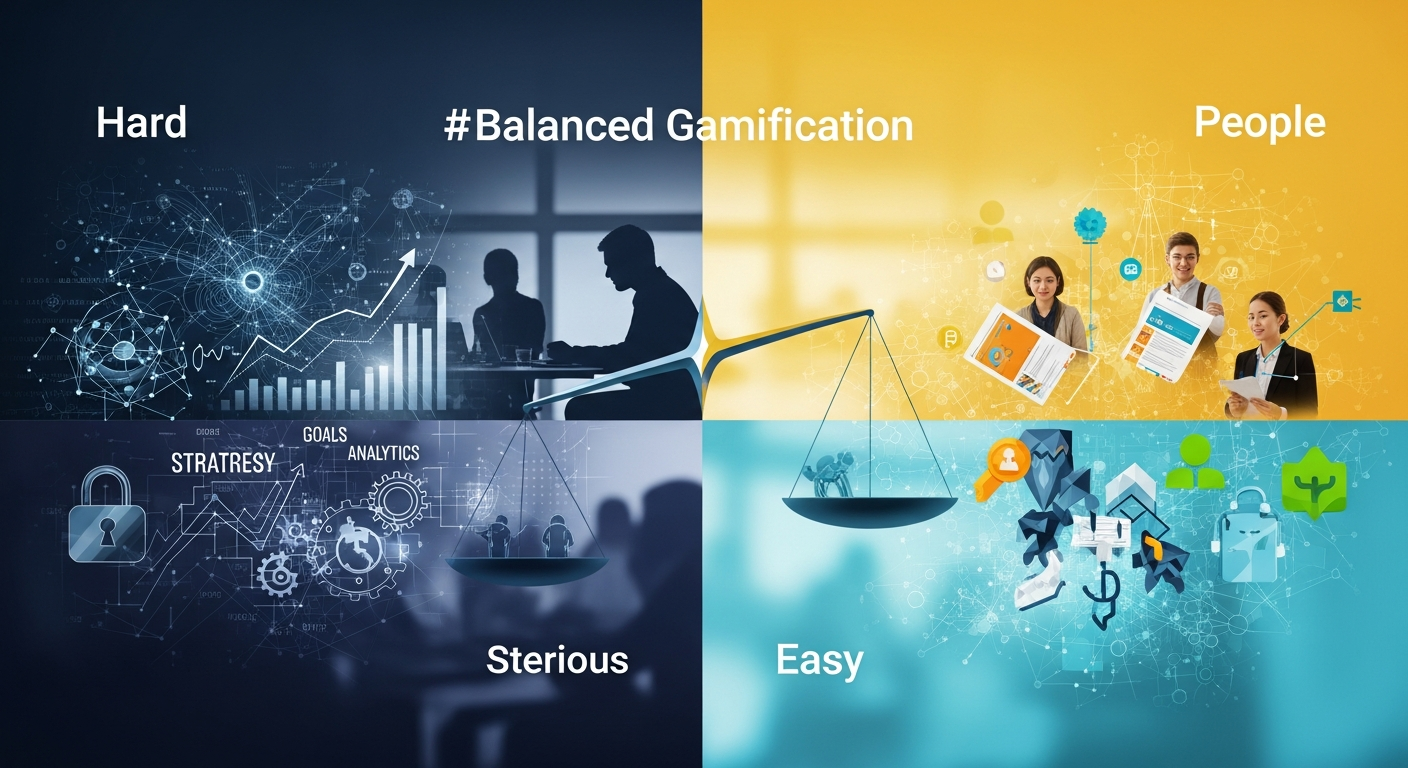
Hard, Easy, Serious, and People: A Guide to Balanced Gamification for L&D Leaders
In the dynamic world of corporate learning and development, engagement is the holy grail. As L&D Vice Presidents, Directors, and Managers, you're constantly seeking innovative ways to capture learners' attention, improve knowledge retention, and drive measurable performance outcomes. Gamification, when implemented thoughtfully, stands out as a powerful strategy to achieve these goals. However, true success lies not just in applying game elements, but in striking a delicate balance. This guide explores the four crucial dimensions – Hard, Easy, Serious, and People – to help you design a truly impactful and sustainable gamified learning experience, leveraging advanced tools like an intuitive Microlearning LMS.
Modern learning management solutions, often referred to simply as an LMS or a comprehensive learning management system, provide the infrastructure for such initiatives. A robust learning content management system is essential for managing diverse content, from microlearning modules to complex simulations, all within a cohesive framework. Let's delve into how to balance these critical aspects for your enterprise learning management strategy.
The Four Pillars of Balanced Gamification
Effective gamification is not a one-size-fits-all solution. It requires a nuanced understanding of learner psychology, business objectives, and technological capabilities. By considering the interplay of 'Hard,' 'Easy,' 'Serious,' and 'People,' you can craft a learning journey that resonates deeply with your workforce across industries like Banking, Finance, Pharma, Retail, and Oil & Gas.
1. The "Hard": Cultivating Mastery and Skill Development
The "Hard" aspect of gamification refers to the challenging elements that push learners beyond their comfort zones, fostering deep learning and mastery. This isn't about frustration, but about productive struggle – the kind that leads to genuine skill acquisition and confidence. In a gamified learning management software environment, this translates into advanced scenarios, complex problem-solving simulations, and adaptive challenges.
- Complex Simulations: For industries like Healthcare, Pharma, or Oil & Gas, this could involve simulating critical procedures, ethical dilemmas, or equipment troubleshooting. Learners might navigate branching scenarios that adapt based on their decisions, requiring critical thinking and application of knowledge.
- Progressive Difficulty: A well-designed cloud based learning management system can track learner progress, automatically introducing more difficult content as proficiency grows. This ensures continuous challenge without overwhelming beginners.
- Mastery Paths: Provide opportunities for learners to specialize in certain areas, unlocking advanced levels or "expert" badges. This is particularly valuable for sales teams honing specific product knowledge or customer service representatives mastering complex service protocols.
A Common Question: How can artificial intelligence personalize gamified learning pathways to optimize for challenging content?
Artificial intelligence (AI) plays a pivotal role in creating truly adaptive and challenging learning experiences. By analyzing learner performance data—such as time spent on tasks, accuracy rates, and error patterns—AI can dynamically adjust the difficulty of modules, recommend supplementary resources, and even generate unique problem sets tailored to an individual's specific knowledge gaps. This ensures that each learner is consistently challenged at their optimal level, preventing boredom for advanced users and frustration for novices. AI also helps in identifying when a learner is ready for more complex material, fostering genuine mastery. This capability is a hallmark of an advanced Adaptive Learning system, allowing the LMS learning management system to evolve with the user.
2. The "Easy": Ensuring Accessibility and Quick Wins
While challenge is crucial, an overly complex system can deter learners. The "Easy" component focuses on lowering the barrier to entry, providing immediate feedback, and offering quick, satisfying wins. This encourages initial engagement and keeps learners motivated through smaller, achievable goals.
- Intuitive Interface: A user-friendly interface is paramount. A good MaxLearn LMS ensures that navigation is straightforward and the learning experience is seamless.
- Microlearning Modules: Short, digestible learning modules are perfect for quick wins. Learners can complete a 5-minute quiz or watch an animated explanation and immediately earn a badge or points. This is particularly effective for busy professionals in any industry.
- Clear Instructions & Tutorials: Make sure the rules of your gamified system are easy to understand. Onboarding challenges or simple introductory tasks can quickly acclimate users.
- Instant Feedback: Provide immediate feedback on performance, whether it's correct/incorrect answers, progress bars, or congratulatory messages. This reinforces positive behaviors and corrects misconceptions swiftly.
3. The "Serious": Aligning with Business Objectives and Real-World Impact
Gamification isn't just about fun; it must deliver tangible business value. The "Serious" aspect ensures that game elements are strategically aligned with learning objectives, compliance requirements, and real-world performance improvements. This is where gamification transitions from a novelty to a critical business tool, especially for Risk-focused Training.
- Compliance Training: Turn mundane compliance modules (e.g., GDPR, HIPAA, Anti-Money Laundering) into engaging, scenario-based games. For instance, in finance, a "fraud investigator" simulation can reinforce crucial protocols far more effectively than a traditional presentation.
- Performance Improvement: Design gamified challenges that directly address performance gaps. For a sales team, this could be a virtual sales call simulation where points are awarded for effective objection handling or closing techniques.
- Ethical Decision-Making: Create scenarios that present ethical dilemmas common in your industry (e.g., Pharma, Retail) and allow learners to practice making tough choices in a safe environment, understanding the consequences of their actions. An LCMS can effectively manage the diverse content required for such complex scenarios.
A Common Question: How can generative artificial intelligence assist in creating serious, industry-specific gamified content that drives global compliance?
Generative artificial intelligence, often supported by an AI Powered Authoring Tool, can revolutionize the creation of serious gamified content. For global compliance, AI can rapidly generate diverse scenarios, character dialogues, and decision trees tailored to specific regional regulations and industry contexts. Instead of manually crafting dozens of compliance situations for different countries or departments, AI can generate countless variations based on core rules and specific parameters. This ensures relevance and cultural appropriateness across different locations, simplifying the localization of training. Furthermore, AI can help ensure that content accurately reflects the latest regulatory updates, making it an invaluable asset for maintaining global compliance standards efficiently within any enterprise learning management system. This ensures that every learner, regardless of their location, receives highly relevant and impactful training.
4. The "People": Fostering Social Interaction and Motivation
Humans are inherently social creatures. The "People" dimension of gamification taps into our desire for connection, competition, and recognition. This aspect can significantly boost engagement and create a vibrant learning community within your organization.
- Leaderboards & Competition: Healthy competition can be a powerful motivator. Leaderboards, visible to peers, can drive individuals and teams to perform better. This works well for sales training or product knowledge contests.
- Team Challenges: Encourage collaboration through team-based games or projects. In Hospitality, this could be a virtual "guest satisfaction" challenge where teams work together to solve service issues.
- Social Sharing & Recognition: Allow learners to share achievements, badges, and certifications on internal social platforms. Peer recognition, comments, and virtual high-fives create a sense of accomplishment and community. A Gamified LMS often comes equipped with these social features.
- Peer Feedback Systems: Integrate mechanisms for learners to give and receive feedback on their performance within game scenarios, fostering a collaborative learning environment.
A Common Question: What advanced analytics can be used to understand learner engagement and social dynamics in a gamified environment?
Advanced analytics provides deep insights into how learners interact with gamified content and each other. Beyond basic completion rates, sophisticated learning management solutions track metrics such as time spent on specific challenges, number of attempts before mastery, patterns of interaction on discussion boards, participation in team activities, and the impact of leaderboards on individual performance. Tools can identify influential learners, detect potential bottlenecks in the learning journey, and even predict at-risk learners who might disengage. Furthermore, sentiment analysis on forum discussions or open-ended feedback can gauge overall learner satisfaction and emotional responses. This rich data helps L&D leaders continuously refine gamification strategies, ensuring they effectively cater to the social and motivational needs of their diverse workforce. This data-driven approach allows an LMS administrator to fine-tune the entire learning ecosystem.
Integrating for Impact: A Holistic Approach
The true power of balanced gamification emerges when these four pillars are not treated in isolation but are integrated seamlessly. Imagine a compliance training module for a financial institution:
- Hard: Complex case studies involving money laundering, requiring learners to identify suspicious transactions from a large dataset.
- Easy: Micro-quizzes and drag-and-drop activities on basic definitions of compliance terms, offering immediate feedback.
- Serious: Direct correlation to real-world penalties for non-compliance, with scenarios designed to prevent actual legal or financial risks.
- People: Team-based challenges where different departments (e.g., legal, auditing, front-line staff) collaborate to solve a compliance breach scenario, competing for recognition on a departmental leaderboard within the learning management system.
This holistic approach ensures that your gamified initiatives within an enterprise learning management framework are engaging, effective, and aligned with strategic organizational goals. It moves beyond superficial point systems to create meaningful learning experiences that stick.
Conclusion
For L&D leaders aiming to transform learning within their organizations, understanding and balancing the "Hard," "Easy," "Serious," and "People" aspects of gamification is paramount. By leveraging an advanced learning management software, particularly one that supports a robust LCMS, you can design experiences that not only captivate your learners but also drive tangible improvements in skills, compliance, and overall business performance. Embrace this balanced approach, and unlock the full potential of gamification to create a truly engaged, knowledgeable, and high-performing workforce across all your segments and industries.
.jpg)


