

Reducing Ramp-Up Time: How Microlearning Accelerates New Hire Onboarding
For Vice Presidents, Directors, and Managers of Learning & Development, the challenge of new hire onboarding is a perennial one. Slow ramp-up times can drain resources, delay productivity, and ultimately impact an organization's bottom line. In today's fast-paced corporate environment, where knowledge retention and immediate application are paramount, traditional onboarding methods often fall short. But what if there was a way to significantly shorten this learning curve, boost engagement, and get new employees contributing faster? Enter microlearning – a powerful methodology poised to revolutionize how organizations approach new hire integration.
The Persistent Challenge of Traditional Onboarding
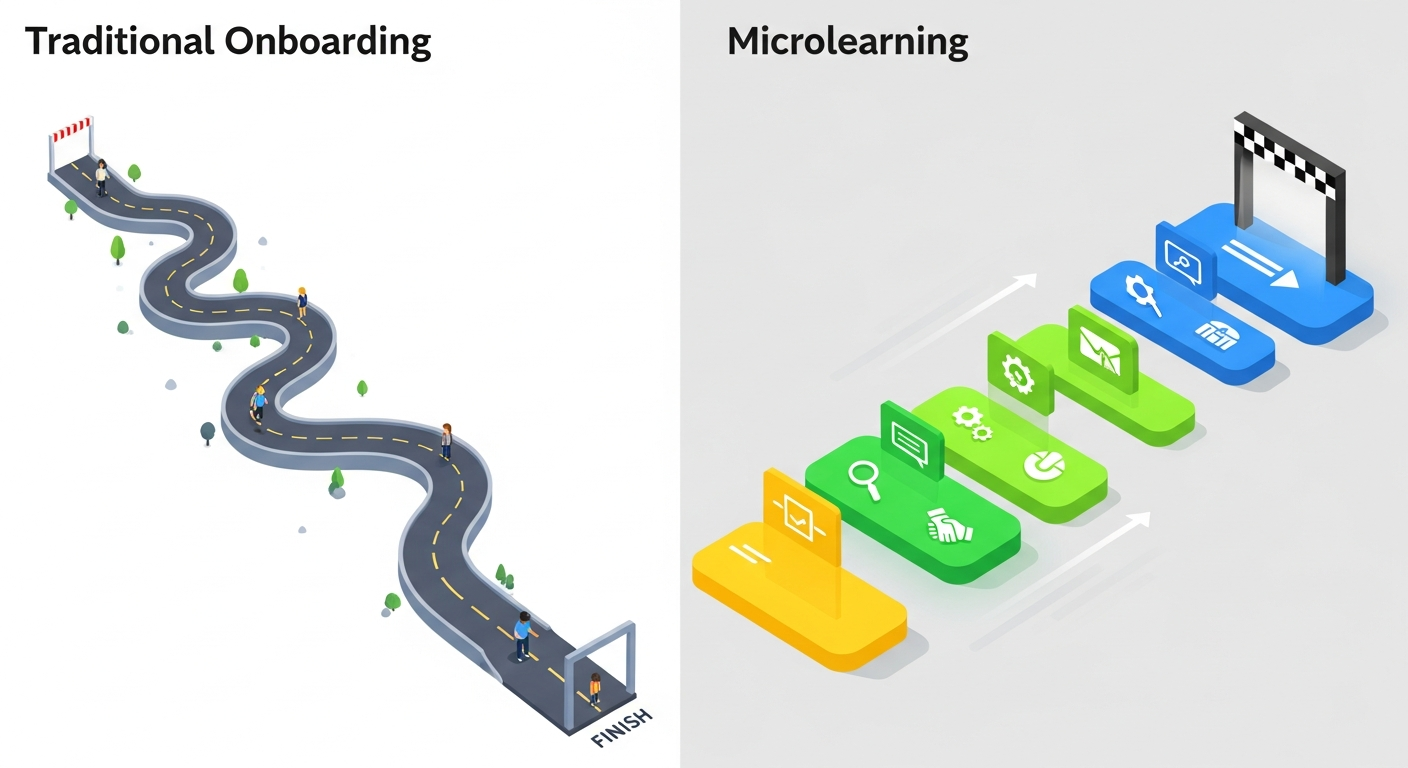
Historically, new hire onboarding has involved an overwhelming deluge of information: lengthy manuals, multi-day seminars, and generic training modules. While well-intentioned, this approach frequently leads to cognitive overload and low retention rates. New hires struggle to absorb vast amounts of data, leading to a prolonged period of uncertainty and reduced productivity.
Consider the costs: every day a new employee spends in unproductive training translates to lost revenue and increased operational expenses. For industries like Compliance, Sales, Banking, Finance, Insurance, Retail, Pharma, Healthcare, Hospitality, Oil and Gas, and Mining, the implications of a slow start are even more critical. From understanding complex regulatory frameworks to mastering new sales techniques or critical safety protocols, the need for efficient, effective training is undeniable. Organizations require a more agile and impactful strategy, and that's precisely where a modern LMS with microlearning capabilities shines.
Enter Microlearning: A Paradigm Shift in Learning
Microlearning, at its core, is the delivery of short, focused, and digestible content modules designed to meet a specific learning objective. Rather than lengthy courses, learners engage with bite-sized videos, infographics, quizzes, or interactive simulations that typically last only a few minutes. This approach aligns perfectly with modern attention spans and the demand for just-in-time information.
By breaking down complex topics into easily consumable segments, microlearning addresses the shortcomings of traditional methods head-on. It transforms the daunting task of onboarding into an engaging, manageable, and highly effective experience. A robust Microlearning LMS can serve as the backbone for delivering this content efficiently and tracking progress seamlessly.
How Microlearning Supercharges Onboarding
Enhanced Knowledge Retention
The human brain is better at retaining information presented in smaller chunks. Microlearning leverages this cognitive principle, allowing new hires to absorb, process, and recall information more effectively. Instead of forgetting most of a 4-hour module, they can master specific concepts through multiple, reinforcing micro-lessons, leading to lasting knowledge. This targeted approach is crucial for mastering industry-specific knowledge, whether it's understanding product features in Retail or intricate financial regulations in Banking.
Increased Engagement & Motivation
Long, monotonous training sessions are a surefire way to disengage new employees. Microlearning, with its dynamic formats and interactive elements, makes learning more enjoyable. Incorporating features like leaderboards, points, and badges, as offered by a Gamified LMS, transforms onboarding from a chore into a compelling journey. This increased engagement directly translates to higher completion rates and a more positive initial experience with the company culture.
Personalized Learning Paths
Not all new hires are created equal. They bring diverse backgrounds, experiences, and roles. Microlearning platforms, especially those incorporating Adaptive Learning, can tailor content delivery to individual needs. This means a sales representative might focus on product knowledge modules, while an HR professional delves into company policies and compliance regulations. This personalization ensures relevance, reduces wasted time on redundant material, and significantly accelerates individual ramp-up. Such a flexible learning content management system is invaluable for large organizations.
Just-in-Time Access to Information
Microlearning content is typically accessible on demand, often via mobile devices. This means new hires can pull up a quick video on how to use a specific software feature, recall a sales pitch key point, or review a safety protocol just before they need it. This just-in-time learning capability empowers employees, reduces reliance on supervisors for basic queries, and fosters immediate application of knowledge, cutting down on initial errors and boosting confidence.
Reduced Cognitive Overload
The sheer volume of information can overwhelm new hires. Microlearning deliberately breaks this down. Instead of a single, daunting onboarding manual, new hires encounter a series of small, achievable learning goals. This not only reduces stress but also allows them to feel a sense of accomplishment with each completed module, reinforcing positive learning behaviors.
Implementing Microlearning for Maximum Impact
Leveraging a Specialized Platform
To truly harness the power of microlearning, organizations need more than just short videos; they need a robust enterprise learning management system. A specialized Microlearning LMS provides the infrastructure for delivering, tracking, and managing bite-sized content effectively. Such a cloud based learning management system should offer intuitive interfaces, mobile accessibility, and powerful analytics to monitor progress. A comprehensive learning management software, or LCMS, specifically designed for microlearning ensures seamless deployment across various departments and geographical locations.
Content Creation & Curation
The quality of microlearning content is paramount. It must be concise, engaging, and directly relevant to the learning objective. Investing in an AI Powered Authoring Tool can significantly streamline the creation process, helping to rapidly convert existing lengthy materials into micro-content and suggesting optimal formats. This ensures that new hires in Sales, Pharma, or Healthcare receive up-to-date and impactful training materials.
Integrating with Existing Workflows
Microlearning should not be an isolated activity but seamlessly integrated into the new hire's daily workflow. This could mean short modules assigned daily during their first few weeks, or quick refreshers accessible directly from their work tools. The goal is to make learning an intrinsic part of their job, not a separate, time-consuming task. An effective learning management system makes this integration simple and efficient.
Microlearning in Action: Industry-Specific Benefits
- Compliance & Risk-focused Training: In industries like Banking, Finance, and Pharma, regulatory updates are frequent and critical. Microlearning delivers concise updates on new policies or risks, ensuring compliance without lengthy disruption.
- Sales & Retail: New product launches or changes in sales strategies can be quickly disseminated through micro-lessons, equipping sales teams with immediate knowledge for customer interactions.
- Healthcare & Hospitality: Essential protocols, equipment operation, or customer service best practices can be taught and reinforced through short, engaging modules, improving service quality and safety.
- Oil and Gas & Mining: Safety procedures and equipment operation can be drilled down into quick, memorable segments, reducing incidents and improving operational efficiency.
Addressing Common Questions with Intelligent Solutions
As L&D leaders, you likely have critical questions about scaling and optimizing your training investments. Modern learning solutions, particularly those powered by intelligent systems, provide compelling answers:
How can we ensure our training remains relevant across diverse global teams?
Intelligent learning management software can analyze regional performance data and feedback, automatically suggesting content adjustments or localization requirements. This ensures that a new hire in London receives culturally relevant examples, while a colleague in Tokyo gets training tailored to their market, all managed within a single, powerful learning management system.
What's the best way to personalize content for each new hire's specific role and prior experience?
Advanced algorithms within a modern LMS can assess a new hire's initial knowledge and role requirements. Based on this, it dynamically curates a unique sequence of micro-lessons. For instance, an experienced new hire might skip basic modules and proceed directly to advanced topics, while a novice receives foundational training first, ensuring efficient learning paths for everyone within the MaxLearn LMS.
How can we measure the actual impact of our onboarding efforts efficiently?
Sophisticated analytics embedded in an enterprise learning management system provide real-time insights into completion rates, knowledge retention, skill application, and even correlation with early job performance. This data allows L&D teams to pinpoint effective modules, identify areas for improvement, and demonstrate a clear return on investment for their training programs, making the case for a cloud based learning management system undeniable.
Accelerating Success with Microlearning
The imperative to reduce new hire ramp-up time has never been greater. Microlearning offers a pragmatic, engaging, and highly effective solution to this critical business challenge. By embracing a strategy that delivers bite-sized, relevant, and accessible learning content, L&D professionals can significantly accelerate the journey from new hire to productive team member. This not only optimizes operational efficiency but also cultivates a more skilled, engaged, and successful workforce across all industries.
.jpg)


