

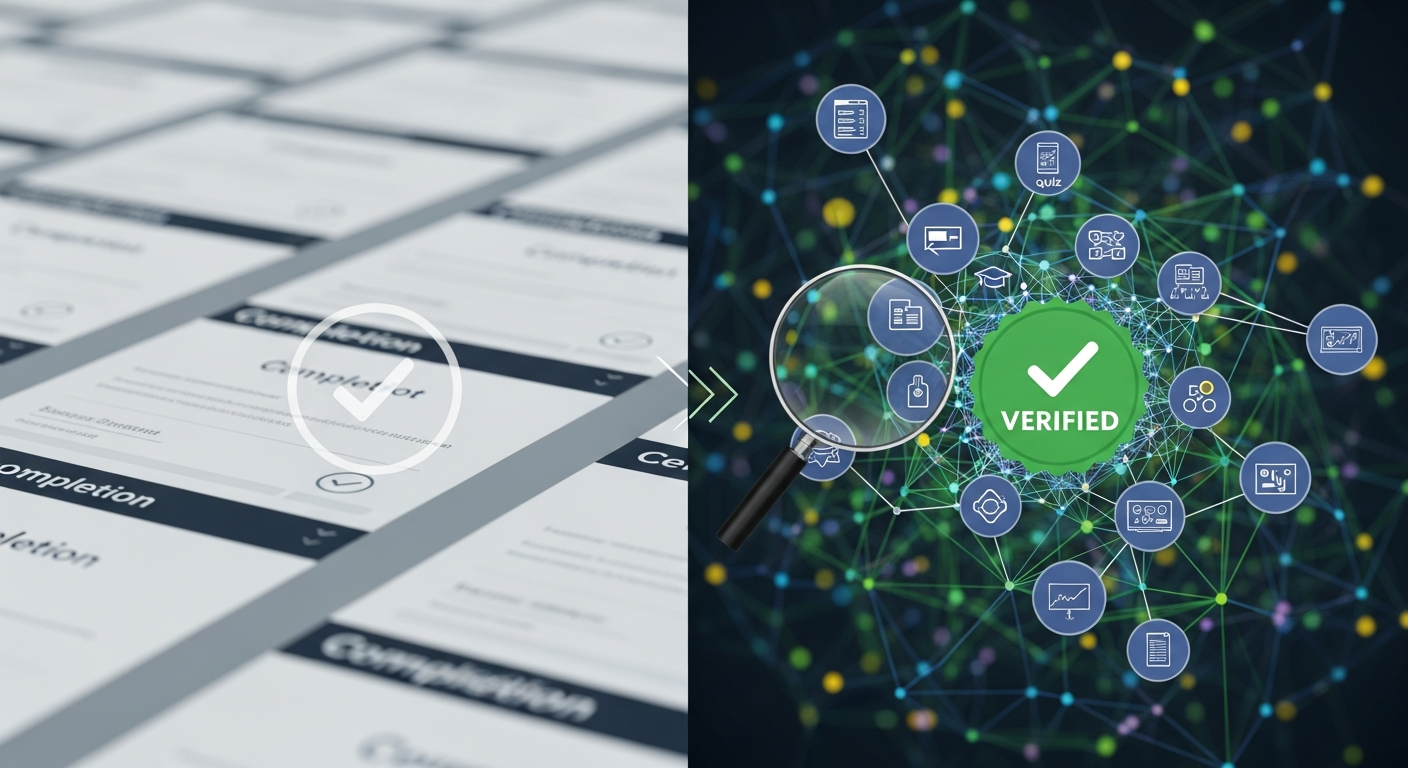
Proof Of Learning: How To Verify Knowledge Retention, Not Just Completion
For Vice Presidents, Directors, and Senior Managers in Learning & Development, the completion rate of a training module often serves as a key performance indicator. But in today’s rapidly evolving corporate landscape across industries like Finance, Healthcare, Retail, and Pharma, simply ticking the "completed" box is no longer sufficient. The true measure of successful training isn't just course completion; it's the tangible, verifiable retention and application of knowledge. This is especially critical for areas like compliance, sales effectiveness, and mitigating operational risks. The challenge lies in moving beyond rudimentary metrics to truly prove learning and ensure that investments in talent development translate into improved organizational performance.
The Imperative of True Knowledge Retention
Why should L&D leaders shift their focus from mere completion to deep retention? The answer lies in the direct impact on business outcomes. A compliance training module, for instance, is useless if employees forget key regulations weeks later, potentially leading to costly fines or reputational damage. Similarly, a sales team that completes product training but fails to recall features or benefits during client interactions will struggle to hit targets. In high-stakes environments like Oil & Gas or Mining, a lack of retained knowledge can have catastrophic safety implications.
Traditional learning management software often emphasizes the administrative aspects: tracking enrollments, completions, and basic scores. While essential, these metrics offer a superficial view. They tell us that a learner interacted with the content, but not if they truly absorbed, understood, or can apply it. To genuinely impact the bottom line and foster an agile workforce, L&D strategies must pivot towards methodologies and technologies that provide robust proof of learning.
Moving Beyond "Click Next": Strategies for Verifying Learning
Formative Assessments and Spaced Repetition
One of the most effective strategies for knowledge retention is the strategic deployment of formative assessments combined with spaced repetition. Instead of a single, high-stakes quiz at the end, integrate frequent, low-stakes checks throughout the learning journey. These can be short quizzes, drag-and-drop exercises, or quick scenario-based questions. Spaced repetition, where key concepts are revisited at increasing intervals, actively combats the forgetting curve, embedding knowledge more deeply.
An effective LMS or learning content management system should facilitate easy creation and deployment of such assessments, providing immediate feedback to learners and valuable data to L&D teams on specific areas of weakness.
Performance-Based Scenarios and Simulations
True learning is often best demonstrated through application. Performance-based scenarios and simulations allow learners to practice new skills in a safe, controlled environment. For sales teams, this could involve practicing pitches with virtual clients. In healthcare, it might be simulating patient interactions or emergency procedures. For finance professionals, it could be navigating complex regulatory frameworks through interactive case studies.
These methods move beyond theoretical recall, requiring learners to make decisions and observe consequences, thereby proving their ability to apply knowledge. A sophisticated learning management system should support the integration of rich media and interactive simulations to create these engaging experiences.
Peer Review and Social Learning
Learning is not always a solitary endeavor. Peer review mechanisms and social learning platforms can provide powerful verification. When learners must articulate their understanding to peers, debate concepts, or critique others' work, it reinforces their own learning. This is particularly valuable in industries requiring collaborative problem-solving, such as engineering in Oil & Gas or strategic planning in Banking.
Discussion forums, collaborative projects, and expert Q&A sessions within an enterprise learning management solution can offer qualitative proof of understanding and the ability to communicate learned concepts effectively.
Adaptive Learning Paths
Not all learners are the same, nor do they enter training with identical knowledge bases. Adaptive Learning personalizes the learning journey based on a learner's pre-existing knowledge, performance on assessments, and preferred learning style. This ensures that content is always relevant, challenging enough without being overwhelming, and addresses specific knowledge gaps. By tailoring the path, adaptive systems ensure efficient and effective knowledge acquisition, leading to better long-term retention.
This approach moves away from a linear, one-size-fits-all model to a dynamic system that verifies learning at each step, redirecting or reinforcing as needed.
Leveraging Technology for Deeper Insights
Advanced Analytics and Reporting
Modern lms learning management system platforms offer far more than simple completion reports. Advanced analytics can track not just what a learner did, but how they did it: time spent on specific sections, number of attempts on questions, common incorrect answers, and even sentiment analysis from open-ended responses. This granular data provides L&D leaders with invaluable insights into knowledge gaps across the organization, allowing for targeted interventions and content improvements.
Predictive analytics, a feature of many sophisticated cloud based learning management system solutions, can even forecast potential areas of skill decay or compliance risk based on past performance, enabling proactive Risk-focused Training strategies.
The Role of AI in Assessment and Personalization
When considering how technology can deepen our understanding of knowledge retention, L&D leaders often ponder its advanced capabilities. How can intelligent algorithms truly help us understand if our employees are retaining critical information, not just clicking through modules?
Artificial intelligence in learning management solutions can revolutionize learning verification. AI can analyze vast amounts of learner data to identify patterns indicative of true comprehension versus rote memorization. It can generate personalized quizzes that target specific weaknesses, suggest remedial resources, and even create dynamic scenarios that adapt in real-time based on learner responses. An AI Powered Authoring Tool can significantly streamline the creation of these intelligent, adaptive assessments.
Is there a way for technology to create learning experiences that adapt to each individual's progress and ensure long-term memory, rather than a one-size-fits-all approach? Absolutely. AI-driven systems within a robust LCMS can power Adaptive Learning, tailoring content delivery and assessment difficulty to individual learner needs, thereby enhancing retention and engagement.
In what ways can smart systems assist in automatically generating relevant training materials and assessments that target specific areas of weakness identified through performance data? An AI Powered Authoring Tool can auto-generate question banks, recommend content updates, and even create micro-learning modules on the fly based on observed knowledge gaps across the workforce. This capability is invaluable for maintaining up-to-date compliance training or rapidly onboarding new products in industries like Retail or Hospitality.
Engaging Methodologies for Retention
Engagement is a precursor to retention. A Gamified LMS injects elements of game design—points, badges, leaderboards, and challenges—into the learning process, making it more interactive and motivating. This competitive and rewarding environment encourages repeated engagement with content and assessments, directly supporting retention. For example, a sales team might compete to master product knowledge fastest, earning recognition and rewards.
Similarly, a Microlearning LMS delivers information in short, digestible bursts, perfect for busy professionals. These focused modules are easier to consume, review, and retain, making them ideal for reinforcing critical concepts in compliance or operational procedures. When combined with smart analytics and AI, MaxLearn LMS solutions provide a holistic approach to ensuring verified knowledge, not just participation.
Implementing a Robust Learning Verification Framework
For L&D leaders ready to elevate their training impact, implementing a comprehensive learning verification framework involves several key steps:
- Define Clear Learning Objectives: Before designing content, establish measurable outcomes that go beyond mere completion. What should learners be able to do after training?
- Integrate Diverse Assessment Strategies: Move beyond multiple-choice. Incorporate simulations, case studies, peer reviews, and real-world application tasks.
- Leverage Advanced Analytics: Utilize the reporting capabilities of your learning management system to gain deep insights into learner performance and content effectiveness. Look for trends, not just individual scores.
- Embrace Adaptive and Personalized Learning: Use technologies that tailor the learning journey, ensuring efficiency and targeting individual needs for better retention.
- Foster a Culture of Continuous Learning: Encourage ongoing engagement with Microlearning LMS modules and refreshers, especially for critical knowledge areas like Risk-focused Training.
- Choose the Right Technology Partner: Invest in an enterprise learning management system like MaxLearn LMS that supports these advanced functionalities, from Gamified LMS features to AI-powered insights.
The shift from tracking completion to verifying true knowledge retention is not just a trend; it's a strategic imperative for L&D departments across all industries. By adopting innovative strategies and leveraging advanced learning management software, L&D leaders can ensure their training initiatives genuinely empower employees, mitigate risks, and drive measurable business success.
.jpg)


