

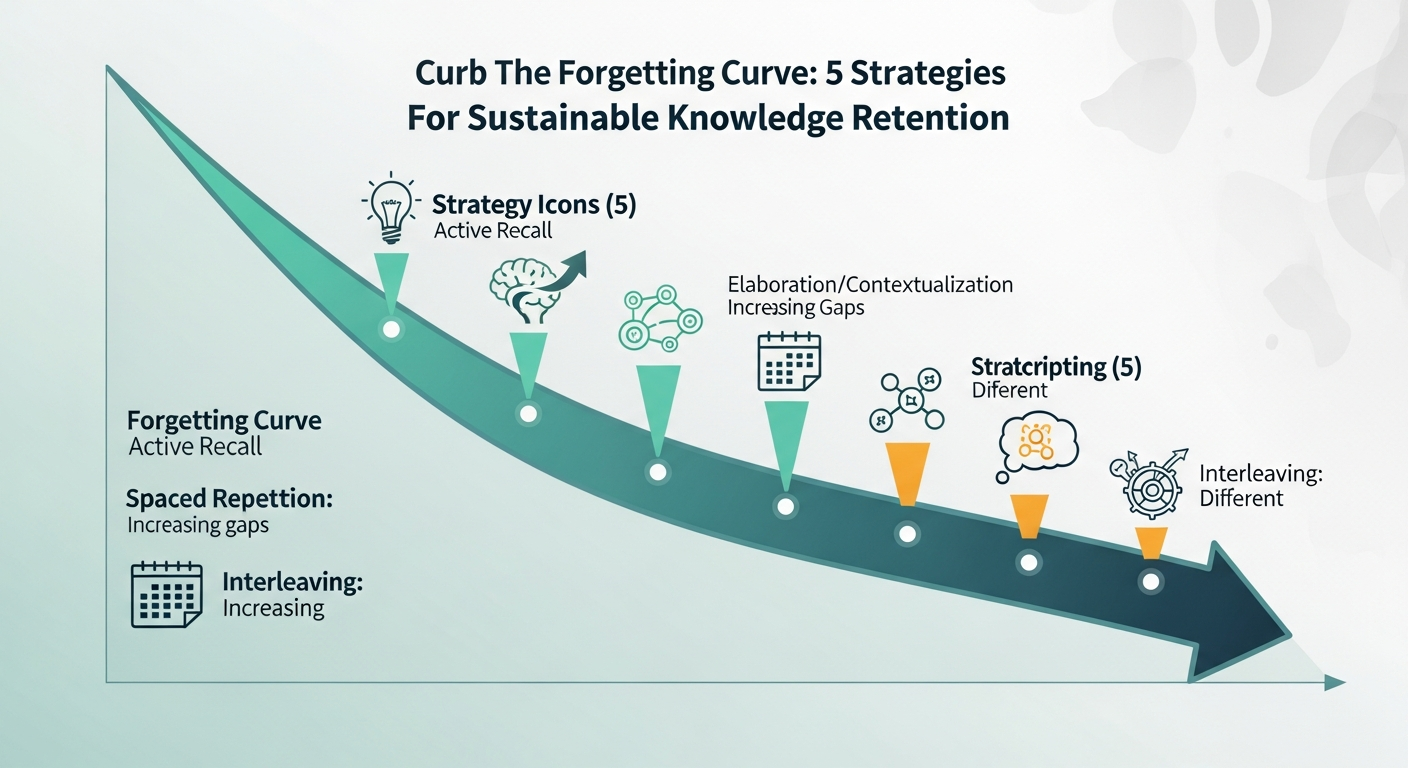
Curb The Forgetting Curve: 5 Strategies For Sustainable Knowledge Retention
As Vice Presidents, Directors, and Senior Managers in Learning & Development, you understand the critical role effective training plays in organizational success. From ensuring compliance in banking and healthcare to optimizing sales performance in retail and pharma, and upholding safety standards in oil and gas or mining, your programs are the bedrock of capability. Yet, a persistent challenge looms large: the notorious ‘forgetting curve.’ Pioneered by Hermann Ebbinghaus, this psychological phenomenon illustrates how quickly learners forget newly acquired information without reinforcement. In today’s fast-paced corporate environment, where knowledge is power and continuous learning is paramount, mitigating this curve is not just beneficial—it's essential for competitive advantage and risk mitigation.
The impact of knowledge decay is profound, leading to wasted training investments, decreased productivity, increased errors, and even regulatory non-compliance. Imagine a new compliance officer forgetting key regulatory updates in finance, or a sales team losing recall on product benefits after a major launch. This isn't just inefficient; it's a direct threat to your organization's bottom line and reputation. The good news? You can proactively curb the forgetting curve. This article explores five strategic approaches that L&D leaders can implement to foster sustainable knowledge retention across diverse industries, transforming transient learning into lasting expertise. By adopting an advanced LMS, your organization can effectively combat this challenge and build a truly knowledgeable workforce.
1. Embrace Microlearning and Spaced Repetition
One of the most powerful antidotes to the forgetting curve is the intelligent combination of microlearning and spaced repetition. Microlearning breaks down complex topics into bite-sized, digestible modules—think short videos, quick quizzes, or interactive infographics—that can be consumed in minutes. This approach reduces cognitive overload and makes learning more accessible and less intimidating. When integrated with a robust Microlearning LMS, these small modules can be delivered precisely when and where they’re needed, often right within the flow of work.
Spaced repetition, on the other hand, strategically reintroduces information at increasing intervals. Instead of a one-and-done training session, key concepts are revisited days, weeks, or even months later, just as the learner is about to forget them. This reinforcement strengthens neural pathways and moves information from short-term to long-term memory. An effective learning management system can automate this process, ensuring that critical information—whether it’s a new banking protocol or a healthcare procedure—is regularly reinforced without conscious effort from the learner. Many organizations find immense value in a cloud based learning management system that can deliver this adaptive content globally and at scale, significantly improving the stickiness of learning. Solutions like MaxLearn LMS are designed to facilitate this strategic delivery.
2. Leverage Gamification and Interactive Experiences
Engagement is the engine of retention. When learners are actively involved and find the learning process enjoyable, they are far more likely to retain information. Gamification injects game-like elements—points, badges, leaderboards, challenges, and rewards—into non-game contexts, transforming mundane training into an exciting experience. This approach fosters a sense of competition, achievement, and mastery, motivating learners to engage more deeply and frequently with the content.
For industries like sales and retail, a Gamified LMS can simulate real-world scenarios, allowing employees to practice customer interactions, product knowledge, or compliance procedures in a risk-free environment. In sectors like pharma or manufacturing, interactive simulations can help technicians master complex machinery operations or adhere to stringent safety protocols. These experiential learning opportunities, facilitated by advanced learning management software, not only make learning fun but also provide immediate feedback, allowing learners to correct mistakes and consolidate their understanding, thereby embedding knowledge more effectively. By adopting these learning management solutions, organizations can transform their training landscape.
3. Implement Adaptive Learning Paths
No two learners are alike, and a one-size-fits-all approach to training often falls short in driving sustainable knowledge retention. Adaptive learning paths leverage data and algorithms to tailor the learning experience to each individual's unique needs, pace, and prior knowledge. This personalization ensures that learners are challenged appropriately—not bored by redundant information nor overwhelmed by concepts they're not ready for. For an enterprise learning management system, this means identifying knowledge gaps and strengths, and then dynamically adjusting the curriculum.
For instance, an employee in the hospitality sector might receive personalized modules based on their specific role and the guest demographics they serve, while a financial advisor might be guided through advanced modules only after mastering foundational regulatory concepts. This targeted approach, often powered by an intelligent learning management system, optimizes learning efficiency and significantly improves retention by focusing on what each learner truly needs. As detailed in the methodology for Adaptive Learning, this personalization is key to overcoming the forgetting curve by ensuring relevance and engagement.
4. Utilize AI-Powered Content Creation and Curation
The speed at which industries evolve demands a constant refresh of training content. Manually updating vast libraries of learning materials across an organization can be a monumental task. This is where artificial intelligence (AI) steps in, revolutionizing content creation and curation. An AI Powered Authoring Tool can dramatically accelerate the development of new courses, update existing ones with the latest information, and even suggest relevant learning resources based on industry trends or learner performance data.
For industries with rapidly changing regulations like banking or healthcare, AI can identify new compliance requirements and automatically generate or update relevant training modules, ensuring that employees are always current. In sales and marketing, AI can help create dynamic product training that adapts to new features or market shifts. By leveraging an LCMS (Learning Content Management System) with AI capabilities, L&D teams can maintain a fresh, relevant, and engaging learning environment without excessive manual effort. This ensures that the knowledge employees acquire is always up-to-date and directly applicable, reinforcing its value and retention.
5. Prioritize Contextual and Risk-Focused Training
Knowledge retention is strongest when learning is relevant and immediately applicable to the learner’s job function and the organization's strategic priorities. Training that is delivered out of context or perceived as theoretical is quickly forgotten. Risk-focused Training, for instance, zeroes in on critical areas where knowledge gaps could lead to significant financial, operational, or reputational damage. This approach prioritizes what learners *must* know and applies it directly to their real-world challenges.
Consider the mining industry, where a lapse in safety procedure recall can have catastrophic consequences. Training focused on specific, high-risk scenarios, coupled with in-situ reinforcement, makes the learning highly relevant and thus, highly retentive. Similarly, in the insurance sector, understanding complex policy details or claims processing procedures is crucial. By designing learning around common errors, compliance violations, or customer service challenges, L&D ensures that the knowledge acquired is not just theoretical, but practically embedded. An effective learning content management system allows for the organization and deployment of such highly contextual and targeted training, making it easier for employees to connect learning to their daily tasks and retain vital information.
Common Questions from L&D Leaders
Q: How can intelligent systems help my organization identify critical knowledge gaps across various operational regions and departments?
A: Advanced analytical capabilities within intelligent learning platforms can analyze performance data, quiz results, and engagement metrics from different regions or departments. By flagging underperforming areas or topics, these systems highlight collective knowledge gaps, enabling L&D to deploy targeted interventions and resources precisely where needed, ensuring global consistency in understanding.
Q: What are the most effective ways to use automated tools to personalize learning experiences for diverse employees with different roles and backgrounds?
A: Automated tools leverage individual learning histories, job roles, and skill assessments to create bespoke learning paths. They can recommend specific modules, resources, or challenges that align with an employee's professional development goals and existing proficiencies. This ensures that whether an employee is in sales, healthcare, or finance, their learning journey is optimized for maximum impact and relevance.
Q: Can self-learning platforms truly improve an organization's recall rates for complex industry standards or compliance procedures?
A: Absolutely. Self-learning platforms, especially those incorporating spaced repetition and interactive simulations, are highly effective. They allow employees to revisit complex compliance topics at their own pace and preferred times, reinforcing the information just before it's forgotten. Quizzes, scenario-based challenges, and immediate feedback mechanisms further embed understanding, leading to significantly higher long-term recall rates for critical standards.
Conclusion
The forgetting curve is a formidable adversary, but it is not insurmountable. By strategically implementing microlearning and spaced repetition, leveraging gamification and interactive experiences, deploying adaptive learning paths, harnessing the power of AI for content, and prioritizing contextual and risk-focused training, L&D leaders can transform how their organizations learn and retain vital knowledge. These strategies are not just about improving training efficiency; they are about building a resilient, knowledgeable workforce that can adapt, innovate, and thrive in an ever-changing landscape.
Investing in an advanced lms learning management system like MaxLearn LMS empowers your organization to move beyond mere training delivery to truly sustainable knowledge retention. It’s an investment in your people, your productivity, and your future. Take the proactive step to curb the forgetting curve and cultivate a culture of continuous, impactful learning.
.jpg)


