

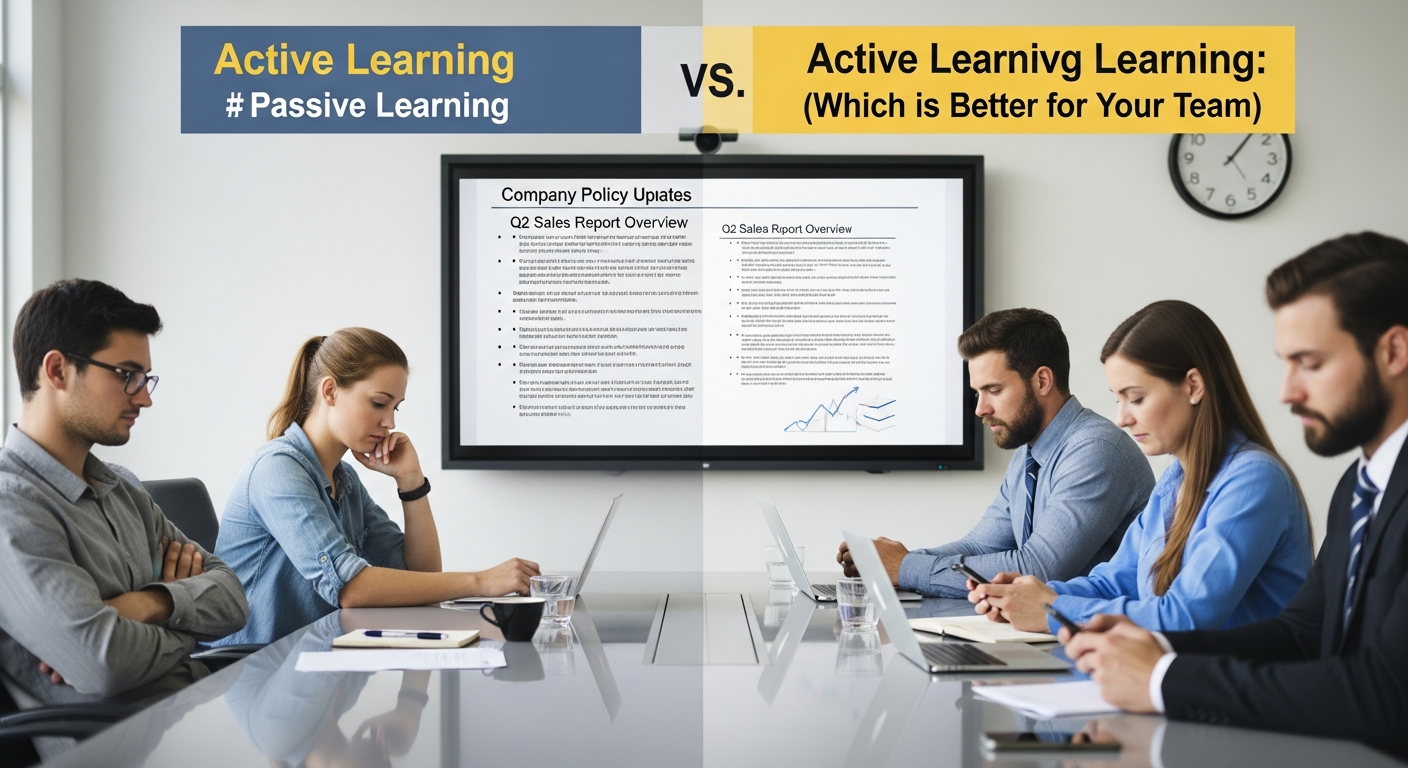
Active Learning Vs. Passive Learning: Which Is Better For Your Team?
As a Vice President, Director, or Senior Manager in Learning & Development, you're constantly evaluating strategies to enhance your team's skills, improve performance, and drive business growth. The landscape of corporate training is evolving rapidly, pushing us beyond traditional methodologies. A fundamental decision lies in choosing between active and passive learning approaches. But which one genuinely delivers superior results for your team, especially in diverse and demanding industries like Compliance, Sales, Banking, Finance, Insurance, Retail, Pharma, Health care, Hospitality, Oil and Gas, and Mining?
This article delves into the nuances of active and passive learning, exploring their benefits, drawbacks, and how a strategic blend, supported by modern Microlearning LMS solutions, can revolutionize your team's development.
Understanding Passive Learning: The Foundation, Or a Relic?
Passive learning is the traditional backbone of education, where information flows primarily from the instructor or content to the learner. Think lectures, pre-recorded video modules, extensive reading assignments, and informational webinars. In a corporate setting, this often translates to mandatory compliance videos, product knowledge presentations, or onboarding manuals.
The Case For Passive Learning:
- Scalability: It's efficient for disseminating large volumes of information to many learners simultaneously.
- Foundational Knowledge: Excellent for introducing new concepts, policies, or broad theoretical frameworks.
- Cost-Effective (Initially): Often requires less upfront resource investment in terms of facilitator time and interactive tools.
- Consistency: Ensures everyone receives the exact same message and information.
The Limitations of Passive Learning:
- Low Engagement: Learners are often spectators, leading to mind-wandering and disinterest.
- Poor Retention: Without active processing, information is quickly forgotten. Studies consistently show that merely listening or reading leads to low recall rates over time.
- Limited Application: It struggles to develop critical thinking, problem-solving, or practical application of skills. For complex financial regulations, intricate sales techniques, or critical healthcare protocols, theoretical knowledge alone is insufficient.
- Lack of Personalization: One-size-fits-all content rarely addresses individual learning styles or existing knowledge gaps.
Understanding Active Learning: Engaging Minds, Building Skills
Active learning flips the script, placing the learner at the center of the experience. It involves learners doing something and thinking about what they are doing. This can range from discussions and debates to simulations, case studies, role-playing, group projects, and practical exercises. In industries where precision, critical thinking, and immediate application are paramount – such as a sales team negotiating a complex deal, a financial analyst identifying market risks, or a healthcare professional making split-second decisions – active learning is indispensable.
The Benefits of Active Learning:
- High Engagement: Learners are directly involved, fostering deeper interest and motivation.
- Superior Retention: By actively processing, analyzing, and applying information, learners build stronger neural connections, leading to better long-term recall.
- Skill Development: It cultivates essential soft and hard skills like critical thinking, problem-solving, communication, collaboration, and decision-making.
- Real-World Application: Active methods bridge the gap between theory and practice, preparing employees for real-world scenarios. This is crucial for Risk-focused Training in banking or compliance.
- Immediate Feedback: Many active learning strategies allow for immediate feedback, enabling learners to correct misunderstandings and refine skills on the spot.
The Challenges of Active Learning:
- Resource Intensive: Often requires more time, skilled facilitators, and specialized tools or technology.
- Logistical Complexity: Can be challenging to implement for very large, geographically dispersed teams without a robust AI Powered Authoring Tool and a capable learning management system.
- Initial Time Investment: Designing effective active learning modules can take more time than simply recording a lecture.
The L&D Imperative: Moving Beyond Traditional Approaches
For L&D leaders, the objective isn't just content delivery; it's driving measurable impact on performance, compliance, and profitability. In dynamic sectors, relying solely on passive learning risks creating a workforce that knows "what" but not "how."
Addressing Key L&D Challenges with Modern Learning
As L&D professionals, you often ponder: How can we ensure training is truly effective and personalized for each team member's unique learning style and knowledge gaps? For teams spread across different regions or working remotely, how can we deliver consistent yet locally relevant training without logistical nightmares? And beyond just delivering content, how do we guarantee our training directly translates into improved performance and reduces specific business risks?
This is where the power of modern eLearning, especially through a sophisticated Adaptive Learning platform, shines. It allows for dynamic adjustments to content and pacing based on individual learner progress and preferences. Imagine a learning management system that not only tracks completion but actively diagnoses knowledge gaps and serves up targeted, interactive content.
The Hybrid Approach: The Best of Both Worlds
The strategic answer isn't necessarily an "either/or" but a "both/and." A blended learning strategy that judiciously combines elements of active and passive learning is often the most effective. Passive learning can efficiently lay the groundwork, delivering foundational knowledge in an accessible format. Active learning then builds upon this foundation, allowing learners to apply, experiment, and master skills in a practical context.
For example, a new sales associate might first watch a series of concise microlearning videos (passive) on product features and sales methodologies. Subsequently, they engage in role-playing exercises, simulated customer interactions, or analyze case studies of successful sales pitches (active), all facilitated and tracked by a Gamified LMS that motivates engagement and competition.
Key Considerations for Your Team
When designing your learning strategy, consider these factors:
- Training Objectives: What specific outcomes do you want? If it's pure information transfer, passive might suffice. If it's skill development, behavioral change, or critical thinking, active is essential.
- Learner Demographics & Prior Knowledge: Experienced teams might benefit more from collaborative active learning, while new hires might need more passive foundational content first.
- Available Resources: Evaluate your budget, time, and technological capabilities. A robust learning management software can make active learning more scalable.
- Industry-Specific Needs: In highly regulated industries like Compliance, Banking, or Pharma, accurate knowledge (passive) combined with rigorous application (active) through simulations is non-negotiable.
Choosing the Right Learning Management System (LMS)
The effectiveness of your chosen approach hinges significantly on the technology you employ. A modern LMS is not just a content repository; it's an ecosystem designed to facilitate dynamic learning experiences. Look for a cloud based learning management system that supports a variety of content formats, from video lectures to interactive simulations and collaborative tools.
An enterprise learning management solution should offer features like personalized learning paths, robust analytics to track engagement and progress, and authoring tools that allow your L&D team to create engaging content efficiently. A strong learning content management system (LCMS) will empower you to manage, update, and deploy learning materials seamlessly across your organization.
Whether you're looking for a comprehensive learning management system for a global corporation or a specialized lms learning management system for a particular department, the right learning management solutions partner, like MaxLearn LMS, can provide the tools to implement a powerful, blended learning strategy.
Conclusion
The debate between active and passive learning isn't about declaring one definitively "better" than the other in all contexts. For L&D leaders, the optimal strategy lies in understanding the strengths and weaknesses of each and strategically blending them to meet specific organizational goals. While passive learning provides a necessary foundation, active learning is the catalyst for true skill development, deeper retention, and measurable performance improvement.
By leveraging advanced eLearning platforms and embracing a hybrid approach, you can create a vibrant, engaging, and effective learning environment that empowers your team across all industries to not just consume information, but to truly master and apply it, driving tangible success for your organization.
.jpg)


