

Mastering Motivation: Leveraging Positive And Negative Reinforcement And Punishment in L&D
As leaders in Learning & Development, you are constantly seeking innovative strategies to cultivate high-performing teams, ensure compliance, and drive measurable business growth. At the heart of effective training lies a deep understanding of human behavior – specifically, how to encourage desired actions and discourage counterproductive ones. This is where the principles of positive and negative reinforcement and punishment, rooted in behavioral psychology, become invaluable tools in your L&D toolkit. When applied strategically and ethically, these methods can transform how your organization approaches everything from essential compliance training in banking and healthcare to advanced sales techniques in retail and pharma, or critical safety protocols in oil and gas and mining.
Understanding Behavioral Psychology in L&D
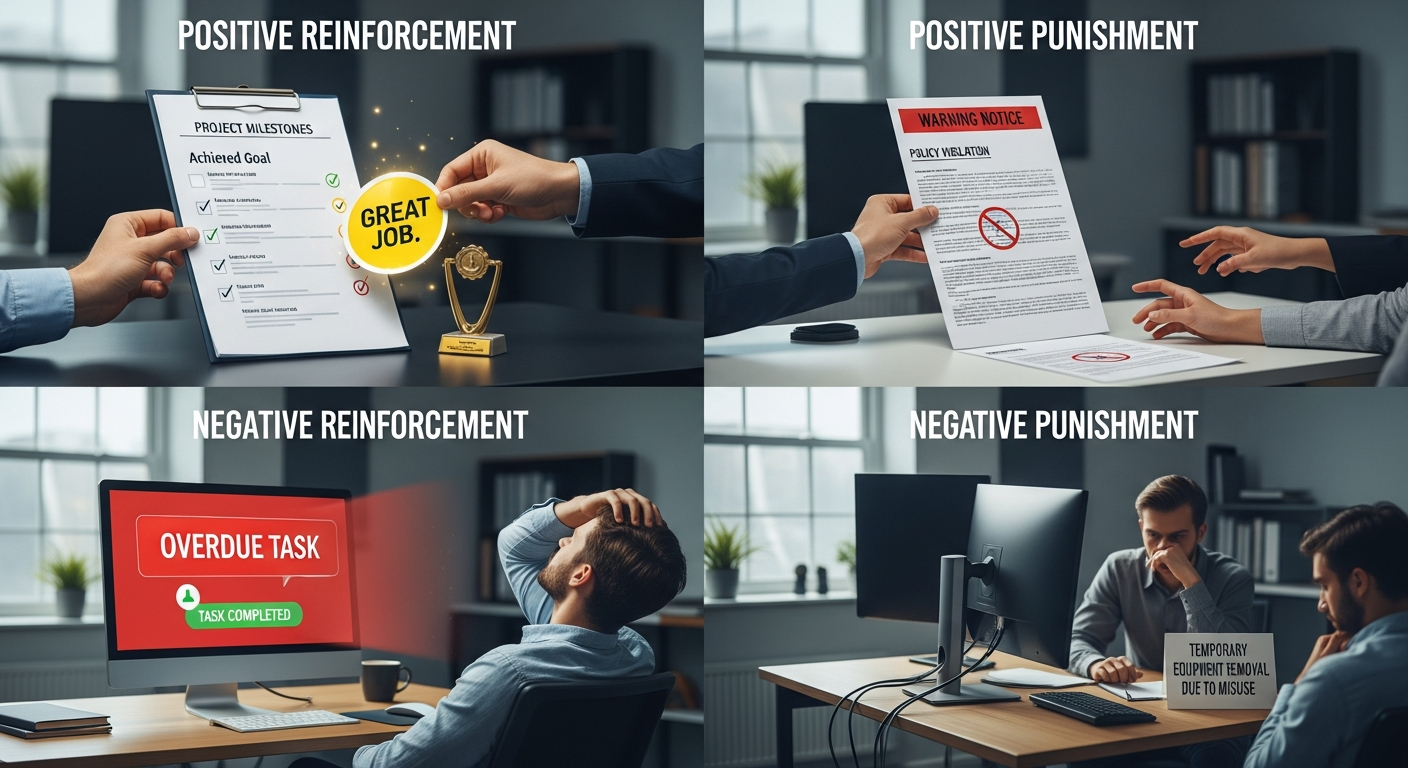
Behavioral psychology offers a framework for understanding and shaping behavior. In L&D, this translates to designing learning experiences that effectively modify employee actions, skills, and knowledge. Let's explore the four core quadrants:
Positive Reinforcement: Encouraging Desired Behaviors
Positive reinforcement involves adding a desirable stimulus to increase the likelihood of a behavior recurring. Think of it as rewarding good performance. In an L&D context, this is arguably the most powerful and widely accepted method.
- Examples in L&D:
- Compliance: Publicly recognizing employees who achieve perfect scores on Risk-focused Training modules or consistently adhere to new regulations. This could involve digital badges, shout-outs in company newsletters, or even small monetary bonuses.
- Sales: Rewarding sales professionals with bonuses, preferred leads, or public acknowledgment for exceeding targets or successfully completing a new product training module.
- Banking & Finance: Offering opportunities for advanced professional development or career progression to employees who proactively complete optional courses on new financial regulations or security protocols.
- Healthcare: Highlighting clinical staff who demonstrate mastery of new medical procedures or patient care protocols, perhaps with certifications or internal awards.
- Retail: Giving store managers who consistently achieve high customer satisfaction scores via their teams access to exclusive leadership workshops.
An effective Microlearning LMS can be instrumental here, allowing for immediate feedback and rewards (points, badges) upon completion of modules, leveraging the power of gamification. A Gamified LMS can provide leaderboards and virtual currency to make learning more engaging and rewarding.
Negative Reinforcement: Removing Obstacles to Success
Negative reinforcement involves removing an undesirable stimulus to increase the likelihood of a behavior recurring. This is often misunderstood as punishment, but it’s about relief, not pain. The goal is still to encourage a positive behavior by taking something unpleasant away.
- Examples in L&D:
- Pharma: If a team struggles with a complex data entry process, providing Adaptive Learning modules that simplify the task and then removing the need for redundant manual checks (the "undesirable stimulus") once proficiency is demonstrated.
- Hospitality: Employees who consistently pass hygiene audits with flying colors might be exempted from certain repetitive daily checklist items, as their consistent good behavior has removed the need for the constant oversight.
- Compliance: Automating the tracking of mandatory training for employees who complete modules ahead of schedule, thus removing the administrative burden of manual follow-ups for those proactive learners.
- Oil & Gas: Streamlining complex permit application processes for safety officers who consistently maintain incident-free records, removing administrative hurdles as a reward for their diligence.
Using a sophisticated LMS with features like automated workflows and progressive module unlocking can facilitate negative reinforcement by removing barriers as learners advance.
Positive Punishment: Discouraging Unwanted Actions
Positive punishment involves adding an undesirable stimulus to decrease the likelihood of a behavior recurring. This is often the least preferred method in L&D due to its potential for resentment and negative impact on morale.
- Examples in L&D:
- Compliance: An employee failing a critical compliance test might be required to re-take the entire module, including additional, more rigorous assessments. (The added rigorous assessment is the undesirable stimulus.)
- Healthcare: Requiring staff members who repeatedly fail to follow protocol on new equipment to undergo additional, mandatory, hands-on retraining sessions during non-work hours.
- Banking: Implementing strict penalties for non-compliance with data security protocols, such as mandatory additional training sessions combined with temporary access restrictions to sensitive systems.
While effective for immediate behavioral correction, positive punishment should be used sparingly and with clear justification. An AI Powered Authoring Tool within an enterprise learning management system can help generate targeted remedial content when such scenarios arise.
Negative Punishment: Withdrawing Privileges for Missteps
Negative punishment involves removing a desirable stimulus to decrease the likelihood of a behavior recurring. This also carries risks similar to positive punishment but can be more palatable if implemented fairly and transparently.
- Examples in L&D:
- Sales: A sales rep failing to complete mandatory training on a new product might temporarily lose access to leads for that product until the training is completed.
- Retail: Managers whose teams consistently underperform on essential training metrics might temporarily lose certain budget allocations for discretionary team activities.
- Hospitality: Removing the privilege of flexible scheduling for employees who consistently miss mandatory training sessions or fail to adhere to quality standards.
- Mining: Suspending access to certain advanced machinery for operators who fail to pass regular safety refresher courses.
A robust learning content management system (LCMS) or cloud based learning management system can facilitate the administrative aspects of such interventions, like managing access rights based on training completion.
The L&D Leader's Toolkit: Applying Reinforcement and Punishment Strategically
The key for L&D professionals, from Directors to Senior Managers, is to understand that these aren't just theoretical concepts. They are practical levers for shaping your organizational culture and achieving strategic goals. While reinforcement (especially positive) is generally preferred for long-term behavioral change and fostering a positive learning environment, punishment may be necessary for critical safety or compliance breaches.
Consider the ethical implications and ensure consistency, fairness, and transparency in application. Your learning management software, such as the MaxLearn LMS, plays a crucial role in enabling these strategies by providing the infrastructure for tracking, delivering, and reinforcing learning.
Leveraging Technology for Impactful Learning Outcomes
Modern learning technologies, including sophisticated learning management solutions, are transforming how we apply these behavioral principles. A cutting-edge lms learning management system can act as the central nervous system for your L&D initiatives.
How an Intelligent System Enhances Behavioral Strategies
An intelligent learning management system can profoundly impact the application of reinforcement and punishment:
- Personalized Reinforcement: Delivering targeted rewards (e.g., badges, points, recognition) based on individual learner progress and preferences. An Adaptive Learning platform can tailor content and feedback, acting as a dynamic reinforcer.
- Automated Feedback Loops: Providing immediate constructive feedback, which acts as a mild form of positive reinforcement or corrective feedback (a mild positive punishment) for incorrect answers.
- Data-Driven Insights: Identifying patterns in learner behavior to optimize training paths. For instance, if data shows a particular module is frequently failed, the system can flag it for review or offer alternative learning pathways, effectively removing an "undesirable stimulus" (the frustrating module) and reinforcing the desire to learn.
- Gamification: Integrating game-like elements like leaderboards, points, and virtual rewards to positively reinforce engagement and achievement. This is a core strength of a Gamified LMS.
Customized Learning for Diverse Industries
Across industries – from the highly regulated environments of Pharma and Health Care to the dynamic needs of Retail and Hospitality – the ability to customize and deliver targeted training via an intelligent LMS is paramount. For example, in Compliance, immediate feedback on policy adherence modules reinforces correct behavior. In Sales, a AI Powered Authoring Tool can quickly generate scenarios that reinforce desired closing techniques, while also flagging incorrect approaches for remediation.
Frequently Asked Questions for L&D Innovators
Question 1: How can advanced analytics inform our reinforcement strategies for global teams?
Advanced analytical capabilities within a modern learning platform can track engagement metrics, completion rates, and performance improvements across diverse geographical locations and cultural contexts. By analyzing this data, L&D leaders can identify which reinforcement techniques resonate most effectively with different regional teams – for instance, public recognition might be highly valued in one culture, while opportunities for individual career advancement might be more motivating in another. This allows for hyper-personalized learning pathways and motivational strategies that account for cultural nuances, ensuring maximum impact for an international workforce.
Question 2: What learning technologies are best for predicting and preventing compliance breaches?
Technologies featuring predictive analytics and Adaptive Learning are crucial for this. Such systems can analyze historical data of past breaches, identify common failure points, and proactively recommend specific Risk-focused Training modules to at-risk employees before issues arise. Real-time feedback mechanisms and intelligent assessment tools within these platforms can also identify gaps in understanding as they happen, triggering immediate, targeted interventions (e.g., micro-assessments or quick refreshers) to correct potential non-compliant behaviors before they escalate into breaches. This proactive approach acts as a powerful preventative measure.
Question 3: Can intelligent platforms truly personalize learning experiences to optimize employee performance?
Absolutely. Intelligent learning platforms leverage algorithms to create highly individualized learning journeys. By assessing an employee's existing skills, job role, learning style, and performance data, these systems can recommend specific content, adjust the pace of learning, and even suggest different formats (e.g., video, interactive simulation, textual guides). This level of personalization acts as a continuous positive reinforcer, as learners are consistently presented with relevant, engaging content that directly addresses their developmental needs, making the learning process more efficient and effective, thereby optimizing their overall performance and job satisfaction.
Conclusion
The strategic application of positive and negative reinforcement and punishment, underpinned by cutting-edge learning technology, is no longer a theoretical exercise but a practical imperative for L&D leaders. By consciously designing learning experiences that reinforce desired behaviors and address unwanted actions, you can create a more engaged, compliant, and ultimately, higher-performing workforce across all industries – from the intricacies of Banking and Finance to the demanding environments of Oil and Gas. Embrace the power of intelligent learning management software to build a culture of continuous improvement and excellence.
.jpg)


