

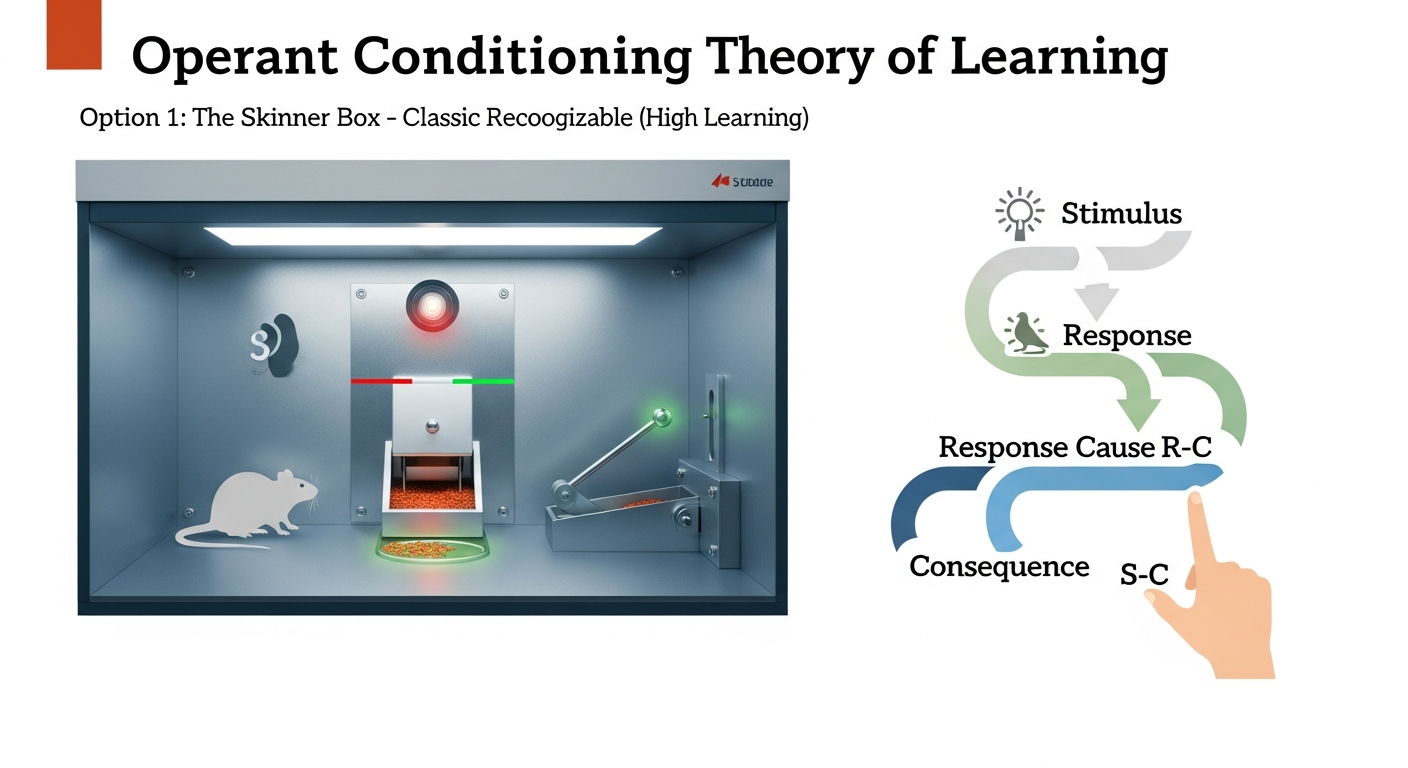
Operant Conditioning: The Science Behind Sustainable L&D Outcomes
For Vice Presidents, Directors, and Senior Managers in Learning & Development, the pursuit of effective, measurable, and sustainable training outcomes is paramount. In a landscape where technological advancements often steal the spotlight, it's easy to overlook the foundational psychological principles that underpin all successful learning. Among these, Operant Conditioning stands out as a timeless framework, offering profound insights into how behaviors are learned, maintained, and modified. Understanding this theory isn't just academic; it's a strategic imperative for designing L&D programs that genuinely drive performance, compliance, and growth across every industry, from Compliance and Sales to Healthcare and Oil & Gas.
This article delves into the core tenets of Operant Conditioning, explores its powerful applications in modern corporate training, and examines how cutting-edge LMS platforms, often powered by AI, are leveraging these principles to create unprecedented learning effectiveness.
What is Operant Conditioning?
At its heart, Operant Conditioning is a theory of learning developed by psychologist B.F. Skinner. It posits that learning occurs through rewards and punishments for behavior. Unlike classical conditioning, which involves involuntary responses to stimuli, operant conditioning focuses on voluntary behaviors, or "operants," which are influenced by the consequences that follow them. Simply put, people tend to repeat behaviors that lead to positive outcomes and avoid those that lead to negative ones.
For L&D professionals, this means understanding how to structure learning experiences to reinforce desired actions and discourage undesirable ones. It’s about creating an environment where the right learning behaviors – engagement, practice, application – are consistently rewarded.
Key Principles of Operant Conditioning in L&D
The theory is built on four core concepts:
- Reinforcement: Any consequence that increases the likelihood of a behavior being repeated.
- Positive Reinforcement: Adding something desirable to increase a behavior. In training, this could be immediate feedback, points, badges in a Gamified LMS, public recognition, promotions, or even a simple "well done." For example, an employee completing a challenging compliance module might receive a digital badge and be highlighted in a team newsletter.
- Negative Reinforcement: Removing something undesirable to increase a behavior. This isn't punishment but rather a reward in the form of relief. Imagine a new sales representative who, after consistently meeting targets, is exempted from a mandatory but disliked weekly report.
- Punishment: Any consequence that decreases the likelihood of a behavior being repeated.
- Positive Punishment: Adding something undesirable to decrease a behavior. This might involve corrective feedback, a mandatory re-training module for a safety violation, or a warning.
- Negative Punishment: Removing something desirable to decrease a behavior. This could be the temporary loss of a privilege or bonus due for failing a critical assessment.
While punishment can be effective, modern L&D strategies largely favor reinforcement. Positive reinforcement, especially, builds motivation and a positive learning culture, which is crucial for sustained engagement and development across sectors like Banking, Finance, and Insurance, where high stakes are involved.
Additionally, the Schedules of Reinforcement are critical. Variable ratio schedules (where reinforcement is delivered after an unpredictable number of responses, like a slot machine) create the most persistent behaviors, making Microlearning LMS platforms with dynamic challenges and rewards highly effective.
Applying Operant Conditioning in L&D Across Industries
The principles of operant conditioning are universally applicable to corporate learning and development:
- Compliance Training: In industries like Pharma, Healthcare, and Oil & Gas, adherence to regulations is non-negotiable. Risk-focused Training leverages operant conditioning by positively reinforcing correct procedural steps and providing immediate, corrective feedback (a form of positive punishment) for errors. A cloud based learning management system can instantly reward completion of mandatory modules with certifications and recognition.
- Sales Training: Sales professionals in Retail, Banking, or any sector benefit immensely. Reinforcing successful sales techniques through performance bonuses, public recognition, and career progression based on metrics encourages consistent application of learned skills. An AI Powered Authoring Tool can create scenarios where the right sales pitch or objection handling is immediately rewarded with progress.
- Customer Service (Hospitality, Retail): Training modules can reinforce empathetic communication, efficient problem-solving, and product knowledge through scenarios that provide positive feedback for correct responses.
- Technical Skills (Mining, Oil & Gas): Practicing complex procedures in simulations where correct actions lead to positive outcomes (e.g., successful operation, safety clearance) and errors lead to immediate, clear negative feedback.
A robust learning management system (LMS) or a comprehensive learning content management system (LCMS) provides the infrastructure to deliver these reinforcements systematically. Whether it's through points, leaderboards, badges, or automated feedback, an effective enterprise learning management solution can be a powerful tool for behavioral shaping.
Operant Conditioning and Modern Learning Technologies
The digital age has supercharged the application of operant conditioning. Modern learning platforms are designed to provide the instant feedback and variable reinforcement schedules that drive effective behavioral change:
- Gamification: Gamified LMS platforms are essentially operant conditioning machines. They provide immediate positive reinforcement (points, badges, levels, leaderboards) for desired learning behaviors, driving engagement and sustained effort.
- Microlearning: Short, focused modules delivered via a Microlearning LMS allow for frequent, rapid reinforcement. Learners receive immediate feedback on small chunks of information, making the learning process highly responsive and motivating. This modular approach is ideal for busy professionals.
- Adaptive Learning: These systems personalize learning paths, providing reinforcement precisely when and where it's most effective. By tailoring content and challenges to individual performance, adaptive platforms optimize the "reward" for learning, ensuring it's always relevant and impactful.
A cutting-edge lms learning management system like MaxLearn LMS is built with these behavioral principles in mind, delivering not just content, but an environment conducive to sustained learning and skill development through intelligent feedback and reward mechanisms. Such learning management software ensures that positive learning experiences are consistently reinforced.
AI's Role in Shaping Behavioral Learning: Questions for L&D Leaders
As L&D leaders, you're constantly seeking ways to optimize learning outcomes. Here are critical questions about how advanced technologies can further enhance behavioral learning:
Q: How can intelligent systems enhance our understanding of learner engagement and optimize feedback loops?
A: AI can meticulously track learner interactions, performance patterns, and even emotional responses to content. By analyzing vast datasets, these systems can identify precise moments for intervention or praise, delivering hyper-personalized feedback and reinforcement that aligns with individual learning styles and progress. This ensures that every learner receives the optimal stimulus to reinforce desired behaviors, making the learning experience highly efficient and effective.
Q: What strategies can advanced computational tools offer to ensure consistent, impactful learning experiences across diverse geographical teams?
A: Advanced computational tools, integrated into your learning management solutions, can dynamically adapt content delivery and reinforcement schedules based on regional performance data, language preferences, and cultural nuances. This ensures that the motivational triggers and feedback mechanisms, essential to operant conditioning, are uniformly effective regardless of location. For global organizations, AI can standardize the learning experience while personalizing its delivery, maintaining a consistent quality of behavioral shaping.
Q: In what ways can artificial intelligence personalize learning paths and motivational triggers for each unique learner within an organization?
A: AI's strength lies in its ability to process individual learner data – their past performance, learning pace, preferred content formats, and even career aspirations. This allows AI to construct bespoke learning paths that present challenges and rewards in an optimal sequence. It can predict when a learner is likely to disengage and introduce a novel reinforcement or adaptive content adjustment, ensuring continuous motivation and tailoring the 'consequences' of learning to maximize positive behavioral change for every employee.
Benefits for L&D Leaders
By consciously applying operant conditioning principles, whether through traditional methods or sophisticated learning management software like a MaxLearn LMS, L&D leaders can:
- Improve Learner Engagement: Consistent positive reinforcement makes learning enjoyable and motivating.
- Accelerate Skill Acquisition: Immediate feedback and rewards shorten the learning curve.
- Ensure Sustainable Behavior Change: Well-designed reinforcement schedules lead to lasting habits.
- Boost ROI on Training: Effective training translates directly into improved performance, compliance, and productivity, demonstrating clear value to the business.
Conclusion
Operant Conditioning theory offers a powerful, evidence-based roadmap for L&D professionals committed to driving tangible behavioral change and performance improvements. By strategically employing reinforcement and, where necessary, judicious punishment, organizations can cultivate a learning environment that encourages growth, adherence to standards, and the adoption of new skills. When integrated with advanced learning management system platforms, particularly those leveraging AI, these timeless psychological principles become even more potent, delivering personalized, engaging, and results-driven training experiences that meet the complex demands of today's diverse industries. Investing in a robust learning management system (LMS) is investing in the scientific advantage of human behavior, transforming potential into performance.
.jpg)


