

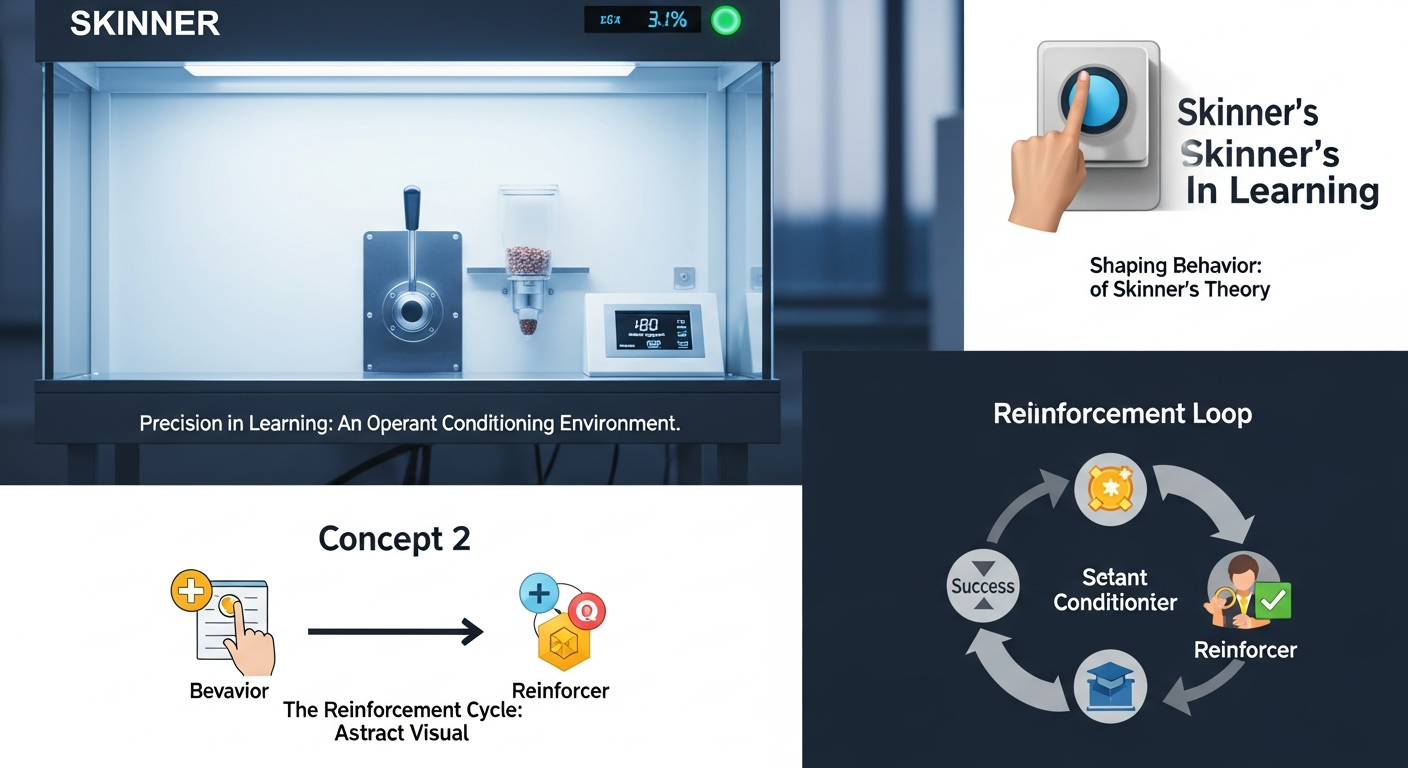
Skinner's Theory in Learning: A Timeless Blueprint for Modern L&D Success
In the dynamic landscape of corporate learning and development, L&D leaders are constantly seeking strategies to cultivate high-performing teams, ensure compliance, and drive organizational growth. While cutting-edge technologies and methodologies often grab the spotlight, sometimes the most profound insights come from revisiting foundational theories. B.F. Skinner's theory of operant conditioning, a cornerstone of behavioral psychology, offers a surprisingly potent and practical framework for designing incredibly effective and engaging learning experiences, even in today's sophisticated Microlearning LMS environments. For Vice Presidents, Directors, and Senior Managers of L&D across sectors like compliance, sales, banking, finance, insurance, retail, pharma, healthcare, hospitality, oil and gas, and mining, understanding and applying Skinner's principles can unlock unprecedented learning outcomes.
The Enduring Core of Skinner's Theory: Operant Conditioning
B.F. Skinner’s work on operant conditioning postulates that learning is a function of change in overt behavior. Changes in behavior are the result of an individual's response to events (stimuli) that occur in the environment. When a stimulus-response results in a positive outcome, the likelihood of that response occurring again increases. Conversely, if it results in a negative outcome, the behavior is less likely to be repeated. This seemingly simple premise has profound implications for how we structure corporate training.
Reinforcement: The Engine of Learning
At the heart of Skinner's theory is reinforcement – any event that strengthens or increases the behavior it follows. In L&D, this translates into designing learning pathways where desired behaviors (e.g., correctly answering a question, applying a new sales technique, adhering to a compliance procedure) are immediately followed by positive consequences. These could be points in a Gamified LMS, virtual badges, explicit recognition, access to advanced content, or even just immediate, constructive feedback that confirms correctness. Positive reinforcement encourages learners to repeat the actions that lead to success. Negative reinforcement, often misunderstood, is about removing an undesirable stimulus to strengthen a behavior. For instance, successfully completing a mandatory module might remove the nagging "incomplete" notification, encouraging timely completion of future modules.
The Limited Role of Punishment
While punishment, the introduction of an adverse stimulus to decrease a behavior, exists within Skinner's framework, its application in L&D is generally discouraged. Punishment can lead to avoidance, fear, and resentment, rather than genuine understanding or behavioral change. Modern L&D focuses on reinforcing desired behaviors rather than punishing errors, fostering a positive learning environment.
Schedules of Reinforcement: Mastering Engagement
Skinner also detailed various schedules of reinforcement, which dictate when and how often reinforcement is delivered. Continuous reinforcement (every correct response is rewarded) is excellent for establishing new behaviors quickly. However, intermittent reinforcement (rewards are given sometimes, but not every time) is far more effective for maintaining long-term engagement and resistance to extinction. Think of a financial professional mastering complex regulations; initial continuous feedback helps build confidence, but later, occasional recognition for exceptional compliance practices maintains high standards. This strategic application of reinforcement schedules is crucial for a robust learning management system.
Applying Skinnerian Principles to Modern L&D
For L&D professionals, Skinner’s theory provides actionable insights for creating impactful training programs.
Structuring Effective Learning Paths
Designing learning content that breaks down complex tasks into smaller, manageable steps, each followed by immediate feedback, is a direct application of Skinner. This is particularly effective in technical training, onboarding, and procedural compliance for industries like banking or manufacturing. Each correct step reinforces the learner's progress, building confidence and competence incrementally.
Immediate and Constructive Feedback Mechanisms
The speed and quality of feedback are paramount. In an eLearning context, this means instant pop-ups indicating correct answers, progress bars, achievement notifications, and personalized insights. This ensures that the desired behavior is reinforced precisely when it occurs, solidifying the learning. An effective Microlearning LMS excels at delivering this prompt feedback.
Motivation and Engagement through Strategic Reinforcement
Beyond traditional incentives, Skinner’s theory helps L&D design intrinsic motivators. A sales manager, for example, might design a training module where practicing a new pitch technique immediately unlocks a case study showing its success. This direct link between effort and positive outcome is highly reinforcing. A well-designed Gamified LMS inherently leverages these principles to boost learner motivation.
Driving Behavioral Change in High-Stakes Training
In industries like healthcare or oil and gas, where errors can have severe consequences, behavioral change is critical. Skinner's principles can be used to design scenarios where correct, safe procedures are consistently reinforced, making them habitual. This applies to Risk-focused Training, where simulating risks and reinforcing correct responses can proactively mitigate future incidents.
Skinnerian Principles in eLearning Technologies
Modern eLearning technologies are perfectly poised to operationalize Skinner's theory, making training more effective and scalable. A comprehensive LMS or a sophisticated learning content management system serves as the foundational platform.
The Role of a Robust Learning Management System
A cutting-edge learning management software provides the infrastructure to track learner progress, deliver content in bite-sized chunks, and record performance. This data is crucial for understanding what behaviors are being reinforced and where learning might be breaking down. An enterprise learning management system must be capable of supporting diverse reinforcement strategies.
Gamified LMS for Dynamic Reinforcement
Gamification is a direct descendant of Skinner's ideas. Points, badges, leaderboards, and progress bars within a Gamified LMS provide continuous and intermittent positive reinforcement, making learning an engaging and rewarding experience. This encourages repetition of desired learning behaviors, crucial for mastering complex skills in sales or finance.
Adaptive Learning and Personalized Feedback
Adaptive Learning systems automatically adjust content difficulty and pathways based on a learner's performance. This ensures that learners are consistently challenged but also consistently reinforced for successful navigation, providing a personalized schedule of reinforcement that keeps them in their optimal learning zone. A cloud based learning management system can efficiently deliver this adaptive content.
Leveraging an AI Powered Authoring Tool
An AI Powered Authoring Tool can help L&D teams create highly interactive content that automatically embeds reinforcement. Imagine an AI suggesting scenario-based questions that provide immediate, context-specific feedback, or generating varied practice exercises to ensure skills are overlearned, making the desired responses automatic. This is where the power of an advanced MaxLearn LMS truly shines.
LCMS for Consistent Content Delivery and Tracking
A powerful LCMS ensures that all learning content, from microlearning modules to comprehensive courses, consistently applies Skinnerian principles. It allows for the systematic deployment of modules that build upon each other, reinforcing foundational knowledge before moving to advanced concepts.
Addressing Key Questions for L&D Leaders
How can L&D leaders optimize learning programs using these principles for maximum organizational impact?
To maximize impact, L&D leaders should conduct thorough behavioral analyses to identify specific, measurable behaviors they want to instill. Then, design explicit reinforcement schedules into every learning module, ensuring immediate and relevant rewards for desired actions. Utilize data from your lms learning management system to continually refine these schedules and content, focusing on outcomes that directly correlate with business goals, such as reduced compliance violations or increased sales performance.
What considerations are crucial when implementing Skinnerian approaches across diverse global workforces?
Cultural nuances significantly influence what constitutes an effective reinforcer. What motivates a learner in one region might be less impactful or even inappropriate elsewhere. L&D leaders must localize reinforcement strategies, for example, by offering culturally relevant recognition or aligning rewards with local values. Furthermore, ensure your learning management solutions can deliver content and reinforcement in multiple languages and formats, respecting diverse learning preferences.
In what ways can advanced technology, like artificial intelligence, enhance the application of Skinner's theory for individual learners?
Artificial intelligence can revolutionize the individualization of Skinnerian principles. AI can analyze a learner's unique response patterns to determine optimal reinforcement schedules, personalize feedback to address specific knowledge gaps, and even predict when a learner might disengage, prompting timely, relevant interventions. This allows for truly Adaptive Learning paths that are continuously optimized for each individual, mimicking a highly attentive, personalized tutor.
Conclusion
B.F. Skinner’s theory of operant conditioning remains remarkably relevant for L&D professionals committed to driving tangible behavioral change and measurable business outcomes. By thoughtfully integrating principles of positive reinforcement, strategic feedback, and intelligent content design, organizations can create learning environments that are not only engaging but profoundly effective. Leveraging modern eLearning technologies, from a sophisticated MaxLearn LMS and Gamified LMS to Adaptive Learning and AI Powered Authoring Tool, L&D leaders can harness these timeless psychological insights to build a workforce that not only knows what to do but consistently does it right, positioning their organizations for sustained success in any industry.
.jpg)


