

The Enduring Influence of Skinner's Learning Theory on Modern eLearning for L&D Leaders
In the dynamic world of corporate learning and development, staying ahead means not only embracing the latest technologies but also understanding the foundational principles that drive effective education. As L&D Vice Presidents, Directors, and Senior Managers, your strategic decisions shape the capabilities of your workforce across vital sectors like Compliance, Sales, Banking, Finance, Insurance, Retail, Pharma, Health care, Hospitality, Oil and Gas, and Mining. Amidst the buzz of AI, adaptive platforms, and immersive experiences, it's easy to overlook the timeless wisdom of pioneers. One such pioneer is B.F. Skinner, whose groundbreaking work on operant conditioning continues to offer profound insights into how we learn and how we can design more impactful training programs today.
Deconstructing Skinner's Operant Conditioning: A Foundation for Behavior Change
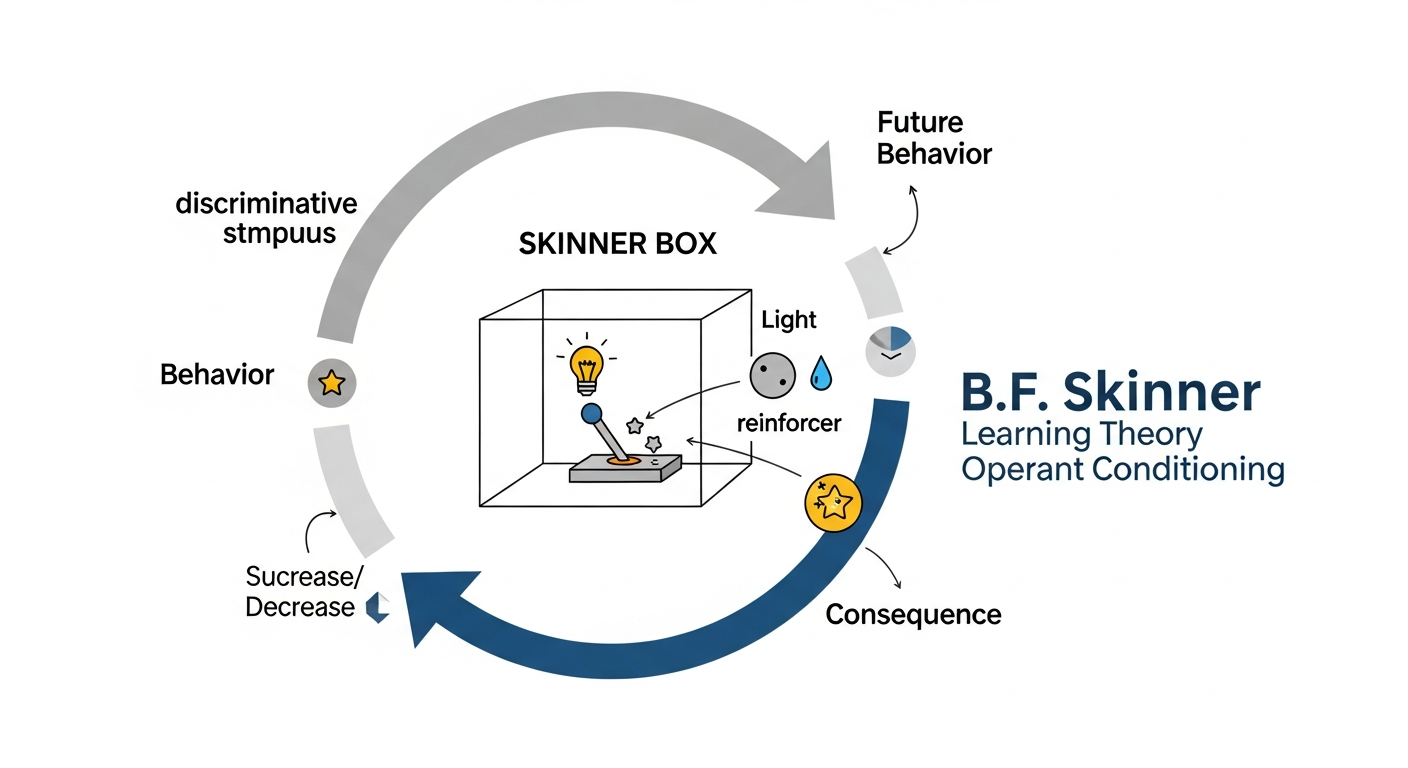
Burrhus Frederic Skinner, a prominent psychologist of the 20th century, revolutionized our understanding of learning through his theory of operant conditioning. Unlike classical conditioning, which focuses on involuntary responses, operant conditioning posits that learning occurs through rewards and punishments for behavior. Essentially, an individual "operates" on their environment, and the consequences of their actions determine the likelihood of those actions being repeated.
- Reinforcement: This is the cornerstone. Reinforcement increases the likelihood of a behavior recurring.
- Positive Reinforcement: Adding something desirable (e.g., praise, a bonus, recognition) after a desired behavior.
- Negative Reinforcement: Removing something undesirable (e.g., an annoying task, a threat) after a desired behavior.
- Punishment: This aims to decrease the likelihood of a behavior recurring.
- Positive Punishment: Adding something undesirable (e.g., a reprimand, a fine) after an undesired behavior.
- Negative Punishment: Removing something desirable (e.g., privileges, access) after an undesired behavior.
- Shaping: A technique where successive approximations of a target behavior are reinforced. This is crucial for teaching complex skills by breaking them into smaller, manageable steps.
- Extinction: The weakening and eventual disappearance of a learned behavior when it is no longer reinforced.
For L&D professionals, understanding these core tenets provides a powerful lens through which to analyze and design training that not only imparts knowledge but actively shapes desired employee behaviors. The objective isn't just knowing, but doing.
Skinner's Theory in Modern L&D Strategy
While Skinner's experiments often involved pigeons and rats, the principles of operant conditioning translate remarkably well to human learning and behavior change in corporate settings. When designing effective training for sales teams, compliance officers, or healthcare providers, these theories guide the structure of engagement and feedback.
Key Principles for Engaging eLearning Design
- Immediate Feedback and Reinforcement: The faster the feedback, the stronger the learning. In eLearning, this means instant gratification for correct answers or constructive guidance for mistakes. This aligns perfectly with the principles of positive reinforcement. Modern Microlearning LMS platforms excel at delivering bite-sized content with integrated, immediate feedback loops, ensuring learners receive consistent reinforcement.
- Shaping Complex Behaviors: Compliance training in finance or intricate machinery operation in oil and gas often requires mastering a sequence of steps. By using shaping, training can introduce concepts incrementally, reinforcing each small success before moving to the next. This modular approach is a hallmark of effective learning management system design.
- Variable Reinforcement Schedules: While continuous reinforcement is good for initial learning, variable reinforcement (where rewards are given unpredictably) leads to more persistent behavior. Think of the unpredictable rewards in a Gamified LMS – points, badges, leaderboards – which keep learners engaged and motivated over time, preventing extinction of desired learning behaviors.
- Clear Antecedents and Consequences: Training should clearly define what behavior is expected (antecedent), what the behavior is, and what the consequences (reinforcement or correction) will be. This clarity is vital in industries like healthcare or pharma, where adherence to protocol is non-negotiable.
AI's Role in Optimizing Skinnerian Learning Experiences
The advent of artificial intelligence offers unprecedented opportunities to implement Skinner's principles with greater precision and personalization. Intelligent systems can analyze learner behavior, adapt content, and deliver highly specific reinforcement, transforming the efficacy of enterprise learning management.
How can intelligent systems personalize feedback and content delivery based on individual learner behavior?
Artificial intelligence can act as a sophisticated "shaping" agent, continuously assessing a learner's performance and adjusting the difficulty, pace, and type of content presented. By tracking engagement, correct answers, and common errors, AI-driven platforms can provide hyper-personalized positive reinforcement or gentle corrective feedback precisely when needed. This ensures each learner receives the optimal stimulus to progress, making the learning journey highly efficient. This capability is at the heart of Adaptive Learning, tailoring the experience to individual needs and maximizing retention.
Where are the most impactful deployments of behaviorist learning frameworks supported by advanced technology being seen in global compliance training?
In heavily regulated sectors such as banking, insurance, and pharma, the application of Skinnerian principles via advanced technology is proving invaluable. Organizations are leveraging sophisticated learning management software to create risk-averse cultures. These systems provide simulations and scenarios where incorrect actions lead to immediate, simulated negative consequences, while correct actions are instantly reinforced. This method is particularly effective for high-stakes Risk-focused Training, embedding compliant behaviors through repeated, reinforced practice in a safe environment. Global companies can scale these programs, ensuring consistent behavior across diverse regions.
What practical steps can L&D leaders take to integrate these proven behavioral learning methods with cutting-edge authoring tools?
L&D leaders should prioritize platforms that combine robust content authoring capabilities with behavioral analytics. Start by identifying specific behaviors you want to reinforce or extinguish within your workforce, whether it's sales closing techniques or safety protocols in mining. Then, utilize an AI Powered Authoring Tool to design scenarios, quizzes, and interactive modules that provide immediate, context-specific feedback. Ensure the learning content management system allows for detailed tracking of learner responses, enabling iterative improvements to the training design. Emphasize simulation-based learning where consequences are clear and immediate, replicating real-world scenarios for optimal behavioral shaping. Choosing a flexible cloud based learning management system facilitates this integration and scalability.
Leveraging Modern Learning Platforms for Behavioral Impact
A sophisticated MaxLearn LMS is more than just a content delivery system; it's an environment designed to foster and reinforce desired behaviors. By integrating Skinner's principles, these platforms can transform training from a passive information dump into an active, engaging, and highly effective behavior-shaping engine.
- Structured Reinforcement: Points, badges, leaderboards, and immediate progress indicators in a Gamified LMS serve as powerful positive reinforcers, encouraging continued engagement and completion.
- Personalized Learning Paths: An advanced learning management software allows for tailored content delivery based on performance, effectively "shaping" individual learners towards mastery by reinforcing correct responses and providing targeted remediation.
- Analytics for Behavioral Insights: Modern learning management solutions provide data on completion rates, proficiency scores, time on task, and error patterns. This data is invaluable for L&D leaders to understand which behaviors are being reinforced effectively and where interventions are needed, allowing for continuous optimization of the LCMS content.
- Accessibility and Consistency: A robust enterprise learning management system ensures that consistent behavioral reinforcement strategies can be deployed across a diverse and geographically dispersed workforce, crucial for industries like retail or hospitality.
Conclusion
B.F. Skinner's learning theory, far from being an outdated concept, remains a powerful framework for designing highly effective corporate training. By understanding and deliberately applying principles of reinforcement, punishment, and shaping, L&D leaders can create eLearning experiences that don't just transfer knowledge but actively cultivate the behaviors essential for organizational success. Coupled with the analytical and adaptive capabilities of modern AI and advanced LMS platforms, Skinner's insights provide a roadmap for building a workforce that consistently performs at its best. Embrace these timeless principles to shape the future of learning in your organization.
.jpg)


