

Mastering Performance: How Operant Conditioning Drives eLearning Success for L&D Leaders
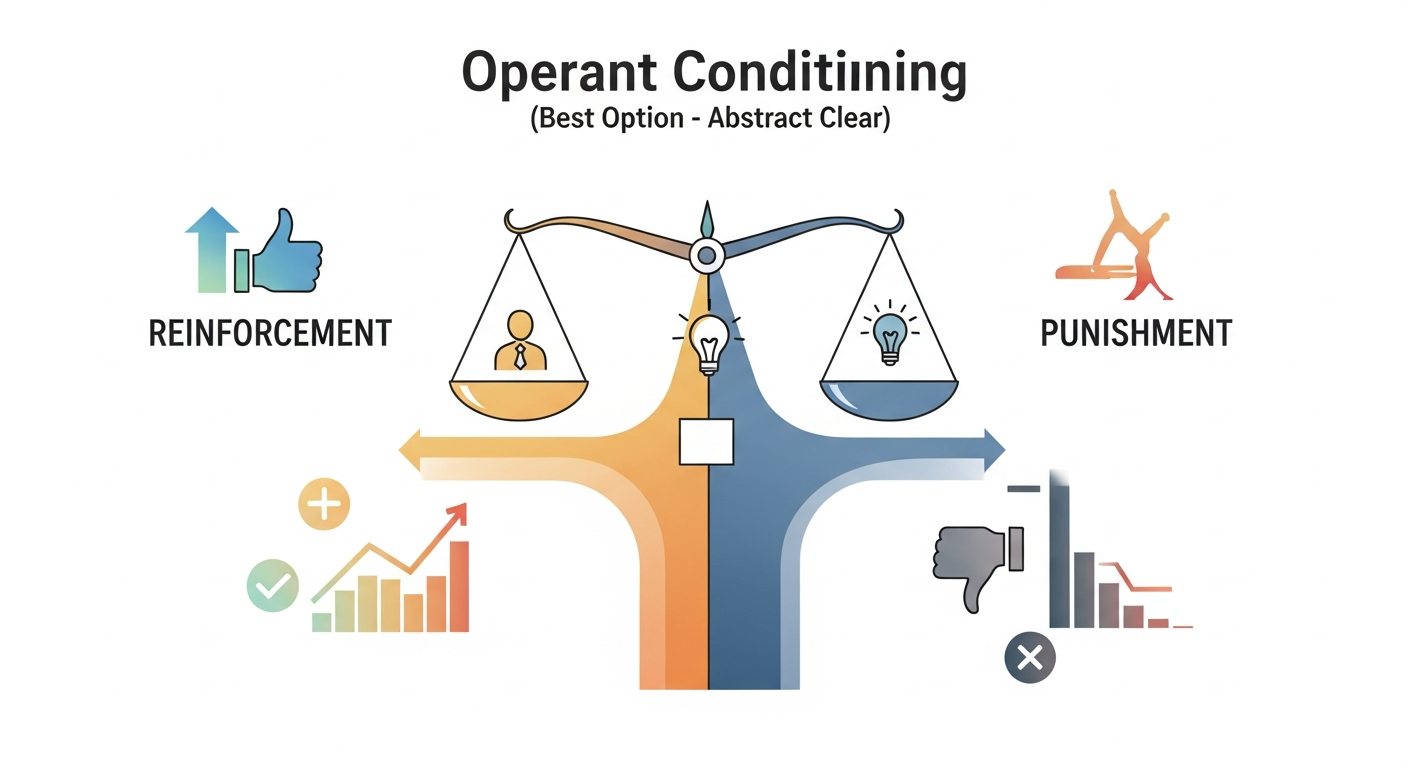
As leaders in Learning & Development (L&D), you are constantly seeking innovative strategies to elevate employee performance, ensure compliance, and foster a culture of continuous improvement. The science of human behavior offers powerful insights into how we learn and adapt. At the heart of this understanding lies operant conditioning, a psychological framework that explains how consequences shape voluntary behavior. By strategically applying its principles – reinforcement and punishment – L&D professionals can engineer more effective, engaging, and impactful learning experiences across diverse industries from finance to healthcare, and retail to oil and gas.
The Pillars of Performance: Reinforcement Explained
Reinforcement is the cornerstone of behavior modification, designed to increase the likelihood of a desired behavior. In the L&D context, understanding and applying reinforcement can significantly boost learner engagement, retention, and application of new skills.
Positive Reinforcement: Adding Value to Desired Actions
Positive reinforcement involves presenting a desirable stimulus after a behavior, making that behavior more likely to recur. Think of it as rewarding good performance. For your teams, this can manifest in various ways:
- Recognition: Acknowledging employees who consistently complete compliance training modules on time or achieve high scores in skill assessments.
- Achievement Badges/Certificates: Gamified elements within a Gamified LMS, such as digital badges for mastering a new sales technique or completing a complex technical course, provide immediate gratification and a sense of accomplishment.
- Promotions/Increased Responsibility: For managers demonstrating leadership competencies acquired through a leadership development program, a promotion serves as a powerful positive reinforcer.
- Access to Exclusive Content: Granting learners who excel in foundational courses access to advanced or specialized Microlearning LMS modules.
In a financial services firm, for instance, a sales manager who consistently uses newly learned negotiation tactics to close bigger deals could be publicly recognized in team meetings or given preferential access to high-value client accounts. This reinforces the desired behavior and motivates others.
Negative Reinforcement: Removing Obstacles to Encourage Learning
Often misunderstood, negative reinforcement is NOT punishment. Instead, it involves removing an aversive (unpleasant) stimulus when a desired behavior is performed, thereby increasing the likelihood of that behavior. The goal is to escape or avoid the unpleasant situation.
- Streamlined Processes: Automating repetitive data entry tasks for employees who complete an efficiency-focused training module. The removal of the tedious task reinforces the adoption of the new, efficient process.
- Waiver of Redundant Training: In a highly regulated industry like pharmaceuticals, if an employee consistently demonstrates mastery of a subject through performance assessments, they might be exempted from certain introductory refresher courses, allowing them to focus on more advanced or novel training.
- Proactive Compliance: Implementing mandatory Risk-focused Training that, when completed, reduces the likelihood of costly errors or audit flags, thereby removing the "aversive stimulus" of potential penalties or reputational damage.
Consider a retail environment: Employees who demonstrate proficiency in a new inventory management system through a concise learning management software module might be excused from tedious manual inventory checks, freeing up their time for customer engagement—a more rewarding task.
Navigating the Disincentives: Punishment in Training
Punishment aims to decrease the likelihood of an undesired behavior. While often effective, its application in L&D requires careful consideration and an ethical approach, focusing on corrective measures rather than punitive ones.
Positive Punishment: Adding Consequences for Undesired Actions
Positive punishment involves presenting an aversive stimulus after an undesired behavior, making that behavior less likely to recur. In L&D, this is rarely about physical discomfort, but rather about presenting an unwanted consequence:
- Corrective Feedback: Immediate, constructive feedback on an incorrect answer or procedure within an interactive simulation. The "aversive stimulus" is the realization of the error and the need to re-engage with the content.
- Mandatory Remedial Training: An employee failing a critical safety assessment in mining might be required to re-take the module and pass a higher-stakes evaluation before resuming duties. The extra time and effort spent is the added consequence.
The key here is that the added consequence should directly relate to the behavior and aim for correction, not humiliation. An Adaptive Learning system might present additional practice questions when an error is made, a mild form of positive punishment that drives mastery.
Negative Punishment: Removing Privileges for Undesired Actions
Negative punishment involves removing a desirable stimulus after an undesired behavior, making that behavior less likely to recur.
- Loss of Advanced Training Access: If an employee repeatedly fails to complete prerequisite courses for specialized training, access to those coveted advanced programs might be temporarily revoked.
- Reduced Project Autonomy: A project manager consistently missing deadlines after a project management training course might temporarily have less autonomy on future projects until they demonstrate improved adherence to timelines.
In healthcare, an administrator repeatedly making data entry errors after CRM training might temporarily lose access to direct data input, instead requiring supervisor review for all entries—removing the privilege of independent work until accuracy improves.
Applying Operant Conditioning in Modern eLearning
The principles of operant conditioning are not just theoretical; they are fundamentally woven into the fabric of effective modern eLearning solutions. A robust AI Powered Authoring Tool, for instance, can be designed to automatically provide positive reinforcement through immediate feedback or adapt content based on performance, which acts as a form of negative reinforcement (removing irrelevant content once mastery is shown). Learning platforms, including any comprehensive learning management system, leverage these principles to create compelling learning journeys.
- Personalized Learning Paths: An Adaptive Learning platform can tailor content presentation based on learner responses, ensuring engagement by keeping the challenge level optimal (negative reinforcement by removing overly easy or difficult content).
- Gamification: Points, leaderboards, badges, and progress bars are all forms of positive reinforcement, making learning intrinsically more rewarding. This is a core feature of a Gamified LMS.
- Immediate Feedback: Providing instant feedback on quizzes and exercises reinforces correct answers and corrects errors efficiently, acting as a mild positive punishment for incorrect responses.
- Scenario-Based Training: Simulating real-world consequences for decisions in sectors like banking or oil and gas provides powerful learning experiences, where the "punishment" is seeing the negative outcome of a poor choice in a safe environment.
AI's Role in Shaping Learning Behaviors
The advent of artificial intelligence revolutionizes how L&D can apply behavioral psychology. AI's ability to process vast amounts of data and personalize interactions takes operant conditioning to an unprecedented level.
Q: How can AI enhance the application of behavioral psychology in training?
AI's analytical capabilities allow for highly nuanced behavioral targeting. By observing learner interactions with an LMS, AI can identify patterns, predict engagement levels, and dynamically adjust learning paths. For example, it can determine the optimal frequency and type of positive reinforcement needed for an individual learner to master a specific compliance topic, or identify if an employee consistently struggles with a particular sales technique and then recommend specific remedial microlearning modules. This precise, data-driven approach ensures that interventions are timely and effective.
Q: Can AI help tailor learning experiences based on an individual's behavioral patterns?
Absolutely. Modern cloud based learning management system solutions powered by AI can create truly individualized learning experiences. If an AI detects a learner disengaging from a complex module, it might switch to a more interactive format or offer a practical application scenario to re-engage them, leveraging negative reinforcement by removing the 'boring' aspect. Conversely, if a learner is excelling, the AI can fast-track them to more challenging content, providing positive reinforcement through advanced opportunities. This ensures optimal pacing and content delivery, maximizing the impact of every learning interaction.
Q: How does AI assist in creating effective feedback loops for skill development?
AI excels at generating continuous, intelligent feedback. Through natural language processing and performance analytics, an AI Powered Authoring Tool can provide immediate, contextual feedback on open-ended responses, coding exercises, or simulated customer interactions. This instant insight acts as a powerful reinforcer for correct actions and a precise corrective (positive punishment) for errors. Furthermore, AI can aggregate feedback across an organization, identifying systemic knowledge gaps or areas needing improved training design, allowing L&D to refine their learning content management system strategies continuously.
The MaxLearn Advantage: Intelligent Learning Solutions
Implementing the sophisticated principles of operant conditioning at scale requires a robust and intelligent learning management platform. MaxLearn offers a comprehensive MaxLearn LMS that empowers L&D leaders to harness these behavioral insights. Whether you're a director in a large enterprise looking for an enterprise learning management system or a manager needing efficient learning management solutions for your team, MaxLearn provides the tools.
Our platform integrates features like Microlearning LMS for just-in-time reinforcement, Gamified LMS for sustained engagement, and AI-driven personalization that supports Adaptive Learning. This ensures that your training initiatives—from critical compliance training in banking to complex technical skills in oil and gas—are not just consumed but truly internalized and applied. With MaxLearn, your LCMS becomes a strategic asset, actively shaping employee behavior towards desired organizational outcomes.
Conclusion: Engineering a High-Performing Workforce
Operant conditioning offers L&D leaders a potent framework for designing training programs that move beyond mere information dissemination to genuine behavior change. By strategically deploying positive and negative reinforcement, and carefully considered forms of punishment, you can cultivate a learning environment that motivates, corrects, and ultimately builds a high-performing workforce. Leveraging advanced lms learning management system platforms like MaxLearn, with their AI-powered capabilities, allows for the precise and ethical application of these psychological principles, transforming your L&D function into a true driver of business success across all industries.
.jpg)


