

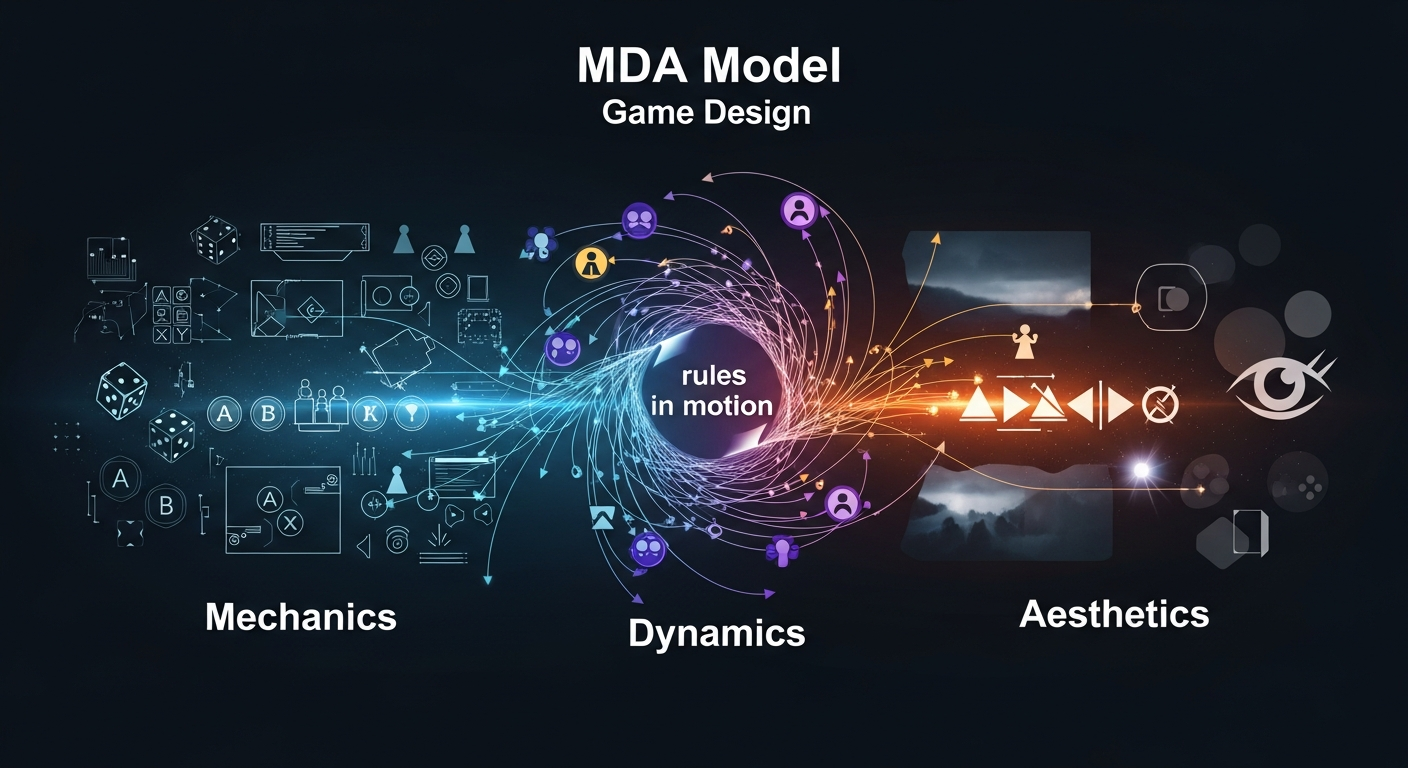
Unlocking Engaging eLearning: The MDA Model for Transformative Game Design in L&D
In today's rapidly evolving corporate landscape, the effectiveness of learning and development (L&D) initiatives is more critical than ever. Organizations across diverse sectors – from compliance and banking to healthcare and oil & gas – face the challenge of not just imparting knowledge, but truly embedding skills and fostering behavioral change. Traditional training methods often fall short in capturing and sustaining learner attention. This is where the MDA Model for game design emerges as a powerful framework, offering L&D leaders a systematic approach to crafting profoundly engaging, effective, and memorable learning experiences.
The MDA (Mechanics, Dynamics, Aesthetics) model, originally conceived for video game design, provides a lens through which to analyze and design interactive systems. It offers a structured way to bridge the gap between a designer's intentions and a player's experience. For L&D professionals, adapting this model means moving beyond superficial gamification to engineer deeply immersive and impactful learning journeys.
Let's dissect the MDA framework and explore its profound implications for modern eLearning.
Understanding the Core Components of the MDA Model
1. Mechanics: The Building Blocks of Learning
Mechanics are the foundational elements of any game or interactive system. They are the rules, actions, and components that define how the system works. In an L&D context, mechanics translate to:
- Rules of engagement: How learners interact with the content (e.g., click, drag-and-drop, multiple choice, simulation choices).
- Goal setting: Clear objectives for each learning module or activity.
- Feedback systems: Immediate validation or correction of learner input.
- Scoring and progression: Points, levels, badges, leaderboards that track progress and achievement.
- Resource management: Scenarios where learners must allocate time, budget, or personnel to solve a problem.
- Constraints: Limitations on choices or resources that encourage critical thinking.
For instance, in compliance training, mechanics might include a quiz with a limited number of attempts, a branching scenario where incorrect choices lead to specific consequences, or a timer for a decision-making exercise. The more thoughtfully designed the mechanics, the clearer the learner's path and the more predictable their interaction with the content.
2. Dynamics: The Emergent Behavior of Learning
Dynamics are the emergent behaviors that arise from the mechanics when a learner interacts with the system. They represent the "gameplay" or the actual experience of learning as it unfolds. Dynamics are about how the rules come alive and influence learner behavior and interaction. In L&D, dynamics manifest as:
- Problem-solving strategies: How learners approach complex challenges within the training.
- Collaboration or competition: The way learners interact with peers, either cooperatively or competitively, based on the mechanics.
- Decision-making processes: The chain of choices learners make in response to scenarios.
- Risk assessment: How learners weigh potential outcomes of their actions, especially in Risk-focused Training.
- Exploration and discovery: The learner's journey through content, uncovering new information or paths.
- Emotional responses: Frustration, triumph, curiosity, satisfaction driven by the interaction.
Consider a sales training simulation where mechanics include role-playing with AI-driven customer avatars and various product options. The dynamics would be the salesperson's evolving strategy, their adaptation to customer objections, and their ability to close the deal, all influenced by the immediate feedback from the system. This active engagement goes far beyond passive content consumption.
3. Aesthetics: The Emotional Core of Learning
Aesthetics are the emotional responses and overall experiential qualities evoked in the learner by the dynamics of the game. They are the feelings and sensations that make a learning experience compelling and memorable. In L&D, aesthetics are crucial for motivation and sustained engagement:
- Challenge: The feeling of overcoming obstacles and mastering new skills.
- Discovery: The joy of uncovering new information or insights.
- Narrative: The feeling of being part of a compelling story or journey.
- Fellowship: The sense of community or teamwork in collaborative learning.
- Expression: The ability to personalize choices or demonstrate unique approaches.
- Fantasy: Escapism or immersion into a different role or scenario.
- Sensation: Visually and aurally pleasing interfaces that enhance immersion.
Imagine a finance training module designed with sophisticated visuals and a compelling storyline about managing an investment portfolio (fantasy/narrative). The mechanics might involve allocating virtual funds, and the dynamics would be the portfolio's performance over time. The aesthetic would be the feeling of empowerment and financial acumen the learner gains, making the learning deeply personal and impactful.
Applying MDA to L&D: From Theory to Transformative Training
For L&D professionals, the MDA model is not just an analytical tool; it's a design blueprint. It encourages a shift in perspective:
- Start with Aesthetics (Desired Experience): What feelings or emotional states do you want your learners to experience? Do you want them to feel challenged, competent, empathetic, or curious?
- Design Dynamics (Emergent Behavior): What behaviors will produce those aesthetics? How will learners interact with the content to evoke those feelings?
- Implement Mechanics (Specific Rules): What specific rules, feedback systems, or interactions will drive those desired behaviors and ultimately lead to the intended emotional experience and learning outcomes?
This "Aesthetics-first" approach ensures that the training is designed with the learner's emotional journey and desired outcomes at its core, rather than just delivering information. For sales professionals, for example, the aesthetic might be "mastery" and "confidence," leading to dynamics of effective objection handling and successful closing, built upon mechanics of realistic customer simulations and performance feedback.
Intelligent Systems and the Future of MDA in L&D
The integration of artificial intelligence (AI) further amplifies the power of the MDA model in L&D. Modern platforms, including a Microlearning LMS and especially a Gamified LMS, are increasingly leveraging AI to enhance each component of the MDA framework.
Consider an organization aiming to maximize learner retention and active participation. How might intelligent analytics guide the design of activities that resonate deeply with individual learning styles and preferences? An AI Powered Authoring Tool can analyze learner data to dynamically adjust mechanics – increasing challenge for advanced learners or providing more scaffolding for those struggling. This leads to more responsive dynamics, where the emergent behavior of learners is continuously optimized for engagement. The resulting aesthetic is one of personalized mastery and sustained motivation.
In a scenario where personalized skill development is paramount, what methods can intelligent systems employ to track individual progress and adapt content to ensure optimal learning outcomes for each employee? AI can facilitate true Adaptive Learning. By observing learner dynamics, an AI system can modify mechanics in real-time – changing the difficulty of scenarios, offering alternative explanations, or recommending supplementary modules. This ensures that the learning experience always feels tailored, challenging enough to be engaging but not so difficult as to be frustrating, thereby fostering an aesthetic of competence and achievement.
How can training programs be intelligently tailored for a diverse, geographically dispersed workforce, ensuring relevance and accessibility across different regions? AI-driven platforms can analyze demographic and regional data to customize content, language, and cultural references within the learning mechanics. This ensures that the dynamics of interaction feel natural and relevant to each learner, cultivating an aesthetic of inclusivity and cultural understanding, regardless of their location.
Conclusion
For L&D VPs, Directors, and Managers across industries like banking, healthcare, retail, and manufacturing, the MDA model offers a strategic roadmap for designing eLearning that moves beyond mere information dissemination. By consciously designing for the desired emotional experience (Aesthetics), fostering specific behaviors and interactions (Dynamics), and meticulously crafting the rules and systems (Mechanics), organizations can create learning interventions that are not only effective but genuinely loved by their employees.
Embracing the MDA model, especially when augmented by intelligent technologies, positions L&D as a strategic driver of engagement, skill acquisition, and ultimately, business success. It's time to play a different game – one where learning is an adventure, and mastery is the ultimate reward.
.jpg)


