

Elevating Corporate Learning: Harnessing MDA from Game Design
In the dynamic world of corporate learning and development, the quest for truly impactful training solutions is unending. As VPs, Directors, and Managers of L&D, you’re constantly seeking innovative approaches to boost engagement, improve retention, and drive measurable behavioral change across your organizations. While terms like "gamification" often surface, many initiatives fall short, merely layering points and badges onto uninspired content. The real power lies deeper, in a framework borrowed directly from the heart of successful video game creation: the MDA framework.
The Mechanics, Dynamics, Aesthetics (MDA) framework offers a robust lens through which to analyze, design, and optimize learning experiences. Originating from the academic pursuit of understanding why games are engaging, MDA provides a structured way to move beyond superficial gamification to create genuinely immersive and effective educational journeys. For industries spanning Compliance, Sales, Banking, Finance, Insurance, Retail, Pharma, Healthcare, Hospitality, Oil and Gas, and Mining, this approach is not just beneficial—it's transformative.
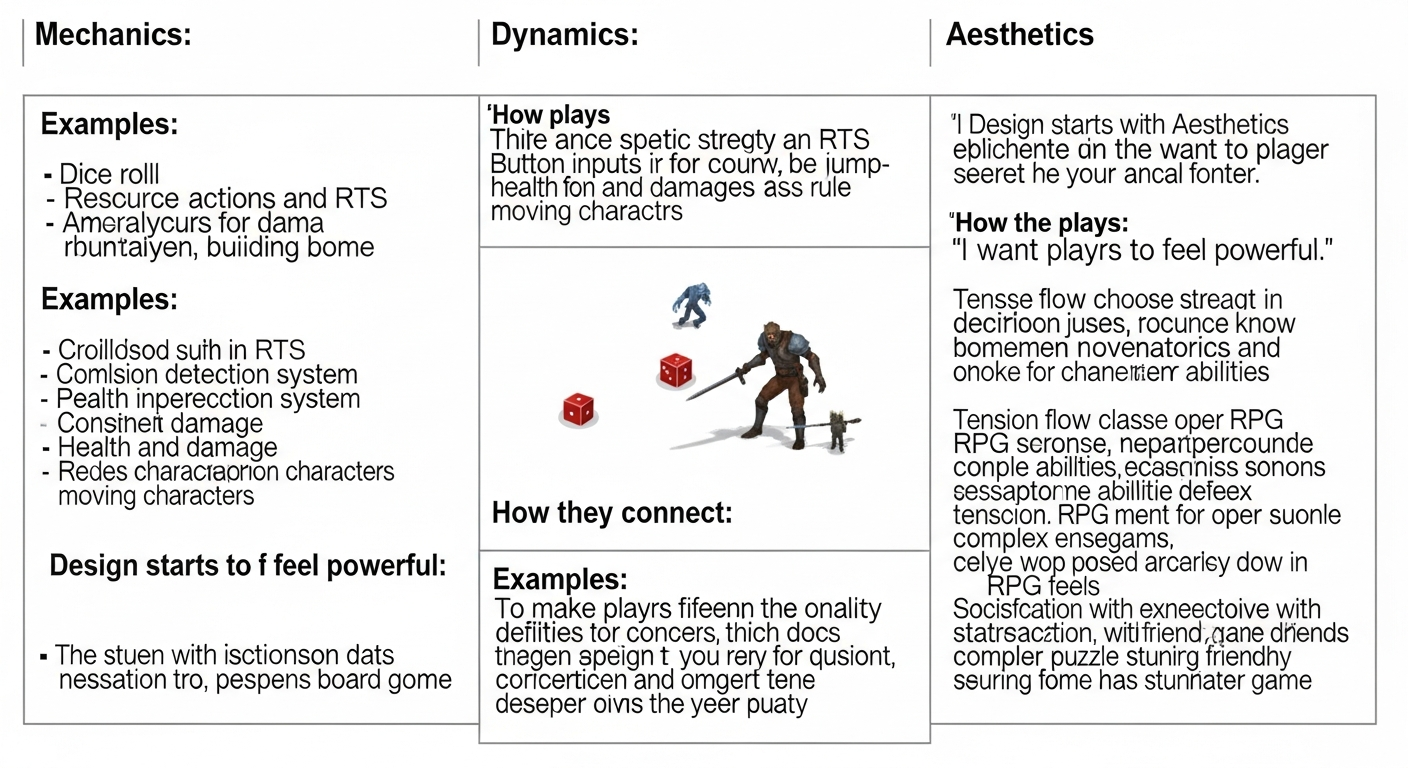
Understanding the MDA Framework in L&D
At its core, MDA breaks down the player (or learner) experience into three interconnected components:
1. Mechanics: The Rules of Engagement
Mechanics are the foundational elements of any system – the actions, components, and rules that govern play. In a game, these might include movement controls, combat systems, inventory management, or quest objectives. In the context of corporate eLearning, Mechanics translate to:
- The structure of your courses: modules, chapters, lessons.
- Interactive elements: quizzes, drag-and-drop exercises, simulations, branching scenarios.
- Progression systems: points, badges, leaderboards, levels, unlockable content, progress bars.
- Feedback mechanisms: immediate correct/incorrect answers, hints, detailed explanations.
- Communication tools: forums, chat functions for peer interaction.
These are the tangible building blocks your learners interact with. A well-designed Microlearning LMS, for instance, provides the technical mechanics for delivering content in digestible, engaging formats.
2. Dynamics: The Emergent Experience
Dynamics emerge from the interaction between learners and the Mechanics. They are not explicitly designed but rather the behaviors, strategies, and patterns that unfold as learners engage with the system. Consider how different learners approach a problem-solving simulation, or how a competitive leaderboard encourages certain behaviors. In eLearning, Dynamics manifest as:
- Learner engagement levels: how actively learners participate and explore.
- Problem-solving approaches: the strategies learners employ to overcome challenges.
- Collaboration or competition: how learners interact with peers based on system rules.
- Emotional responses to challenges: persistence in the face of difficulty, satisfaction from success.
- Adaptation to content: how learners adjust their pace or focus based on immediate feedback.
If Mechanics are the rules of chess, Dynamics are the unfolding strategies and interactions of the players on the board.
3. Aesthetics: The Emotional Core
Aesthetics represent the emotional and experiential responses evoked in the learner by the Dynamics. This is the subjective "feel" of the learning experience – why a learner finds it compelling, frustrating, challenging, or empowering. MDA identifies several common aesthetic appeals:
- Sense of Challenge: Overcoming obstacles, testing limits (e.g., complex compliance scenarios).
- Fellowship: Social interaction, collaboration, community building (e.g., team-based sales training).
- Discovery: Exploration, uncovering new information, curiosity (e.g., simulated product features).
- Expression: Self-actualization, creativity, customization (e.g., designing marketing strategies).
- Fantasy: Escapism, imagination, role-playing (e.g., simulating patient interactions in healthcare).
- Narrative: Storytelling, unfolding drama (e.g., ethical dilemmas in finance).
- Sensation: Visual, auditory, haptic pleasure (e.g., high-fidelity simulations).
- Submission: Passive entertainment, relaxation (less common in active learning, but can apply to introductory content).
The Aesthetics are the ultimate goal – the desired emotional state and learning outcome you want to cultivate in your audience. A truly effective Gamified LMS aims to evoke specific aesthetics, not just apply game elements.
Why MDA Matters for L&D Leaders
For L&D professionals, understanding MDA means moving beyond simply "gamifying" content. It means intentionally designing for experience:
- Strategic Design: Instead of asking "How can we add points?", you ask "What emotional experience do we want our learners to have (Aesthetics)? What emergent behaviors will lead to that (Dynamics)? What rules and tools do we need to put in place to enable those behaviors (Mechanics)?"
- Deeper Engagement: When training evokes specific aesthetics like challenge, discovery, or mastery, learners are intrinsically motivated, leading to higher engagement and better retention.
- Targeted Impact: You can tailor the learning experience to specific industry needs. For example, in Banking, Finance, and Insurance, the aesthetic of "challenge" and "narrative" can transform complex regulatory training into compelling scenarios. In Oil & Gas or Mining, "sensation" and "fantasy" through high-fidelity simulations can foster vigilance and Risk-focused Training.
- Measurable Outcomes: By focusing on desired aesthetics and their underlying dynamics, L&D can better define and measure the impact of training on real-world performance.
Implementing MDA: A Top-Down Approach
The most effective way to apply MDA in eLearning design is to work backward:
- Start with Aesthetics: What emotional and cognitive experience do you want your learners to have? Do you want them to feel a sense of mastery over complex procedures in Healthcare, or urgency and responsibility in Pharma compliance? What specific knowledge and skills should they gain, and how should they feel about that process?
- Design for Dynamics: Once the desired aesthetic is clear, consider what learner behaviors and interactions will lead to that feeling. If "mastery" is the goal, dynamics might involve iterative practice, immediate corrective feedback, and progressively difficult challenges. If "fellowship" is key for Sales teams, dynamics would involve collaborative problem-solving and peer-to-peer feedback. This is where Adaptive Learning shines, allowing dynamics to shift based on individual learner progress.
- Build the Mechanics: Finally, select and implement the specific rules, tools, and components that will enable those dynamics. This could involve crafting detailed branching scenarios, designing a sophisticated point system tied to performance, integrating a virtual mentor, or leveraging the robust features of an AI Powered Authoring Tool to generate relevant content and assessments.
AI and the Evolution of MDA in Learning
The advent of artificial intelligence is supercharging the application of MDA in corporate learning. AI can significantly enhance each component:
How can artificial intelligence personalize learning journeys for corporate employees?
AI excels at analyzing individual learner data—performance, preferences, and progress. This allows it to dynamically adjust the Mechanics of a course, such as content difficulty, challenge type, or even the order of topics. By doing so, AI creates highly personalized Dynamics, where each learner engages with content tailored to their needs. This fosters powerful Aesthetics of mastery, challenge, and individual discovery, making the learning process far more engaging and effective for diverse employee groups across industries like Retail and Hospitality.
What role does advanced technology play in making compliance training more engaging and effective?
Advanced technology, including AI, can transform traditionally dry compliance training into highly interactive and immersive experiences. It powers sophisticated simulations and realistic scenarios (Mechanics) that mimic real-world situations in Banking, Finance, or Insurance. These simulations create powerful Dynamics where learners must apply knowledge under pressure, make critical decisions, and experience the consequences. The resulting Aesthetics of challenge, narrative, and even urgency significantly improve knowledge retention and ensure learners truly grasp the gravity and nuances of regulations, directly supporting Risk-focused Training.
In what ways can intelligent systems help L&D professionals design more impactful microlearning content?
Intelligent systems can revolutionize the content creation process. An AI Powered Authoring Tool can assist L&D professionals by suggesting optimal Mechanics for specific learning outcomes, such as quiz formats, interactive elements, or even narrative structures that promote engagement. By analyzing vast amounts of data, AI can predict which Dynamics will emerge from certain content designs, helping creators to fine-tune the learning flow. This ensures that microlearning modules are not only concise but also strategically designed to evoke specific Aesthetics like a sense of accomplishment or quick insight, making them highly impactful for sales training, product knowledge, or safety protocols in any industry.
Conclusion: The Future of Learning is Designed
The MDA framework is more than just an academic concept; it's a practical blueprint for L&D leaders aiming to revolutionize corporate learning. By intentionally designing for the learner's emotional experience (Aesthetics), understanding the emergent behaviors (Dynamics), and strategically implementing the foundational rules and tools (Mechanics), you can move beyond mere compliance checklists to create truly transformative training.
Embracing MDA, particularly when augmented by intelligent systems, positions your L&D function at the forefront of educational innovation. It allows you to craft learning experiences that resonate deeply with employees, driving genuine skill acquisition, behavioral change, and ultimately, organizational success across all segments, from Pharma to Mining. The future of corporate learning isn't just about what's taught, but how it feels to learn it.
.jpg)


