

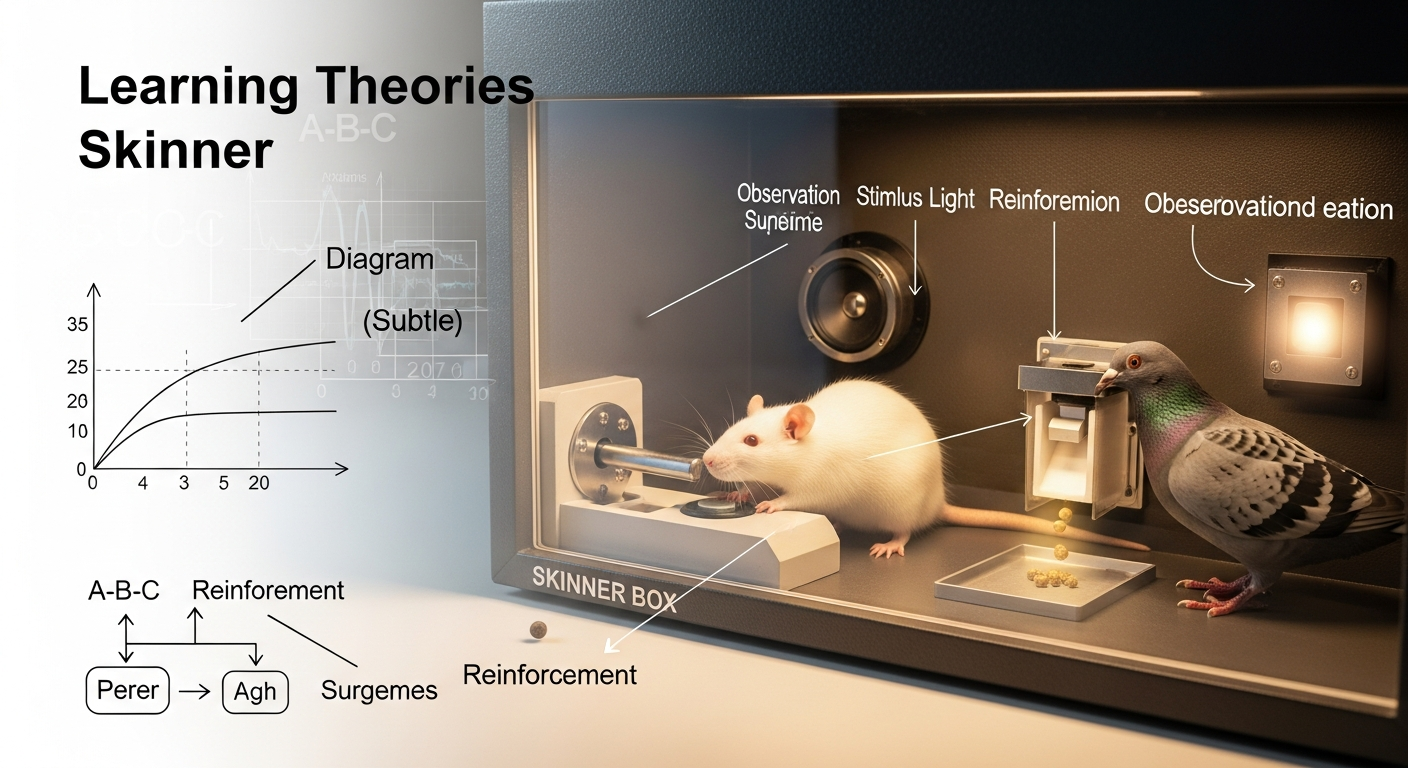
Mastering Modern L&D: How Skinner's Learning Theories Drive Digital Transformation
For Learning & Development (L&D) leaders navigating the complexities of modern corporate training, understanding the foundational principles of how humans learn is paramount. While innovative technologies and buzzwords often grab headlines, the bedrock of effective instruction remains rooted in timeless psychological theories. Among the most influential is the work of B.F. Skinner, whose principles of operant conditioning offer a powerful lens through which to design, deliver, and optimize today's digital learning experiences across industries ranging from Compliance and Sales to Banking, Healthcare, and beyond.
As Vice Presidents, Directors, and Managers of L&D, your mandate is clear: create training programs that not only educate but also instigate lasting behavioral change and measurable performance improvements. Skinner's theories, far from being relics of the past, provide actionable frameworks that, when integrated with cutting-edge eLearning strategies and artificial intelligence, can unlock unprecedented levels of engagement and efficacy.
The Core of Skinner's Operant Conditioning
B.F. Skinner's groundbreaking research revolutionized our understanding of behavior. Unlike classical conditioning, which focuses on involuntary responses, operant conditioning deals with voluntary behaviors and how they are strengthened or weakened by their consequences. At its heart are four key concepts:
Understanding Reinforcement and Punishment
- Positive Reinforcement: Introducing a desirable stimulus after a behavior to increase its likelihood of recurring. Think of an employee receiving praise or a bonus for exceeding sales targets. In eLearning, this could be immediate positive feedback, points, or badges for correct answers.
- Negative Reinforcement: Removing an undesirable stimulus after a behavior to increase its likelihood of recurring. For instance, a manager stops nagging an employee once a report is submitted. In training, this might involve removing a mandatory review module for learners who demonstrate mastery early.
- Positive Punishment: Introducing an undesirable stimulus after a behavior to decrease its likelihood of recurring. A verbal reprimand for failing to follow safety protocols. This is less ideal in L&D but can manifest as constructive, corrective feedback.
- Negative Punishment: Removing a desirable stimulus after a behavior to decrease its likelihood of recurring. Taking away privileges for consistently missing deadlines. Again, used cautiously in L&D, perhaps by removing access to advanced modules until prerequisite knowledge is demonstrated.
The Power of Reinforcement Schedules
Skinner also identified different schedules of reinforcement, which dictate how often and when reinforcement is provided. These schedules profoundly impact the persistence and rate of learned behaviors:
- Continuous Reinforcement: Reinforcing every correct response. Ideal for initial learning, quickly establishing a new behavior.
- Partial Reinforcement: Reinforcing only some responses. This leads to slower learning but much greater resistance to extinction. Key partial schedules include:
- Fixed-Ratio: Reinforcement after a fixed number of responses (e.g., getting a reward after completing 5 modules).
- Variable-Ratio: Reinforcement after an unpredictable number of responses (e.g., occasional unexpected positive feedback for strong performance). This is highly resistant to extinction and drives high response rates.
- Fixed-Interval: Reinforcement after a fixed amount of time (e.g., monthly performance reviews).
- Variable-Interval: Reinforcement after an unpredictable amount of time (e.g., spontaneous check-ins or unannounced spot bonuses).
Applying Skinner's Theories in Modern L&D
The beauty of Skinner's work lies in its practical applicability. For L&D professionals, these principles are not just academic; they are tools for engineering more effective learning environments and driving desired corporate behaviors.
Behavioral Shaping for Performance Improvement
Skinner's concept of "shaping" involves reinforcing successive approximations of a desired behavior. In a corporate setting, this means breaking down complex skills into smaller, manageable steps and reinforcing learners at each stage. For example, in Sales training, you might reinforce mastering product knowledge, then effective prospecting, then objection handling, before rewarding a full sales cycle completion.
- Compliance Training: Clear, immediate feedback on correct policy adherence, with positive reinforcement for demonstrating understanding of complex regulations, significantly reduces Risk-focused Training.
- Banking & Finance: Reinforcing ethical decision-making scenarios through simulations, providing points or progress markers for correct choices, can embed critical behaviors.
- Healthcare & Pharma: Training on new protocols or drug administration benefits from continuous reinforcement during practice, ensuring precise and safe procedures.
- Retail & Hospitality: Positive reinforcement for excellent customer service simulations or mastering new POS systems can translate directly into improved customer experience.
Skinner's Theories in the Digital Age: eLearning and AI Synergy
The advent of digital learning platforms has amplified the potential to apply Skinner's principles with unprecedented precision and scale. Modern Microlearning LMS and other advanced systems are perfectly positioned to leverage these insights.
Enhanced Feedback Loops and Gamification
Digital platforms allow for instant, targeted feedback, acting as immediate positive reinforcement. Learners receive confirmation of correct answers or guidance on errors right away, cementing learning more effectively than delayed feedback. This instantaneous reward system is fundamental to the success of Gamified LMS environments, where points, badges, leaderboards, and virtual rewards serve as powerful motivators rooted in Skinnerian principles.
Personalization and Microlearning
The modular nature of microlearning, delivering content in short, digestible bursts, naturally lends itself to frequent reinforcement. Each completed module or answered question can trigger a reward or progress update, keeping learners engaged and motivated. This approach aligns perfectly with shaping complex behaviors by reinforcing small, achievable steps.
AI and Skinner: A Powerful Synergy for L&D
Artificial intelligence is not just automating tasks; it's transforming how we understand and apply learning theories. When combined with Skinner's insights, AI can create highly personalized, adaptive, and effective training programs.
How can advanced computational intelligence enhance the application of Skinner's principles for individual learners?
Advanced computational intelligence excels at collecting and analyzing vast amounts of learner data. It can identify individual learning patterns, pinpoint specific knowledge gaps, and even predict where a learner might struggle. This allows an Adaptive Learning system to dynamically adjust the content difficulty, type of feedback, and frequency of reinforcement. For example, a system might provide more frequent positive reinforcement to a struggling learner, or introduce variable-ratio reinforcement schedules for those who are highly engaged, keeping motivation levels optimized for each individual.
What role does advanced computational intelligence play in crafting effective training modules based on behavioral psychology?
Advanced computational intelligence can significantly aid in the design and delivery of learning content. An AI Powered Authoring Tool can analyze learning objectives, target audience behaviors, and existing content to suggest optimal reinforcement strategies. It can help create scenarios that trigger specific responses, recommend appropriate feedback mechanisms, and even generate variations of questions to ensure a variable-ratio reinforcement schedule. This enables L&D teams to build modules that are not just informative but also scientifically structured to elicit and reinforce desired behaviors efficiently.
How can machine learning applications help in developing more targeted and impactful training, particularly in high-stakes environments like compliance or finance?
Machine learning excels at identifying trends and anomalies within large datasets. In high-stakes environments, machine learning can analyze incident reports, audit findings, and performance data to pinpoint areas where behavioral changes are critically needed. For example, it can identify specific compliance regulations frequently violated or financial procedures prone to error. This intelligence then allows L&D leaders to develop highly targeted training modules that address these specific behavioral shortcomings. By focusing reinforcement on the precise behaviors that mitigate risk or improve adherence to critical protocols, training becomes far more impactful and demonstrably reduces organizational exposure in sectors like Pharma, Oil and Gas, or Mining.
Benefits for L&D Leaders
For L&D VPs, Directors, and Managers, integrating Skinner's learning theories with modern eLearning and AI offers several compelling advantages:
- Measurable Outcomes: By focusing on observable behaviors and their consequences, training effectiveness becomes more quantifiable.
- Increased Engagement: Immediate feedback and strategic reinforcement keep learners motivated and invested.
- Sustainable Behavioral Change: Well-designed reinforcement schedules lead to long-lasting improvements in employee performance.
- Optimized Resource Allocation: AI-driven insights allow for more targeted and efficient training investments.
- Reduced Risk: In critical industries, consistent reinforcement of correct procedures significantly lowers the probability of errors and non-compliance.
Conclusion
B.F. Skinner's theories of operant conditioning remain profoundly relevant in shaping effective corporate learning. By understanding and strategically applying principles of reinforcement, L&D leaders can design programs that not only impart knowledge but actively cultivate desired behaviors, boost performance, and mitigate risk across all industries. When combined with the power of modern eLearning platforms and the intelligent capabilities of artificial intelligence, Skinner's timeless insights provide a robust framework for transforming L&D from a cost center into a strategic driver of organizational success.
.jpg)


