

Argyris Single And Double-Loop Learning: A Blueprint for Transformative L&D
In the dynamic landscape of modern business, where disruption is the norm and innovation is currency, the ability to learn and adapt is paramount. For Vice Presidents, Directors, and Senior Managers of Learning & Development, the challenge isn't just delivering training; it's cultivating a profound, resilient learning culture that drives sustained organizational growth. Central to this endeavor is Chris Argyris's foundational work on Single-Loop and Double-Loop Learning – a powerful framework that distinguishes between merely fixing problems and fundamentally rethinking the way we operate.
As L&D leaders in sectors ranging from Compliance, Sales, Banking, and Finance to Pharma, Healthcare, Hospitality, Oil and Gas, and Mining, you grapple daily with evolving regulations, market shifts, technological advancements, and the imperative for continuous skill development. Understanding and applying Argyris's model can transform your approach from reactive problem-solving to proactive, strategic evolution, particularly when augmented by sophisticated eLearning technologies.
Understanding Single-Loop Learning: The Efficiency Model
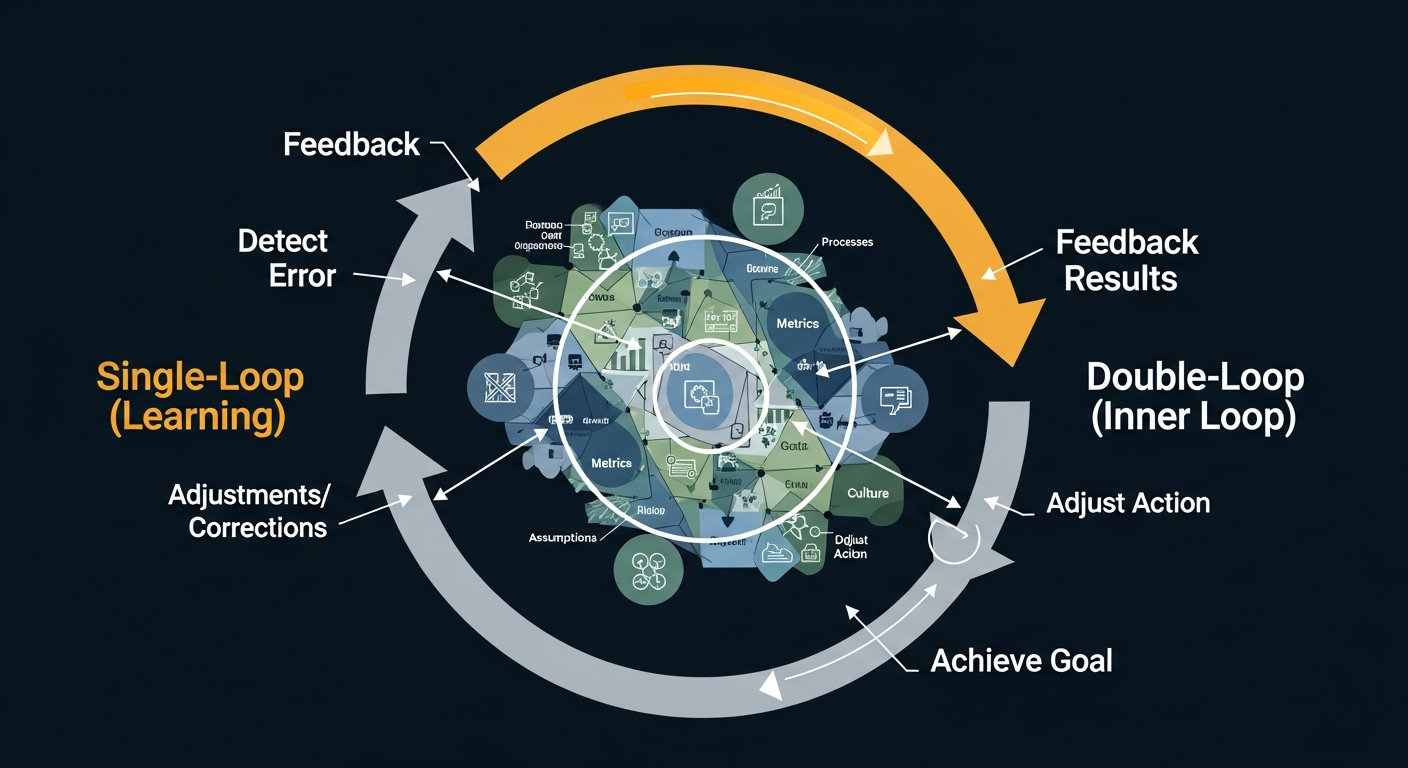
Single-loop learning is akin to a thermostat. When the room gets too cold, the thermostat registers the deviation from the set temperature and kicks on the heater. The system learns to maintain a specific condition without questioning the fundamental setting itself. In an organizational context, this means detecting and correcting errors to maintain existing goals, policies, and assumptions.
- Definition: Correcting errors or deviations from established norms and goals without questioning the underlying assumptions or policies.
- Focus: “Are we doing things right?”
- Characteristics:
- Reactive problem-solving.
- Focus on symptoms rather than root causes.
- Reinforces existing mental models and strategies.
- Often efficient for routine tasks and known problems.
- L&D Examples:
- In a banking institution, if customer service agents consistently misplace documents, single-loop learning might involve retraining them on the correct document filing procedure.
- For a pharmaceutical sales team, if sales targets are missed, single-loop learning might involve providing additional product knowledge training or refining sales scripts.
- In compliance, updating employees on a new regulation without questioning the entire framework of how regulations are interpreted or integrated into daily operations.
While essential for operational efficiency and ensuring tasks are performed correctly, single-loop learning has its limitations. It rarely leads to innovation, significant strategic shifts, or a deeper understanding of why problems persist. It's about fixing the "how" without questioning the "what" or "why."
Embracing Double-Loop Learning: The Transformative Imperative
If single-loop learning is adjusting the thermostat, double-loop learning is asking, “Why is the thermostat set to this temperature in the first place? Is this the optimal temperature for our environment? Should we even be using a thermostat, or is there a better way to regulate temperature?” It involves a fundamental shift in perspective, challenging the underlying assumptions, values, policies, and goals that guide action.
- Definition: Questioning and modifying the underlying assumptions, values, policies, and goals themselves. It involves reflecting on the context, intent, and effectiveness of current strategies.
- Focus: “Are we doing the right things?” and “Why are we doing things this way?”
- Characteristics:
- Proactive and generative.
- Addresses root causes and systemic issues.
- Challenges existing mental models and encourages innovation.
- Fosters critical thinking, psychological safety, and self-reflection.
- L&D Examples:
- Instead of just retraining banking agents on filing, double-loop learning might lead to questioning the entire document management system, analyzing its efficiency, security, and user-friendliness, potentially leading to its overhaul or digitization.
- For the pharmaceutical sales team, consistently missed targets might trigger a re-evaluation of the product's market positioning, the sales strategy's alignment with customer needs, or even the incentive structure for the team.
- In compliance, consistently missing targets might lead to questioning the entire framework of how regulations are interpreted or integrated into daily operations. This could lead to redesigning the compliance framework to be more agile and preventative, rather than just reactive.
- For a retail chain experiencing high employee turnover, double-loop learning isn't just about better onboarding; it's examining compensation structures, management styles, career progression opportunities, and the overall company culture.
Double-loop learning is uncomfortable. It requires humility, a willingness to admit that current approaches might be flawed, and the courage to challenge long-held beliefs. However, it is the only path to genuine innovation, sustained competitive advantage, and building a truly resilient organization capable of navigating unprecedented change.
Why Double-Loop Learning is Crucial for Modern L&D Leaders
In today's fast-paced environment, merely optimizing existing processes (single-loop) isn't enough. L&D leaders must champion double-loop learning to:
- Drive Strategic Agility: Equip employees and the organization to not just adapt to change but to anticipate and shape it.
- Foster True Innovation: Move beyond incremental improvements to developing breakthrough solutions and business models.
- Cultivate Resilience: Build a workforce that can critically assess challenges, question assumptions, and pivot effectively in times of crisis.
- Optimize Investment in eLearning: Ensure that significant investments in eLearning technologies lead to fundamental improvements, not just more efficient delivery of outdated content.
Integrating Technology for Enhanced Learning & Development
Advanced learning technologies play a pivotal role in facilitating both single and double-loop learning, especially with the rise of AI. Here's how:
- For Single-Loop Efficiency: Modern Learning Management Systems (LMS) excel here. They track progress, identify knowledge gaps, deliver targeted content, and automate certifications, ensuring employees adhere to established procedures effectively. For instance, a Microlearning LMS can quickly deploy updates to compliance regulations or new product features, ensuring immediate knowledge transfer.
- For Double-Loop Transformation: This is where AI truly shines, moving beyond simple content delivery to facilitate deeper reflection and systemic change.
Consider these questions that L&D leaders often encounter:
Question: How can learning platforms help identify and address underlying issues in training effectiveness beyond just content updates?
Answer: Advanced analytics within platforms can pinpoint recurring performance gaps across different teams or demographics. For example, if data consistently shows a specific operational error despite repeated training modules, this suggests that the initial training design, the underlying process, or even the organizational policy itself might need re-evaluation, moving beyond merely tweaking content.
Question: What impact does feedback from various regional markets have on refining global sales or compliance training strategies?
Answer: By collecting and analyzing performance data and learner feedback from diverse regulatory and cultural environments worldwide, L&D can critically examine the universal applicability and foundational principles of global programs. This insight allows for a deep dive into whether current strategies are optimally aligned with global realities, prompting a re-evaluation of core approaches rather than just localizing content.
Question: When employees consistently make the same errors despite numerous training interventions, what deeper organizational problems might be at play, and how can technology assist in uncovering them?
Answer: Persistent errors often signal more profound issues like flawed processes, unclear policies, or misaligned incentives, rather than just individual knowledge deficiencies. AI-driven data analysis tools can correlate training outcomes with operational data, employee engagement, and even external market factors to reveal these systemic issues, prompting a critical re-evaluation of fundamental organizational practices and strategic goals.
Practical Applications for L&D Leaders
To foster a culture of double-loop learning:
- Promote Psychological Safety: Create an environment where employees feel safe to question assumptions, admit mistakes, and challenge the status quo without fear of reprisal. This is foundational for any transformative learning.
- Encourage Critical Reflection: Design learning experiences that go beyond rote memorization. Utilize scenarios, simulations, and case studies that require learners to analyze underlying assumptions and make judgments.
- Leverage Advanced Learning Tools:
- A Gamified LMS can provide a safe space for experimentation, allowing learners to “fail forward” and reflect on outcomes in a low-stakes environment.
- Adaptive Learning technologies, often powered by AI, can identify individual learning patterns and challenge learners with scenarios designed to prompt deeper critical thinking about existing methods.
- An AI Powered Authoring Tool can help L&D teams rapidly create and iterate on content that explores complex “what if” scenarios, encouraging learners to think beyond prescribed solutions.
- Implement Risk-focused Training that doesn't just teach how to mitigate known risks but encourages questioning the very assumptions that define and identify those risks in the first place, leading to more robust preventative strategies.
- Lead by Example: L&D leaders must model double-loop learning by openly questioning their own strategies, seeking feedback, and being willing to evolve their approaches based on new insights.
Conclusion
For L&D Vice Presidents, Directors, and Senior Managers, mastery of Argyris’s Single-Loop and Double-Loop Learning framework is not merely an academic exercise; it’s a strategic imperative. While single-loop learning ensures operational excellence, it is double-loop learning that fuels true organizational transformation, innovation, and sustainable competitive advantage. By consciously shifting your focus towards questioning fundamental assumptions and leveraging intelligent eLearning solutions, you can empower your workforce across all industries — from banking to healthcare, retail to oil and gas — to not just perform better, but to think differently, adapt profoundly, and drive the future success of your organization.
.jpg)


