

Mastering the Learning Retention Curve: Strategies for Lasting Knowledge in Dynamic Industries
In today's fast-paced professional landscape, the ability to acquire and retain knowledge is paramount for individual and organizational success. From the intricate compliance requirements in Finance and Insurance to the critical safety protocols in Mining and Oil and Gas, and the evolving patient care standards in Healthcare, effective learning isn't just a benefit—it's a necessity. Yet, a formidable challenge looms over all training efforts: the learning retention curve.
This concept, often attributed to the pioneering work of Hermann Ebbinghaus, illustrates how quickly newly learned information fades from memory if not reinforced. For industries reliant on precise knowledge and continuous skill development, understanding and actively combating this curve is crucial. This article delves into the science behind knowledge decay, its profound impact across various sectors, and cutting-edge strategies to ensure your workforce retains what matters most, transforming transient learning into enduring expertise.
Unveiling the Forgetting Curve: The Science of Knowledge Decay
The Ebbinghaus Forgetting Curve Explained
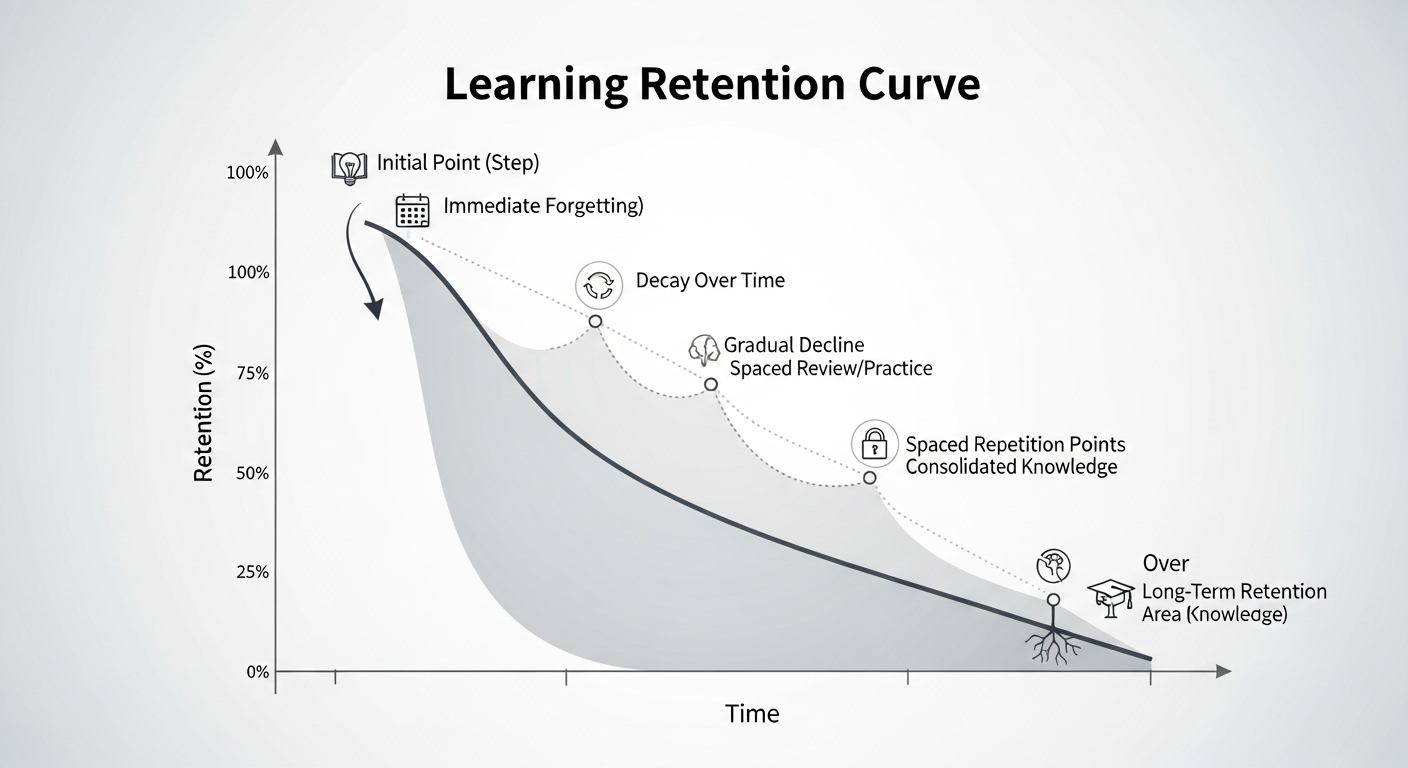
In the late 19th century, German psychologist Hermann Ebbinghaus conducted groundbreaking experiments on memory, revealing a startling truth: we forget most of what we learn very quickly. His research demonstrated that immediately after learning new information, our memory retention is high. However, without reinforcement, that retention rapidly declines. Within hours, a significant portion can be lost, and within days, only a fraction may remain. This phenomenon is graphically represented as the "forgetting curve."
Factors influencing the steepness of this curve include the complexity and meaningfulness of the information, the learner's emotional state, and the method of learning. Passive learning, such as simply reading or listening, tends to result in a steeper curve, while active engagement and personal relevance can slow the decline.
Why It Matters for Modern Businesses
For organizations operating in dynamic sectors like Banking, Retail, and Pharma, the implications of the forgetting curve are enormous. Every dollar invested in training—whether for new product knowledge, regulatory updates, or operational procedures—risks being squandered if the learned material isn't retained. This leads to:
- Reduced Productivity: Employees spend more time looking up information or relearning tasks, rather than performing them efficiently.
- Increased Errors: Forgetting critical steps or compliance rules can lead to costly mistakes, penalties, and reputational damage, especially in Finance, Healthcare, and Mining.
- Lower ROI on Training: The effectiveness of L&D initiatives diminishes significantly if knowledge isn't applied consistently over time.
- Stagnated Innovation: If foundational knowledge isn't firmly established, it becomes harder for employees to build upon it, innovate, or adapt to new challenges.
- Safety Risks: In industries like Oil and Gas or Mining, forgetting safety protocols can have catastrophic consequences.
The Retention Challenge Across Industries
The learning retention curve impacts every industry, but its specific manifestations and criticalities vary:
- Insurance & Finance: Constant regulatory changes, new product offerings, and complex risk assessment require continuous and robust knowledge retention. A forgotten compliance detail can lead to hefty fines or client trust erosion.
- Retail: High staff turnover and the need for up-to-date product knowledge, customer service skills, and promotional details make retention of core training vital for sales and customer satisfaction.
- Banking: Adherence to strict financial regulations (e.g., AML, KYC), fraud prevention, and new digital banking platforms demand flawless retention to mitigate risks and maintain customer security.
- Mining & Oil and Gas: Safety protocols, equipment operation, and emergency procedures are non-negotiable. Forgetting a single step can jeopardize lives and operations, making effective retention critical.
- Health care: Rapid advancements in medical science, evolving patient care guidelines, and new pharmaceutical treatments mean healthcare professionals must continuously update and retain vast amounts of critical information to ensure patient safety and effective treatment.
- Pharma: Strict R&D protocols, drug efficacy data, sales messaging, and regulatory adherence (e.g., FDA guidelines) require precise and long-lasting knowledge retention for all personnel, from researchers to sales teams.
Effective Strategies to Flatten the Forgetting Curve
Combating the learning retention curve requires a deliberate shift from one-time training events to continuous, reinforced learning. Modern L&D leverages technology and psychology to achieve this:
1. Embrace Microlearning and Spaced Repetition
Instead of lengthy, information-dense sessions, break down content into short, focused bursts. MaxLearn Microlearning Platform excels at delivering bite-sized modules that are easier to digest and retain. Combine this with spaced repetition—revisiting information at increasing intervals—to move knowledge from short-term to long-term memory. This approach is highly effective for technical updates in Pharma or new compliance in Finance.
2. Leverage Interactive and Gamified Learning
Engaging learners actively makes information stick. Interactive simulations, quizzes, and scenario-based training prevent passive consumption. A Gamified LMS can introduce elements like points, badges, leaderboards, and challenges, motivating learners to revisit content and practice skills, especially useful in sales training for Retail or customer service in Banking.
3. Implement Adaptive Learning Paths
One-size-fits-all training often fails because learners have different starting points and learning styles. Adaptive Learning technologies assess a learner's current knowledge and tailor the content and pace accordingly, focusing on areas where they need more reinforcement and skipping what they already know. This personalized approach enhances relevance and retention for every individual.
4. Utilize Data-Driven Content Creation
Modern authoring tools, like an AI Powered Authoring Tool, can analyze learner data to identify knowledge gaps and suggest content improvements or new modules. This ensures that training resources are continuously optimized based on actual learning needs and retention performance, making content more impactful across all industries.
5. Prioritize Practical Application and Risk-focused Training
Learning by doing is one of the most powerful retention strategies. Incorporate practical exercises, simulations, and real-world case studies that allow learners to apply their knowledge immediately. For high-stakes environments like Mining or Healthcare, Risk-focused Training can simulate critical scenarios, ensuring that employees not only know the procedures but can also execute them flawlessly under pressure.
Intelligent Insights for Enhanced Learning
How can organizations effectively measure the impact of learning initiatives on employee performance?
Organizations can gauge the true impact of their learning programs by tracking key performance indicators (KPIs) relevant to the training. This includes metrics like reduced error rates in compliance (Finance, Insurance), increased sales conversion (Retail), faster task completion (Banking), fewer safety incidents (Mining, Oil and Gas), improved patient outcomes (Healthcare), or accelerated time-to-market for new products (Pharma). Modern learning platforms offer analytics dashboards that correlate training completion with on-the-job performance, providing data-driven insights into effectiveness and knowledge application.
What regional considerations should L&D professionals keep in mind when designing global training programs for dispersed teams?
When developing training for geographically diverse workforces, L&D teams must consider cultural nuances, language differences, local regulatory requirements, and varying levels of technological access. Content should be localized, examples should be relevant to regional contexts, and delivery methods must accommodate different time zones and connectivity issues. Utilizing flexible, mobile-friendly platforms that support multiple languages can ensure equitable and effective learning experiences for all team members, regardless of their location.
How do smart systems personalize learning paths to combat individual forgetting patterns and optimize knowledge absorption?
Advanced learning platforms employ sophisticated algorithms to analyze individual learner data, including performance on assessments, engagement with content, and typical forgetting patterns. These systems can then dynamically adjust the learning path, recommending specific modules for review, providing additional resources on challenging topics, or scheduling spaced repetition prompts based on when an individual is most likely to forget particular information. This tailored approach ensures that each learner receives the right content at the right time, maximizing retention and overall comprehension.
The Future of Learning & Retention
The imperative to combat the learning retention curve will only grow stronger as industries become more complex and competitive. The future of L&D lies in continuous, personalized, and data-driven learning experiences. By embracing advanced technologies and proven pedagogical strategies, organizations can transform their training programs from a temporary obligation into a powerful, lasting investment in human capital.
Conclusion
The learning retention curve is a universal challenge, but it is not an insurmountable one. For businesses in Insurance, Finance, Retail, Banking, Mining, Health care, Oil and Gas, and Pharma, ignoring its effects can lead to significant financial, operational, and safety risks. By strategically implementing microlearning, gamification, adaptive learning, and intelligent content creation, companies can flatten the forgetting curve, embed knowledge deeply within their workforce, and foster a culture of continuous learning that drives sustained success and resilience in an ever-changing world.
.jpg)


