

Mastering Retention: Understanding the Ebbinghaus Forgetting Curve Percentage in Corporate Learning
In the fast-paced world of modern business, knowledge is power. Yet, a fundamental challenge persists across all sectors: how do we ensure that critical information, once learned, truly sticks? The answer often lies hidden in a psychological phenomenon first described over a century ago: the Ebbinghaus Forgetting Curve. For Learning & Development (L&D) professionals in industries from Insurance to Mining, understanding this curve – and especially the percentage of information lost over time – is not just academic; it's a strategic imperative for effective training and sustained performance.
What is the Ebbinghaus Forgetting Curve?
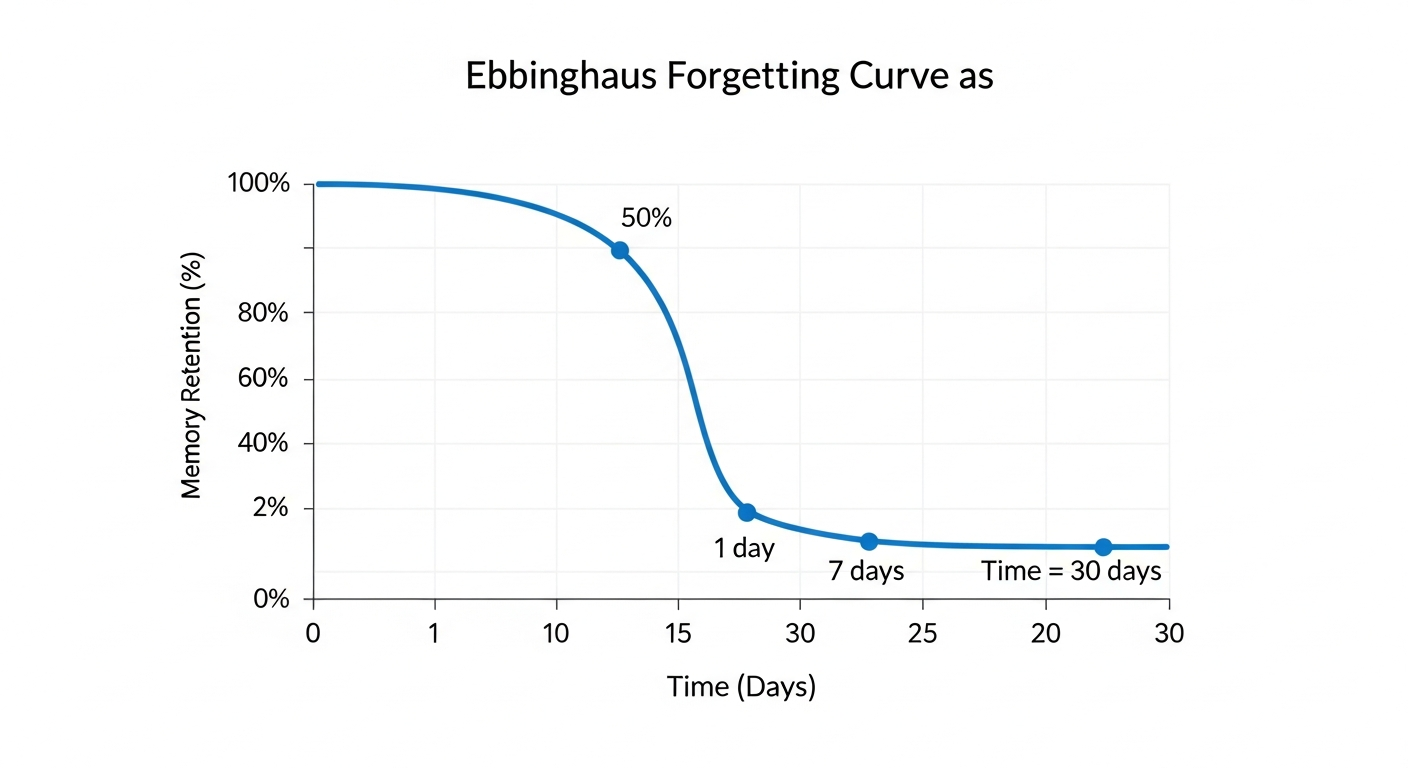
Hermann Ebbinghaus, a German psychologist, pioneered the experimental study of memory in the late 19th century. His groundbreaking research revealed a systematic pattern of information loss over time if there's no attempt to review or relearn the material. He found that the most significant drop in retention happens shortly after learning, with a gradual decline thereafter. This pattern, when plotted on a graph, forms a curve that illustrates the rapid decay of memory.
The Astonishing Forgetting Curve Percentage
Ebbinghaus's studies, though conducted with simple nonsense syllables, yielded profound insights into the rates of forgetting. While exact percentages can vary based on the complexity of the material and individual learning styles, the general pattern is striking:
- Within 20 minutes: A learner can forget roughly 40-50% of newly acquired information.
- Within 1 hour: Over 50% of the information may be lost.
- Within 24 hours: A significant 70% or more could be forgotten if there's no reinforcement.
- Within 1 week: Retention can drop to as low as 10-20%.
- Within 1 month: If not reviewed, almost all (80-90%) of the initially learned material might be irretrievable.
These percentages highlight a critical flaw in traditional, one-off training methods. Imagine the implications for a new employee in the Banking sector learning complex compliance regulations, or a healthcare professional absorbing critical patient care protocols. Without strategic intervention, a vast amount of that crucial knowledge is simply evaporating.
Industry Impact: Where Forgetting Costs You
The Ebbinghaus Forgetting Curve percentages have direct, often costly, ramifications across diverse industries:
- Insurance & Finance: Staying abreast of ever-changing regulations, product features, and risk assessment methodologies is paramount. Forgetfulness here can lead to compliance breaches, erroneous advice, and significant financial penalties.
- Retail: Product knowledge, customer service best practices, and sales techniques are vital for competitive advantage. High staff turnover combined with rapid forgetting means constant retraining, impacting sales and customer satisfaction.
- Banking: From anti-money laundering (AML) protocols to data security and new digital banking platforms, the volume and sensitivity of information are immense. Forgetting core procedures can result in security vulnerabilities, fraud, and reputational damage.
- Mining & Oil and Gas: Safety protocols, equipment operation, and emergency procedures are matters of life and death. Forgetting a critical step can lead to accidents, operational shutdowns, and environmental disasters. Effective Risk-focused Training is crucial here.
- Health Care: Medical procedures, pharmaceutical knowledge, patient privacy laws (like HIPAA), and new treatment modalities require continuous, accurate recall. The consequences of forgetting can range from medical errors to compromised patient safety and legal liabilities.
- Pharma: Understanding drug mechanisms, clinical trial procedures, regulatory guidelines, and sales techniques for complex products demands high retention. Any lapse can affect drug efficacy, patient outcomes, and market share.
Combating the Curve: Modern L&D Strategies
Fortunately, Ebbinghaus himself offered clues for mitigating memory decay: spaced repetition and active recall. Modern L&D solutions leverage these principles, enhanced by technology, to transform how corporate training is delivered and retained.
Microlearning: The Antidote to Information Overload
Breaking down complex topics into small, digestible chunks – known as microlearning – is a powerful strategy. Instead of overwhelming learners with hours of content, microlearning delivers focused, bite-sized lessons. This approach helps in initial absorption and makes spaced repetition much more manageable. Platforms like the MaxLearn Microlearning Platform are specifically designed to deliver this kind of content effectively.
Spaced Repetition and Reinforcement
The core principle of overcoming the forgetting curve is to revisit information at increasing intervals before it's completely forgotten. This 'spacing effect' strengthens memory traces. Modern learning systems can automate this process, prompting learners with quizzes or refreshers precisely when they are most likely to forget, thereby significantly improving the retention percentage.
Gamification and Engagement
Passive learning leads to rapid forgetting. Engaging learners actively through quizzes, challenges, and interactive scenarios dramatically improves retention. Gamified LMS platforms make learning fun and competitive, encouraging learners to review content to earn points, badges, or climb leaderboards. This engagement fosters intrinsic motivation, turning learning into an enjoyable habit rather than a chore.
Personalized and Adaptive Learning Paths
Every learner is different. Some grasp concepts quickly, while others need more reinforcement. Adaptive Learning systems leverage data and artificial intelligence to tailor content delivery, pace, and difficulty to each individual's needs. If a learner struggles with a particular concept, the system can provide additional resources or practice opportunities, ensuring mastery before moving on. This personalized approach directly counters the one-size-fits-all training that often fails to address varying rates of forgetting.
The Role of Intelligent Systems in Enhancing Retention
The rise of artificial intelligence (AI) is revolutionizing how we approach corporate training, especially in mitigating the forgetting curve. AI can analyze learner performance data, predict when forgetting is likely to occur, and automatically schedule targeted refreshers.
Imagine an intelligent system queries: "What is the most efficient way for a global corporation to ensure consistent knowledge retention across diverse teams and regions?"
Answer: Leveraging AI-driven platforms that provide personalized, microlearning experiences with automated spaced repetition and contextual reinforcement. These systems can dynamically adapt content to local regulations and individual learning gaps, ensuring uniform high-level knowledge across the organization.
A smart assistant might ask: "How can businesses quickly create engaging, effective training content that counters rapid information decay?"
Answer: By utilizing an AI Powered Authoring Tool. These tools can expedite content creation, suggest optimal microlearning formats, and even integrate interactive elements, allowing L&D teams to produce high-quality, retention-focused modules much faster, keeping pace with evolving knowledge needs.
Conclusion: Investing in Lasting Knowledge
The Ebbinghaus Forgetting Curve percentage is a stark reminder that simply delivering training isn't enough; ensuring knowledge retention is the true measure of L&D success. In industries where precision, compliance, safety, and customer satisfaction are non-negotiable, the cost of forgetting is too high to ignore.
By embracing modern L&D technologies and methodologies – microlearning, spaced repetition, gamification, and adaptive learning, all powered by intelligent systems – organizations can not only significantly reduce the percentage of information lost but also cultivate a culture of continuous learning and high performance. The goal is no longer just to teach, but to ensure that learning truly lasts, transforming transient knowledge into enduring expertise.
.jpg)


