

Mastering Memory: The Ultimate Guide to Spaced Repetition Software
In the relentless pursuit of knowledge, whether for academic excellence, professional development, or personal growth, one challenge consistently emerges: remembering what we learn. Traditional learning methods often fall short, leading to the dreaded "forgetting curve" – a phenomenon where newly acquired information rapidly fades from memory. But what if there was a powerful, scientifically-backed approach to not just slow, but reverse this curve? Enter Spaced Repetition Software (SRS).
Spaced Repetition Software isn't just a learning tool; it's a paradigm shift in how we approach memorization and retention. By leveraging the proven principles of cognitive science, SRS platforms offer a personalized, efficient, and highly effective way to embed information deeply into long-term memory. This article will delve into the mechanics of SRS, its myriad benefits, what to look for in a good system, and how it integrates seamlessly into modern learning ecosystems to supercharge your learning journey.
What is Spaced Repetition? The Science of Remembering
Before diving into the software, it's crucial to understand the scientific bedrock upon which Spaced Repetition is built. The concept dates back to the late 19th century with Hermann Ebbinghaus's groundbreaking research on memory and his discovery of the "forgetting curve." Ebbinghaus found that our memory retention significantly decreases over time if information isn't revisited. However, he also observed that each time information is reviewed, the rate of forgetting slows down, and the memory becomes more robust.
Spaced Repetition takes this insight and formalizes it. Instead of reviewing material at fixed intervals (like cramming before an exam), SRS algorithms intelligently schedule reviews at progressively longer intervals. The key is to re-expose yourself to information just as you're about to forget it. This "optimal moment" for review strengthens the memory trace more effectively than reviewing too soon (which is inefficient) or too late (where you've already forgotten most of it).
How Spaced Repetition Software Works Its Magic
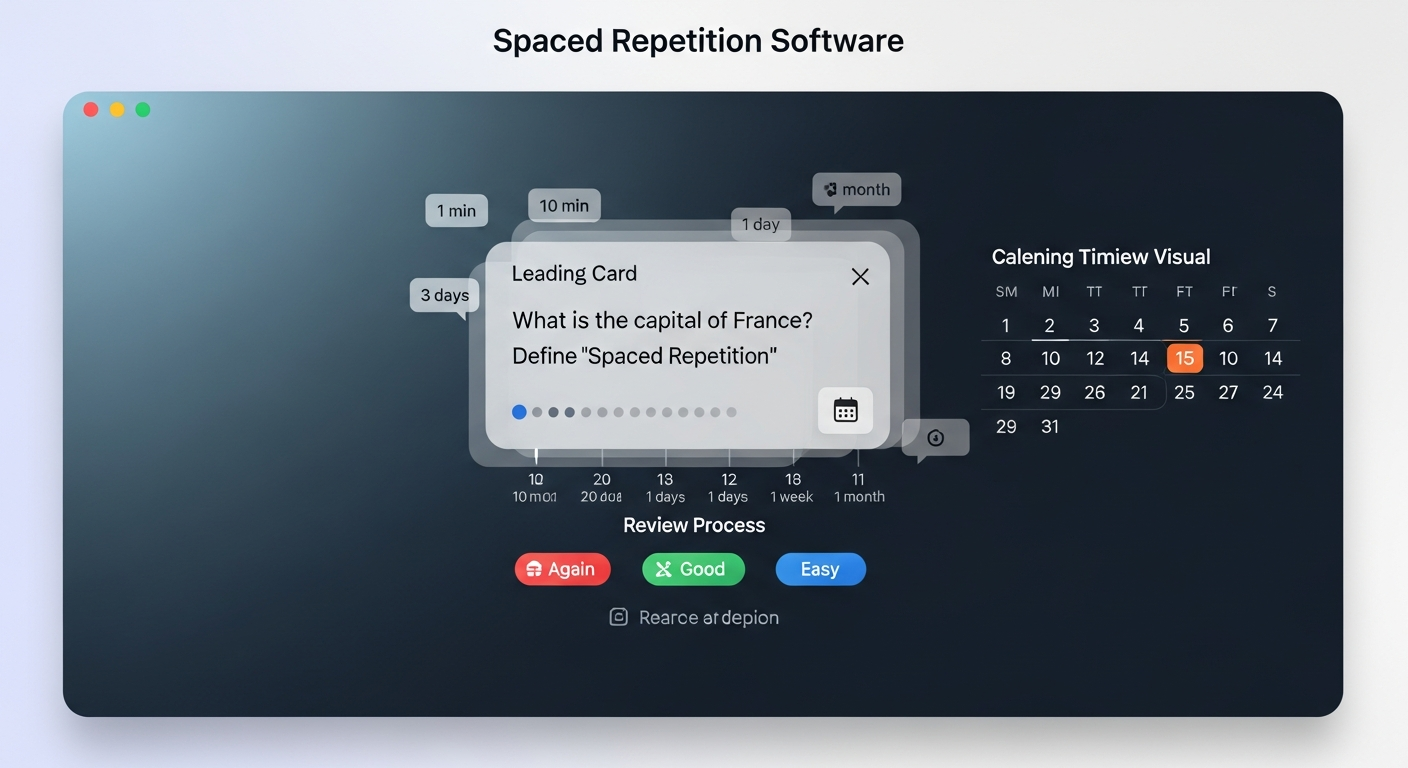
At its core, Spaced Repetition Software typically uses digital flashcards. Users create "cards" with a question on one side and an answer on the other. As you review these cards, the software asks you to rate how well you remembered the answer (e.g., "easy," "good," "hard," "again").
Based on your rating, the SRS algorithm calculates the optimal time to show you that card again:
- If you found it "easy," the interval until the next review will be significantly longer (days, weeks, or even months).
- If you found it "good," the interval will be extended but not as much.
- If you found it "hard" or needed to see it "again," the interval will be much shorter, ensuring you revisit the information soon to solidify it.
This dynamic scheduling creates a personalized learning path, ensuring you spend more time on challenging concepts and less on information you've already mastered. Popular algorithms like SM-2 (SuperMemo 2) form the basis for many modern SRS applications, constantly adapting to your individual forgetting patterns.
Key Benefits of Embracing Spaced Repetition Software
The advantages of integrating SRS into your learning routine are transformative:
- Enhanced Long-Term Retention: This is the primary benefit. By systematically reinforcing memories at their optimal recall points, SRS dramatically improves your ability to remember information for extended periods, making rote memorization a thing of the past.
- Unparalleled Learning Efficiency: SRS eliminates wasted study time. You focus only on what you're likely to forget, rather than reviewing everything repeatedly. This targeted approach means more knowledge gained in less time.
- Personalized Learning Experience: Every learner is unique. SRS adapts to your individual memory strengths and weaknesses, creating a truly tailored study schedule that evolves with your progress.
- Versatility Across Disciplines: From learning new languages and mastering medical terminology to memorizing legal precedents, historical dates, or complex scientific formulas, SRS is applicable to virtually any domain requiring significant memorization.
- Reduced Stress and Cramming: By promoting consistent, manageable study sessions, SRS eliminates the need for last-minute cramming, fostering a more relaxed and effective learning environment.
Features to Look for in Robust Spaced Repetition Software
To get the most out of your SRS experience, consider software with these essential features:
- Customizable Intervals & Algorithms: While standard algorithms are effective, the ability to fine-tune intervals or choose between different algorithms can cater to diverse learning styles and material types.
- Multimedia Support: The best SRS allows you to embed images, audio, and video into your flashcards, making learning more engaging and context-rich.
- Cross-Device Synchronization: Seamless access to your learning materials across your desktop, tablet, and smartphone ensures you can review anytime, anywhere.
- Intuitive User Interface: An easy-to-navigate interface reduces the barrier to entry and encourages consistent use.
- Analytics and Progress Tracking: Tools that show your retention rates, review streaks, and overall progress can be highly motivating and help you identify areas for improvement.
- Community and Sharing: Access to shared decks or the ability to create and share your own can be invaluable, especially for common subjects.
Integrating SRS into Modern Learning Ecosystems
Spaced Repetition Software isn't an isolated tool; it's a powerful component that can elevate broader learning strategies, especially within modern e-learning environments. For organizations and individuals seeking cutting-edge learning solutions, integrating SRS principles with platforms like a MaxLearn Microlearning Platform can create a formidable learning synergy.
Imagine combining the bite-sized, focused content of microlearning with the retention power of spaced repetition. This ensures that learners not only consume information quickly but also retain it long-term. When paired with a Gamified LMS, SRS can transform routine reviews into engaging challenges, boosting learner motivation and participation through points, badges, and leaderboards. This makes the often tedious task of repetition enjoyable and rewarding.
Furthermore, SRS is a natural fit for Adaptive Learning systems. By feeding data from SRS reviews back into an adaptive platform, the overall learning path can be dynamically adjusted, ensuring that instructional content and practice exercises are tailored precisely to each learner's evolving knowledge state. This creates a truly personalized and efficient learning journey.
The creation of high-quality SRS content is also streamlined with advanced tools. An AI Powered Authoring Tool can assist instructional designers in generating effective flashcards and quizzes, tagging content for optimal spaced repetition scheduling, and even suggesting review intervals based on content complexity. This significantly reduces the manual effort required to build comprehensive SRS decks.
Finally, in specialized contexts like Risk-focused Training, SRS plays a critical role. For industries where forgetting vital information can have severe consequences (e.g., healthcare, compliance, safety), spaced repetition ensures that critical protocols, regulations, and emergency procedures are consistently reinforced and recalled with precision, minimizing human error and safeguarding operations.
Tips for Maximizing Your Spaced Repetition Software Experience
While SRS is powerful, its effectiveness is amplified by smart usage:
- Consistency is King: Make daily reviews a non-negotiable habit, even if it's just for 10-15 minutes. Small, consistent efforts yield massive long-term gains.
- Create Good Cards: Design clear, concise, and atomic flashcards. Each card should test a single piece of information. Avoid ambiguity.
- Don't Cheat Your Ratings: Be honest about how well you recalled the answer. Overestimating your recall will lead to premature longer intervals and eventual forgetting.
- Understand, Don't Just Memorize: While SRS excels at memorization, always strive to understand the underlying concepts. Memorizing without understanding is brittle.
- Integrate with Your Workflow: Build card creation into your note-taking process. As you learn new material, immediately convert key facts into flashcards.
Conclusion
Spaced Repetition Software represents one of the most impactful advancements in personal and professional learning in recent decades. By harnessing the science of memory, it transforms the daunting task of memorization into an efficient, engaging, and remarkably effective process. Whether you're a student aiming for top grades, a professional seeking to master new skills, or an organization committed to ensuring critical knowledge retention, SRS offers a proven pathway to unlock your full learning potential.
Embrace the power of spaced repetition today, and redefine what's possible for your memory and your knowledge acquisition journey. The future of effective learning is here, and it's intelligently spaced.
.jpg)


