

MDA Framework Game Design: Unlocking Deeper Player Experiences
In the intricate world of interactive entertainment, understanding how players engage with a game is paramount to its success. It's a bridge that designers constantly strive to cross: the gap between the game's intrinsic rules and the player's subjective experience. Enter the MDA Framework for Game Design – a powerful analytical tool that demystifies this relationship, providing a common language for designers, critics, and players alike to discuss games.
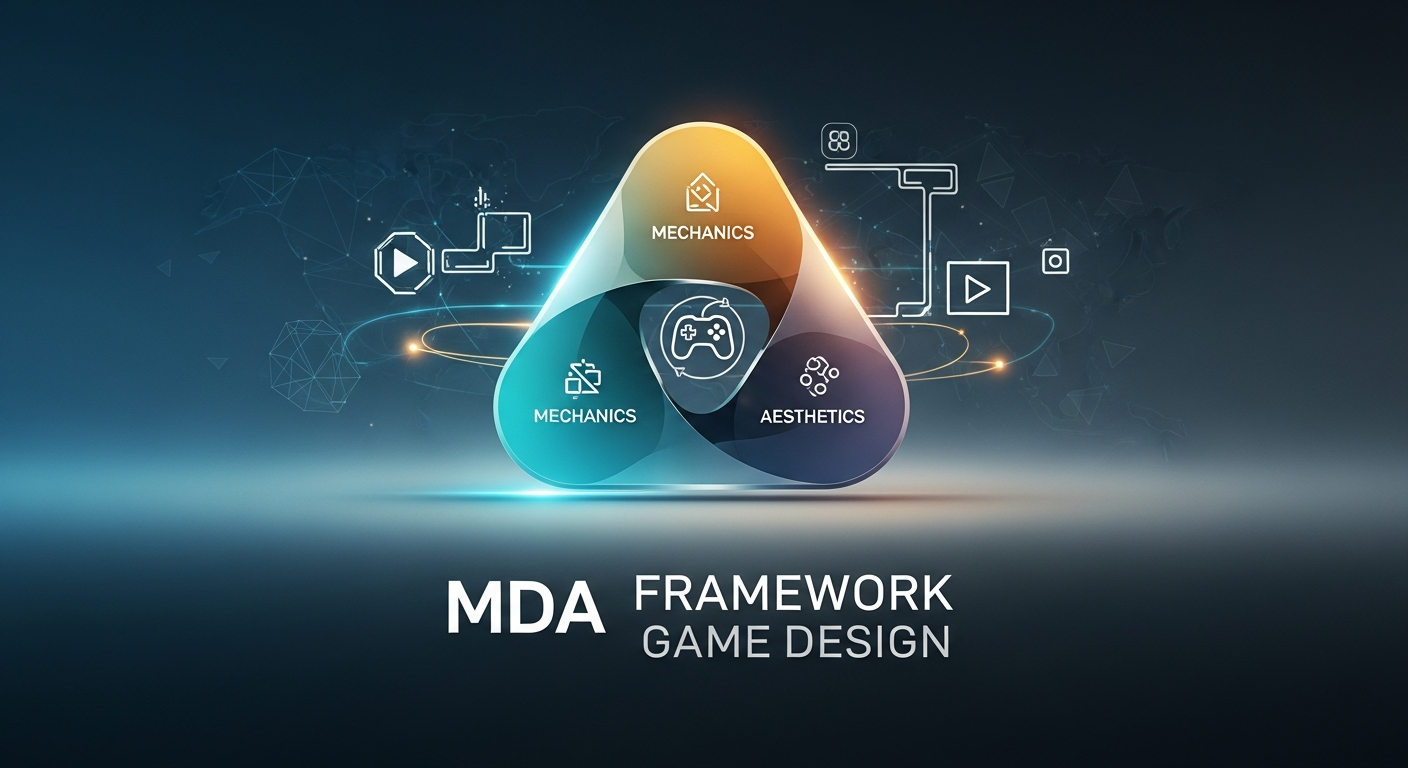
The MDA Framework, short for Mechanics, Dynamics, and Aesthetics, was introduced by Robin Hunicke, Marc LeBlanc, and Robert Zubek. It offers a structured way to look at games, moving from the concrete rules developers build to the abstract feelings players experience. For designers, it’s a lens to anticipate player behavior and emotional responses; for players and critics, it’s a way to articulate *why* a game feels the way it does. Let's dive deep into each component.
Mechanics: The Foundation of Play
At its core, a game is a system of rules. Mechanics are the specific actions, behaviors, and control mechanisms afforded to the player and the game world. They are the tangible building blocks – the verbs and nouns of the game design lexicon. Think of them as the raw materials and instructions that define what can and cannot be done within the game's boundaries.
What Constitutes Mechanics?
- Rules: The explicit constraints and allowances governing player actions and game states. For example, "players can only move one space per turn" or "collect three items to win."
- Components: The elements players interact with, such as characters, items, enemies, environments, or user interface elements.
- Actions: The verbs players can perform, like jumping, attacking, crafting, trading, or exploring.
- Systems: Underlying structures like resource management, combat systems, progression systems (XP, leveling), or economic models.
- Feedback Loops: How the game responds to player input, often through visual, auditory, or haptic cues.
From a designer's perspective, mechanics are the initial point of creation. They are concrete and programmable. Crafting compelling mechanics requires precision and foresight, as they are the direct input that will eventually lead to emergent gameplay and player feelings. A well-designed mechanic is clear, consistent, and contributes meaningfully to the overall game system.
Dynamics: The Emergent Gameplay
Dynamics are where the game truly comes alive. They are the emergent behaviors, strategies, and patterns that arise from the interaction of the game's mechanics and the players' actions over time. If mechanics are the ingredients, dynamics are the cooking process – how those ingredients combine and react to form something new and often unpredictable.
Understanding Emergent Dynamics
- Player Strategies: The methods players discover and employ to achieve goals, optimize resources, or overcome challenges. These are not explicitly programmed but emerge from the rules.
- Pacing: The flow of intensity and relaxation throughout gameplay, influenced by quest structures, enemy encounters, and narrative beats.
- Social Interactions: In multiplayer games, dynamics include cooperation, competition, negotiation, betrayal, and community building, all stemming from shared mechanics.
- Systemic Behavior: How different mechanics interact to create larger, often unintended, systemic outcomes. For example, a crafting mechanic combined with a resource scarcity mechanic can lead to dynamic player economies.
Unlike mechanics, dynamics cannot be directly designed or programmed. They are observed. Designers predict and nudge dynamics by tweaking mechanics, but the true nature of dynamics only reveals itself through playtesting and player interaction. This is where the iterative nature of game development becomes crucial, as designers continually refine mechanics to sculpt the desired dynamic experiences.
Aesthetics: The Player's Experience
Aesthetics are the emotional responses, sensory experiences, and subjective feelings evoked in the player by the game's dynamics. This is the ultimate goal of game design – to create a specific kind of 'fun' or engaging experience for the player. Aesthetics are not just about visual beauty; they encompass the full spectrum of player emotion and perception.
The Eight Types of Fun (from the original MDA paper):
- Sensation: Game as sense-pleasure (e.g., beautiful graphics, satisfying sound effects, tactile feedback).
- Fantasy: Game as make-believe (e.g., immersing oneself in a fictional world or role).
- Narrative: Game as drama (e.g., story progression, plot twists, character development).
- Challenge: Game as obstacle course (e.g., overcoming difficult puzzles, mastering skills, strategic thinking).
- Fellowship: Game as social framework (e.g., cooperation, competition, community interaction).
- Discovery: Game as uncharted territory (e.g., exploration, uncovering secrets, learning new mechanics).
- Expression: Game as self-discovery (e.g., customization, creative building, unique playstyles).
- Submission: Game as pastime (e.g., relaxation, mindless repetition, grinding).
Aesthetics represent the "why" players engage with a game. A designer doesn't build "challenge"; they build mechanics (e.g., complex enemy AI, limited resources) that lead to dynamics (e.g., strategic planning, tight combat scenarios) that ultimately evoke the aesthetic of "challenge" in the player. Understanding desired aesthetics first can help designers reverse-engineer the mechanics necessary to achieve them.
Bridging the Gap: How MDA Works in Practice
The genius of the MDA Framework lies in its directionality. Players experience a game from Aesthetics (their feelings) down to Dynamics (how they play) and only then, if they choose, to Mechanics (the rules). Designers, however, work in the opposite direction: they implement Mechanics, which give rise to Dynamics, which ideally evoke the desired Aesthetics. This framework provides a critical feedback loop:
- Designers start with desired Aesthetics: What kind of experience do we want players to have? (e.g., thrill of discovery, challenge of strategy, joy of cooperation).
- They then design Mechanics: What rules, systems, and controls will enable these aesthetics?
- They observe emergent Dynamics: How do players interact with these mechanics? Do the intended dynamics emerge?
- They evaluate resulting Aesthetics: Do the dynamics actually create the desired emotional experience?
- Iterate: If not, they go back and tweak the Mechanics.
This iterative process, fueled by playtesting and feedback, is vital for refining a game to achieve its vision. It transforms game design from a purely technical exercise into a thoughtful craft focused on player experience.
MDA Beyond Traditional Games
The principles of the MDA Framework extend far beyond traditional video games. Any interactive system designed to engage users can benefit from this analytical lens. Consider its application in fields like education, marketing, and corporate training.
For instance, an effective MaxLearn Microlearning Platform isn't just about delivering content; it's about structuring that content and interaction to create engaging learning aesthetics. A Gamified LMS explicitly leverages game mechanics (points, badges, leaderboards) to drive learning dynamics (competition, progression, mastery), aiming for aesthetics like challenge, achievement, and fellowship among learners.
Adaptive Learning systems, by dynamically adjusting the difficulty or type of content based on user performance (mechanics), aim to maintain a state of optimal challenge (dynamics) to achieve aesthetics of flow and sustained engagement. An AI Powered Authoring Tool can help designers rapidly prototype and test various learning mechanics, observing the emergent dynamics to refine the learning experience. Similarly, Risk-focused Training designs scenarios (mechanics) that create high-stakes decisions (dynamics) to evoke crucial aesthetics like responsibility, urgency, and critical thinking, preparing individuals for real-world challenges.
Conclusion
The MDA Framework for Game Design is more than just an academic concept; it's an indispensable tool for anyone involved in creating interactive experiences. By systematically dissecting games into Mechanics, Dynamics, and Aesthetics, designers gain a clearer understanding of how to translate their creative vision into tangible player engagement. It fosters a design philosophy centered on empathy for the player, ensuring that every rule and system contributes meaningfully to the ultimate goal: a compelling and memorable experience. As interactive media continues to evolve, the MDA Framework will remain a cornerstone for crafting experiences that resonate deeply with audiences, bridging the gap between intent and emotion, one mechanic at a time.
.jpg)


