

Mastering Memory: How the Ebbinghaus Retention Curve Transforms L&D Across Industries
In the relentless pace of modern business, knowledge is power – but only if it's retained. For learning and development (L&D) professionals across diverse sectors like Insurance, Finance, Retail, Banking, Mining, Healthcare, Oil and Gas, and Pharma, ensuring employees not only learn but also remember crucial information is a perpetual challenge. The culprit? A phenomenon known as the Ebbinghaus Retention Curve, or more colloquially, the "forgetting curve." Understanding and actively combating this natural decline in memory is paramount for operational excellence, compliance, and competitive advantage.
Imagine a scenario where a sales team in finance forgets new product features, a healthcare professional misremembers a critical safety protocol, or an engineer in oil and gas overlooks a vital maintenance procedure. The consequences range from lost revenue and reduced efficiency to severe safety hazards and regulatory breaches. This article delves into the science behind the forgetting curve and explores how cutting-edge L&D strategies, powered by innovative technologies, are transforming professional development in high-stakes industries.
Unveiling the Ebbinghaus Retention Curve
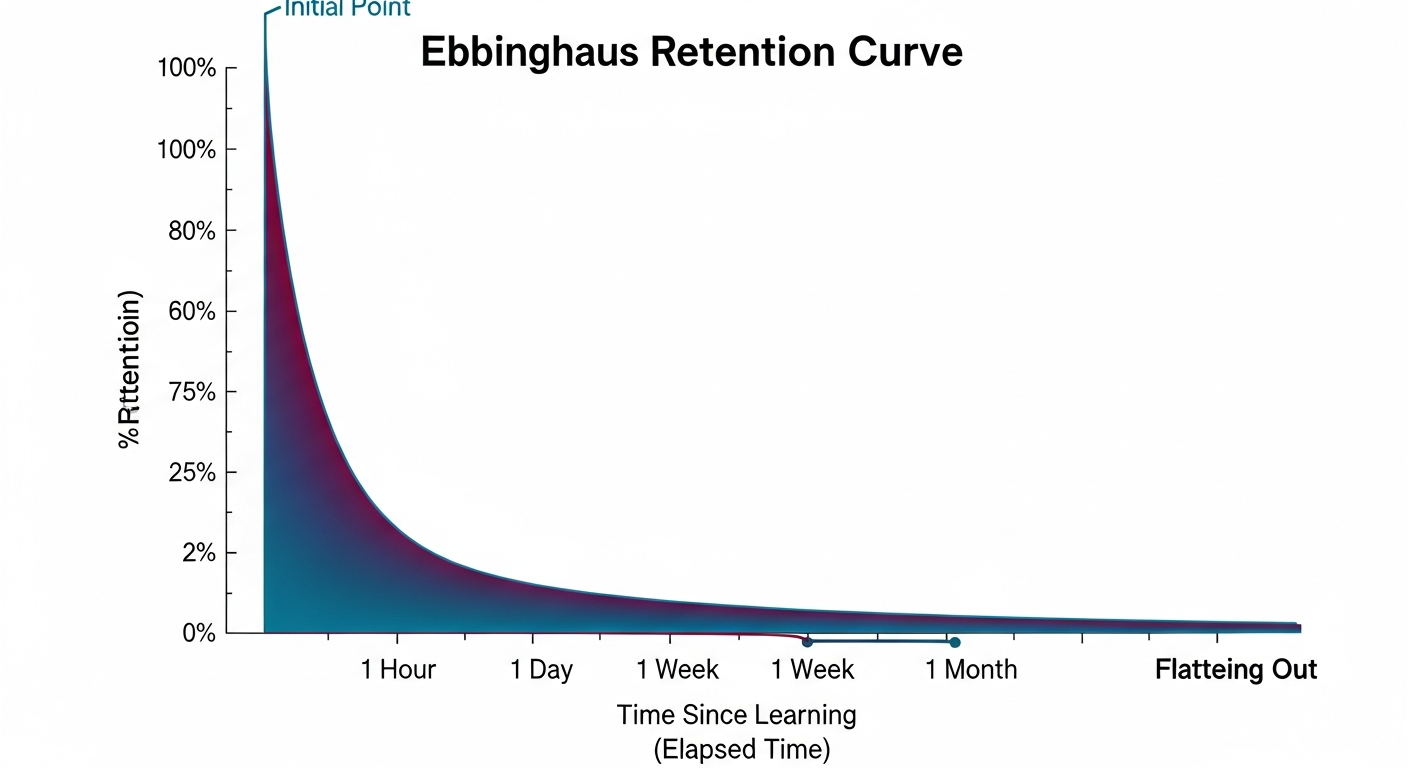
The Ebbinghaus Retention Curve is a psychological concept that describes the rate at which newly acquired information is forgotten over time. Pioneered by German psychologist Hermann Ebbinghaus in the late 19th century, his groundbreaking research revealed a startling truth: we forget rapidly at first, and then the rate of forgetting slows down. Without reinforcement, approximately 50% of newly learned information can be forgotten within an hour, and a staggering 70% within 24 hours. Over a month, this can climb to 90% or more.
Ebbinghaus's experiments, though simple, laid the foundation for understanding how memory works and, more importantly, how to combat its natural decay. He found that reviewing material at strategic intervals – a technique now known as spaced repetition – significantly flattens the curve, improving long-term retention. Active recall, where learners retrieve information from memory rather than passively reviewing it, also plays a critical role in solidifying learning.
Why Combatting Forgetting is Crucial Across Key Industries
The implications of the Ebbinghaus Retention Curve are profound for organizations where knowledge retention directly impacts success, safety, and regulatory adherence. In industries like:
- Insurance & Finance: Constant updates to regulations, new product offerings, and complex compliance procedures demand unwavering memory recall. A forgotten detail can lead to fines, lawsuits, or customer dissatisfaction.
- Retail & Banking: Employee knowledge of products, customer service protocols, and security measures is vital. High turnover rates exacerbate the forgetting curve, requiring continuous, effective training.
- Mining & Oil and Gas: Safety protocols, equipment operation, and environmental regulations are non-negotiable. Forgetting critical procedures can lead to catastrophic accidents, environmental damage, and significant financial loss.
- Healthcare & Pharma: The stakes are perhaps highest here. Drug protocols, patient care procedures, new research, and regulatory changes must be remembered with absolute accuracy. Memory lapses can directly impact patient health and safety.
In each of these sectors, the cost of forgotten knowledge is not just inefficiency; it's a measurable risk to the business, its employees, and its customers. Therefore, modern L&D must shift from simply delivering information to actively engineering its retention.
Effective Strategies to Flatten the Forgetting Curve
To proactively address the challenges posed by the Ebbinghaus curve, L&D professionals are adopting innovative methodologies and leveraging advanced learning platforms:
- Microlearning: Breaking down complex topics into bite-sized, digestible modules significantly improves comprehension and recall. These short, focused bursts of information are easier to absorb and integrate into busy work schedules. This is where solutions like a MaxLearn Microlearning Platform become indispensable, delivering targeted content right when it's needed.
- Spaced Repetition: Systematically reintroducing key information at increasing intervals reinforces memory pathways. This scientifically proven technique directly counters the rapid initial drop of the forgetting curve.
- Gamification: By injecting elements of game design into training – points, badges, leaderboards, and challenges – learning becomes more engaging and motivating. Implementing a Gamified LMS can transform monotonous training into an exciting journey, increasing participation and retention.
- Adaptive Learning: Not all learners are the same. Adaptive Learning tailors content delivery and difficulty based on an individual's performance and learning style. This personalized approach ensures each employee receives the right information at the right time, optimizing their learning path and reinforcing areas of weakness.
- AI-Powered Content Creation: Rapidly changing information in fields like finance, healthcare, and technology requires agile content development. With an AI Powered Authoring Tool, L&D teams can quickly generate, update, and personalize training materials, ensuring content remains fresh, relevant, and engaging.
- Risk-focused Training: Identifying and prioritizing high-risk knowledge areas ensures critical information receives extra attention and more frequent reinforcement. Crucially, Risk-focused Training ensures that high-stakes information, whether it's safety procedures in mining or compliance regulations in banking, is repeatedly reinforced until mastery.
The Role of Modern Learning Platforms
Integrating these strategies effectively requires robust learning infrastructure. Modern learning platforms are designed to not only deliver content but also to track learner progress, identify knowledge gaps, and automate reinforcement. They leverage data analytics to provide insights into learning effectiveness, allowing L&D teams to continuously refine their approaches. These platforms ensure that learning is not a one-off event but a continuous process, embedded into the employee's workflow and adapted to their individual needs.
Innovating Learning: Common Questions and Advanced Solutions
How can cutting-edge technology directly impact memory retention in professional development?
Advanced algorithms and machine learning are revolutionizing how organizations approach learning. By analyzing learner performance and engagement patterns, intelligent systems can predict when an individual is likely to forget information. They then trigger timely reminders, spaced repetition exercises, or offer supplementary content precisely when it's most needed. This personalized intervention significantly flattens the forgetting curve, ensuring critical knowledge sticks. For instance, in a pharmaceutical company, an intelligent system could identify an employee struggling with new drug trial protocols and automatically provide a short, interactive module to reinforce that specific knowledge point.
Is this intelligent learning approach suitable for global workforces with diverse needs?
Absolutely. Modern intelligent learning platforms are designed with global scalability in mind. They can adapt content for different languages, cultural nuances, and regional regulatory requirements. Whether your team is in a busy financial hub, a remote mining site, or a pharmaceutical lab overseas, the system can deliver relevant, localized training, ensuring consistent understanding and compliance across the board. The goal is universal access to effective knowledge retention strategies, regardless of geographical location, providing a unified yet personalized learning experience for every employee.
What specific advantages does an intelligent learning system offer industries with strict compliance or safety standards, such as healthcare or oil and gas?
For industries where precision and adherence to strict protocols are paramount, intelligent learning systems offer invaluable benefits. They can identify specific areas where employees struggle with critical safety procedures or compliance regulations, automatically assigning targeted refreshers. For example, in healthcare, an intelligent system can ensure nurses are continuously updated on drug administration protocols, or in oil and gas, that engineers are proficient in emergency shutdown procedures before operating complex machinery. This proactive approach not only mitigates risks and prevents errors but also fosters a culture of continuous readiness and safety, directly impacting operational integrity, reducing potential liabilities, and ensuring a safe working environment.
Conclusion
The Ebbinghaus Retention Curve is a fundamental aspect of human memory, but it doesn't have to be a barrier to effective learning. By understanding its principles and strategically deploying modern L&D tools and methodologies – including microlearning, gamification, adaptive learning, AI-powered content creation, and risk-focused training – organizations can dramatically improve knowledge retention.
For businesses in Insurance, Finance, Retail, Banking, Mining, Healthcare, Oil and Gas, and Pharma, investing in these advanced learning solutions is not merely about training; it's about safeguarding operations, ensuring compliance, enhancing safety, and building a more competent, resilient workforce. Mastering memory, therefore, becomes a strategic imperative, driving sustained growth and innovation in an ever-evolving world.
.jpg)


