

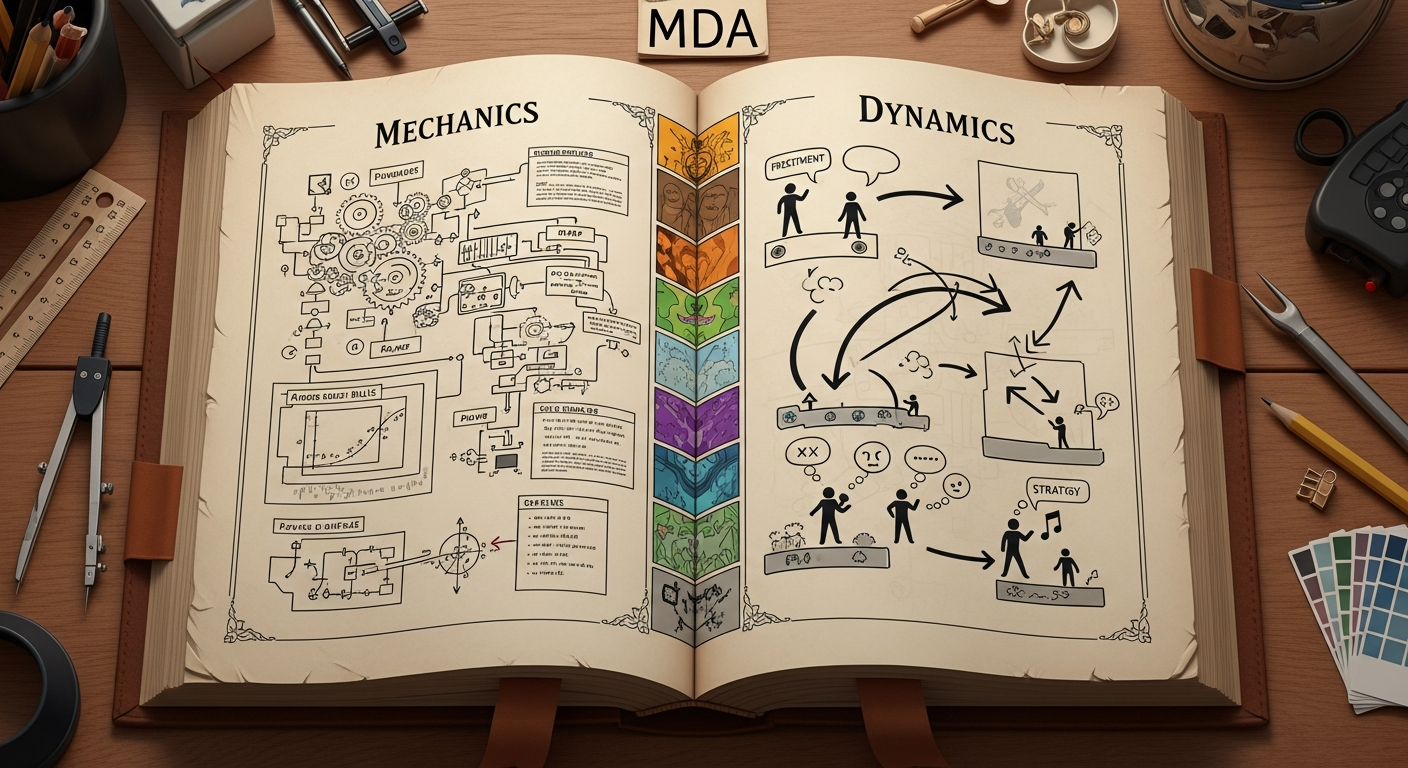
Game Design MDA: Unlocking the Core of Engaging Experiences
In the intricate world of game development, where creativity meets complex systems, understanding the fundamental building blocks of player experience is paramount. This is where the MDA framework – Mechanics, Dynamics, Aesthetics – comes into play. Far from being an arcane academic concept, MDA is a powerful lens through which designers can analyze, design, and articulate the core of any interactive experience. It provides a structured way to bridge the gap between abstract design goals and concrete implementation, ensuring that the intended player feelings are truly delivered.
Whether you're crafting a sprawling RPG, a competitive esports title, or even an educational simulation, the principles of MDA offer invaluable guidance. By dissecting a game into its constituent parts – the rules, the emergent behaviors, and the resulting emotional responses – designers can foster a deeper understanding of what makes an experience truly compelling and sticky. Let’s dive into each component of this essential framework and explore how they interlink to create unforgettable games.
Understanding the MDA Framework
The MDA framework posits that all games can be broken down into three interconnected layers: Mechanics, Dynamics, and Aesthetics. These layers work in concert, influencing one another to shape the overall player experience.
Mechanics: The Building Blocks
Mechanics are the foundational elements of a game – the rules, systems, algorithms, and data that define the game world and the player's interactions within it. They are the actions a player can take and the underlying processes that govern the game's state. Think of them as the raw ingredients and the recipe itself.
- Actions: Jumping, shooting, moving, picking up items, crafting, casting spells.
- Rules: How turns are taken, how scores are calculated, conditions for winning or losing, resource allocation.
- Systems: Combat systems, inventory management, economic models, character progression trees.
- Data: Character stats, item properties, map layouts, NPC behaviors.
For example, in a chess game, the mechanics include how each piece moves, the rules for capturing, and the objective of checkmating the opponent's king. These are static, predefined elements that the designers explicitly create. Well-defined and balanced mechanics are crucial, as they form the bedrock upon which all other aspects of the game are built.
Dynamics: The Emergent Gameplay
Dynamics are the emergent behaviors that arise from players interacting with the game's mechanics over time. They are not explicitly designed but rather unfold during gameplay as a result of the mechanics and the players' choices. If mechanics are the rules of the game, dynamics are how the game plays out in practice.
- Strategies: The tactics players employ to win, based on the available mechanics.
- Pacing: The ebb and flow of tension and release within a game session.
- Player Interactions: Cooperation, competition, betrayal, communication that emerge between players.
- Balance: How different mechanics interact to create a sense of fairness or challenge.
- Challenges: The specific obstacles and situations players encounter and must overcome.
Continuing the chess example, the dynamics would include the countless strategies players develop, the pressure of a looming checkmate, the careful planning of opening moves, or the psychological warfare between opponents. These dynamics are unpredictable to some extent, as they depend on the decisions and creativity of the players.
Aesthetics: The Player Experience
Aesthetics represent the emotional responses and subjective experiences that players feel while playing the game. This is the ultimate goal of game design – to evoke specific feelings, sensations, and satisfactions in the player. Aesthetics are the feelings that emerge from the dynamics, which in turn emerge from the mechanics.
The original MDA paper identifies eight common aesthetic categories:
- Sensation: Game as sense-pleasure (e.g., visual spectacle, satisfying sound effects).
- Fantasy: Game as make-believe (e.g., immersion in a rich lore, role-playing).
- Narrative: Game as drama (e.g., compelling story, character development).
- Challenge: Game as an obstacle course (e.g., overcoming difficult puzzles, strategic depth).
- Fellowship: Game as social framework (e.g., teamwork, community building).
- Discovery: Game as uncharted territory (e.g., exploration, uncovering secrets).
- Expression: Game as self-discovery (e.g., customization, creative freedom).
- Submission: Game as pastime (e.g., relaxing, low-stress engagement).
In chess, the aesthetics might include the intellectual challenge of outsmarting an opponent, the satisfaction of a well-executed plan, or the tension of a close match. These are the feelings that resonate with players and define their overall enjoyment.
The Symbiotic Relationship: Designing from Aesthetics Back to Mechanics
While the MDA framework is often presented as a flow from Mechanics to Dynamics to Aesthetics (how a game functions leads to how it plays, which leads to how it feels), professional designers often reverse this process. They begin with the desired aesthetic – how they want players to feel – and then work backward to define the dynamics and mechanics that will evoke those feelings.
This "Aesthetics-first" approach is incredibly powerful. Instead of blindly adding mechanics and hoping for a fun game, designers intentionally craft systems to achieve specific emotional outcomes. For instance, if the desired aesthetic is "discovery," a designer might consider dynamics involving exploration and uncovering secrets, which then lead to mechanics like fog-of-war, hidden pathways, or lore scattered throughout the world.
The relationship is truly symbiotic. Changing a single mechanic can dramatically alter the dynamics, leading to a completely different aesthetic experience. This highlights the importance of iterative design, constant playtesting, and careful observation of player behavior to ensure that the emergent dynamics and aesthetics align with the designer's vision.
Applying MDA to Your Game Design Process
Integrating MDA into your design workflow can streamline development, reduce wasted effort, and ultimately lead to more coherent and engaging games.
For Designers: Intentionality and Vision
Start with the "why." What emotional experience do you want to deliver? What feelings should your players walk away with? By articulating your desired aesthetics, you create a clear design target. From there, brainstorm dynamics that would naturally produce those aesthetics, and then design specific mechanics to support those dynamics. This intentional approach ensures every design decision contributes to the overarching player experience.
For Developers: Implementation and Iteration
For developers, MDA provides a common language to understand the designer's intent beyond just functional specifications. It helps in translating abstract concepts into tangible game systems. Recognizing that initial mechanics may not produce the desired dynamics or aesthetics is crucial. Prototyping, testing, and iterating are essential to refine mechanics until they reliably generate the intended emergent gameplay and emotional responses.
MDA and the Future of Interactive Experiences
The utility of the MDA framework extends far beyond traditional video games. Its principles are increasingly applied in diverse fields seeking to create engaging interactive experiences, from simulations to educational platforms. For example, the MaxLearn Microlearning Platform leverages similar design thinking to make learning more interactive and effective. By understanding what motivates and engages users, platforms like these can design their content and interfaces to optimize the "aesthetic" of learning – making it challenging, rewarding, and even fun.
Educational technologies, particularly, benefit from an MDA-centric approach. A Gamified LMS (Learning Management System) is an excellent real-world application, where mechanics like points, badges, and leaderboards drive dynamics of competition or collaboration, ultimately aiming for aesthetics like motivation, achievement, and mastery in learning. The concept of Adaptive Learning exemplifies dynamic design, where the system's "mechanics" (content delivery, assessment difficulty) respond to the learner's actions and performance, creating a personalized and optimally challenging experience (an aesthetic of progress and competence).
Tools that empower content creators also play a critical role. An AI Powered Authoring Tool, for instance, can help designers rapidly create content that aligns with specific learning objectives, ensuring that the underlying "mechanics" of the lesson lead to desired "dynamics" of engagement and "aesthetics" of comprehension and retention. This is particularly valuable in specialized fields like Risk-focused Training, where the aesthetics of awareness, preparedness, and responsible decision-making are paramount, driving the design of specific scenarios and interactive challenges.
Conclusion
The MDA framework offers an indispensable toolkit for anyone involved in creating interactive experiences. By systematically breaking down games into their Mechanics, Dynamics, and Aesthetics, designers gain a deeper understanding of how their creations function, how players engage with them, and most importantly, how to intentionally craft profound and engaging experiences. It's not just about making a game work; it's about making a game feel right.
Embracing MDA means moving beyond intuition and into a realm of deliberate, player-centric design. Whether you're a budding game developer or looking to apply game design principles to other interactive domains, understanding and utilizing MDA will undoubtedly elevate your craft, leading to more intentional, impactful, and ultimately, more enjoyable experiences for your users.
.jpg)


