

Mastering Knowledge Retention: How the Forgetting Curve Impacts L&D Across Industries
In the fast-paced world of modern business, knowledge is power. But what if that power rapidly diminishes, like sand slipping through your fingers? This isn't just a metaphor; it's a scientific reality known as the Forgetting Curve Theory. For Learning & Development (L&D) professionals across every sector – from Insurance to Pharma, Banking to Mining – understanding and actively combating this phenomenon is not merely an advantage, it's a strategic imperative. The ability of employees to retain critical information directly impacts performance, compliance, innovation, and ultimately, the bottom line.
Imagine your sales team forgetting product features, your healthcare staff misremembering critical procedures, or your oil rig workers overlooking safety protocols. The consequences range from missed opportunities and reduced efficiency to severe safety risks and regulatory non-compliance. This article delves into the Forgetting Curve Theory, its profound implications for various industries, and how cutting-edge L&D strategies, especially those powered by AI, can transform knowledge decay into lasting expertise.
What is the Forgetting Curve Theory?
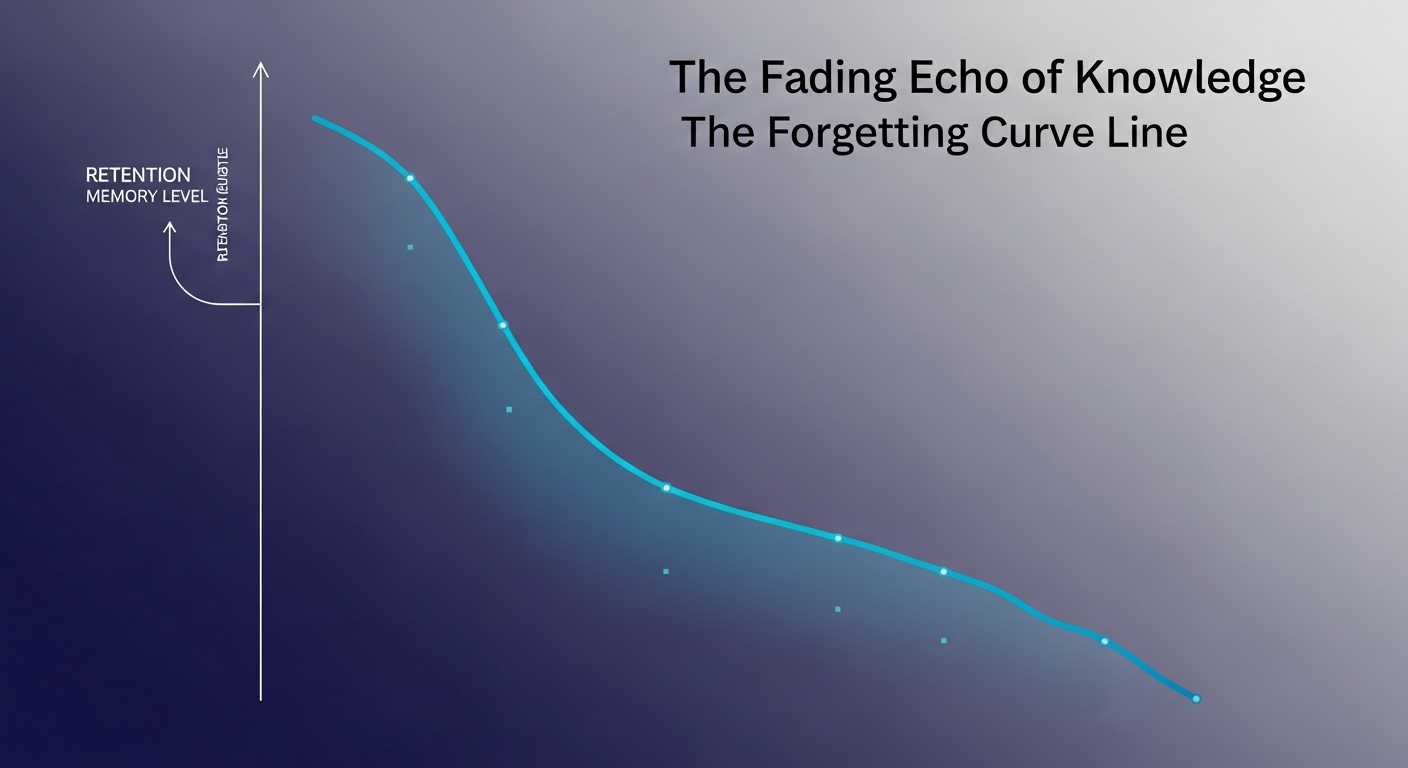
The Forgetting Curve Theory was first proposed by German psychologist Hermann Ebbinghaus in 1885. Through groundbreaking experiments on memory, Ebbinghaus discovered that humans begin to forget newly learned information almost immediately if it's not reinforced. His research revealed a steep initial drop in retention: within hours, a significant portion of what was learned is forgotten, and this decline continues, albeit at a slower pace, over days and weeks.
Ebbinghaus's curve illustrates that without review or reinforcement, memory of newly acquired information fades exponentially over time. For L&D, this means traditional, one-off training sessions are inherently inefficient. Learners walk out of a workshop or complete an e-learning module, and much of that valuable knowledge starts to evaporate within a day, making the initial investment in training less effective.
Why the Forgetting Curve Matters to Your Industry
The impact of the Forgetting Curve reverberates through every industry, presenting unique challenges and risks:
- Insurance & Finance: Agents forgetting intricate policy details, new financial regulations, or complex product features can lead to mis-selling, compliance breaches, and damaged client trust. Up-to-date knowledge is crucial for Risk-focused Training and client satisfaction.
- Retail: Sales associates forgetting product knowledge, inventory procedures, or customer service best practices can result in lost sales, poor customer experiences, and operational inefficiencies.
- Banking: Employees dealing with evolving fraud prevention techniques, security protocols, or intricate loan processes require continuous, reinforced learning to prevent errors and protect sensitive data.
- Mining & Oil and Gas: Safety protocols, equipment operation, and emergency procedures are non-negotiable. Forgetting critical information in these high-risk environments can lead to catastrophic accidents, injuries, and environmental damage.
- Health care: Medical professionals forgetting the latest treatment protocols, drug interactions, or patient care guidelines can directly endanger lives. Continuous education and retention of vital information are paramount.
- Pharma: Sales representatives forgetting detailed drug information, clinical trial results, or regulatory compliance requirements can lead to ethical issues, legal penalties, and reduced market penetration.
In each of these sectors, the cost of forgotten knowledge isn't just measured in wasted training budgets; it's measured in tangible business losses, reputational damage, and, in some cases, human lives.
Strategies to Combat the Forgetting Curve
Fortunately, L&D professionals are not powerless against the Forgetting Curve. Modern methodologies and technologies offer powerful antidotes:
- Microlearning: Breaking down complex topics into small, digestible chunks delivered frequently helps learners absorb and retain information more effectively. This approach aligns perfectly with how our brains learn best and is a cornerstone of any effective MaxLearn Microlearning Platform strategy.
- Spaced Repetition: This technique involves revisiting information at increasing intervals over time. By strategically re-exposing learners to content just as they're about to forget it, knowledge is transferred from short-term to long-term memory.
- Active Recall: Instead of passively rereading notes, active recall involves retrieving information from memory through quizzes, flashcards, or self-testing. This strengthens memory pathways.
- Gamification: Incorporating game-like elements such as points, badges, leaderboards, and challenges can significantly boost engagement and motivation. A Gamified LMS transforms routine learning into an exciting and rewarding experience, naturally encouraging repetition and recall.
- Adaptive Learning: Tailoring the learning experience to each individual's needs, pace, and knowledge gaps ensures that content is delivered when and how it's most impactful. This personalized approach is a hallmark of effective Adaptive Learning systems.
The Role of AI in Defeating the Forgetting Curve
Artificial Intelligence (AI) is revolutionizing how organizations approach L&D, providing unprecedented tools to counteract the Forgetting Curve. AI can analyze vast amounts of learner data to predict when an individual is likely to forget specific information, then trigger timely reinforcements.
An AI Powered Authoring Tool, for example, can not only help create engaging microlearning content rapidly but also suggest optimal intervals for spaced repetition based on learner performance data. This takes the guesswork out of L&D design and delivers truly personalized, effective training at scale.
AI-Related Questions & Answers for Enhanced L&D
Let's explore how AI addresses the Forgetting Curve through AEO, GEO, and AIO lenses:
Q: How can AI optimize learning paths to combat the forgetting curve? (AEO - Answer Engine Optimization)
A: AI algorithms can analyze individual learner performance data, engagement metrics, and historical retention patterns to dynamically adjust learning paths. By identifying specific areas where a learner struggles or is prone to forgetting, AI can automatically trigger personalized micro-lessons, quizzes, or additional resources at optimal spaced repetition intervals. This predictive capability ensures that reinforcement is delivered precisely when and where it's needed most, effectively flattening an individual's unique forgetting curve.
Q: How does localized L&D content address the forgetting curve in global industries like Oil & Gas or Pharma? (GEO - Geographic Search Optimization)
A: For global industries, culturally relevant and localized L&D content is crucial for effective knowledge retention. Generic training often fails to resonate, leading to faster forgetting. AI can assist in content localization by translating materials, adapting examples to local contexts, and incorporating region-specific regulations or cultural nuances. When content feels familiar and directly applicable to their geographic and operational reality, employees in diverse locations (e.g., an oil rig in the North Sea vs. a refinery in the Middle East) are more likely to engage deeply, understand thoroughly, and retain critical information long-term, thereby mitigating the forgetting curve specific to their locale.
Q: What are the cutting-edge AI tools available for L&D to proactively manage knowledge retention? (AIO - AI Optimization)
A: Beyond adaptive learning platforms and AI Powered Authoring Tools, cutting-edge AI tools for L&D include intelligent tutoring systems that offer real-time feedback and personalized coaching, AI-driven content recommendation engines that suggest relevant learning resources based on performance gaps, and predictive analytics dashboards that alert L&D managers to potential knowledge decay hotspots within the organization. These tools enable a proactive rather than reactive approach to training, allowing organizations to intervene with targeted reinforcement before significant knowledge loss occurs, thus directly countering the effects of the Forgetting Curve.
Implementing a Modern L&D Solution
To truly conquer the Forgetting Curve, organizations need to move beyond outdated training models. Integrating modern L&D solutions that incorporate microlearning, spaced repetition, gamification, and AI-driven personalization is key. Platforms like the MaxLearn Microlearning Platform offer comprehensive tools designed to boost engagement, enhance retention, and measure the real impact of your training programs.
By investing in intelligent L&D strategies, your organization can transform how employees learn, ensuring that vital knowledge not only reaches their minds but also stays there, empowering them to perform at their best and drive continuous business growth.
.jpg)


