

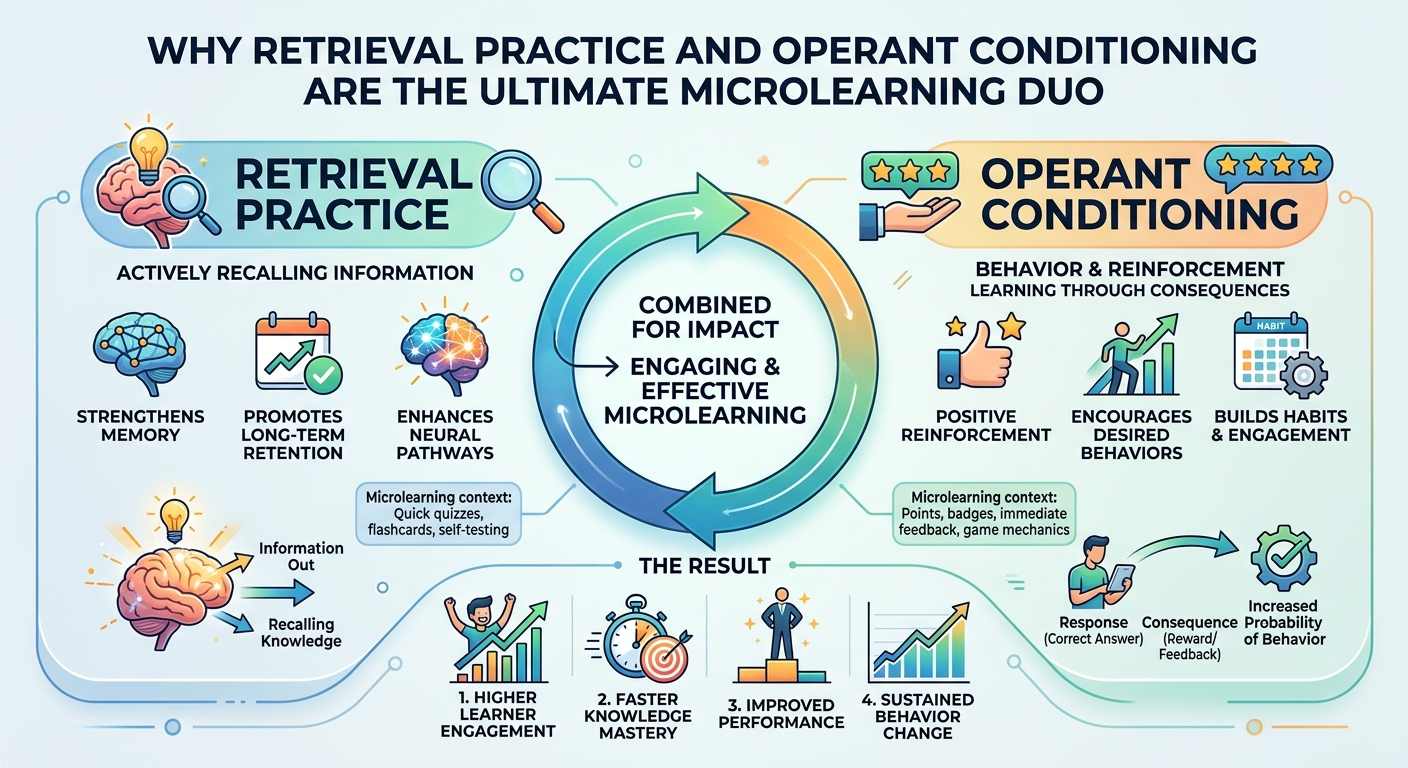
Why Retrieval Practice and Operant Conditioning Are the Ultimate Microlearning Duo
As Learning & Development (L&D) leaders, you're constantly seeking innovative strategies to maximize training effectiveness, engagement, and retention within your organizations. In today's fast-paced corporate environment, traditional lengthy training modules often fall short. This is where microlearning steps in, offering digestible, focused content that fits seamlessly into busy schedules. But what truly supercharges microlearning from a convenient format into a powerhouse of knowledge retention and behavioral change? The answer lies in the synergistic application of two powerful psychological principles: Retrieval Practice and Operant Conditioning.
This article will delve into how these two pillars of learning science, when strategically integrated into a microlearning framework, create an unparalleled learning experience, driving tangible results across diverse industries from compliance and finance to sales and healthcare. We’ll also explore how intelligent systems are further amplifying this duo's potential.
Understanding the Power of Retrieval Practice
Retrieval practice, often referred to as "active recall," is a learning strategy where learners actively retrieve information from memory. Instead of passively re-reading or listening, learners are prompted to pull knowledge out of their minds. This act of recalling doesn't just assess knowledge; it strengthens the memory trace itself, making it easier to retrieve that information again in the future. It's a fundamental aspect of effective learning, proven to combat the forgetting curve.
How Retrieval Practice Transforms Microlearning:
- Enhanced Memory Retention: Short, frequent quizzes or flashcards embedded within microlearning modules force learners to actively recall information, solidifying their understanding.
- Identification of Knowledge Gaps: Immediate feedback on retrieval attempts helps learners pinpoint what they don't know, guiding them to re-engage with specific content segments.
- Increased Engagement: The active nature of retrieval practice keeps learners more engaged than passive consumption, turning learning into an interactive challenge.
- Application in Diverse Contexts: Scenario-based questions or quick problem-solving prompts within microlearning enable learners to practice applying knowledge, which is crucial for roles in retail, banking, and pharma, where quick decision-making is vital.
For organizations leveraging an LMS, integrating retrieval practice can be as simple as adding quick polls, short answer questions, or true/false challenges after each micro-lesson. A modern Microlearning LMS will provide tools to easily author and deploy these interactive elements.
Unleashing the Potential of Operant Conditioning
Operant conditioning, a concept pioneered by B.F. Skinner, is a method of learning that occurs through rewards and punishments for behavior. Essentially, an association is made between a behavior and a consequence for that behavior. In the context of L&D, the focus is overwhelmingly on positive reinforcement – encouraging desired behaviors through rewarding outcomes.
Applying Operant Conditioning to Microlearning:
- Immediate Feedback: Providing instant confirmation of correct answers or guidance on incorrect ones reinforces desired learning behaviors.
- Gamification Elements: Points, badges, leaderboards, and progress bars—hallmarks of a Gamified LMS—serve as powerful positive reinforcements, motivating learners to complete modules and achieve mastery.
- Recognizing Achievements: Acknowledging progress and completion through digital certificates or social sharing options provides a sense of accomplishment.
- Behavioral Shaping: By rewarding small steps towards a larger learning objective, organizations can gradually shape complex behaviors, from mastering a new compliance protocol in finance to improving customer service skills in hospitality.
The consistent application of positive reinforcement within microlearning modules ensures that learners associate successful learning with positive experiences, fostering a continuous learning mindset. An effective learning management system facilitates the systematic delivery of these reinforcements.
The Ultimate Duo: Retrieval Practice and Operant Conditioning in Microlearning
While powerful on their own, retrieval practice and operant conditioning create an unstoppable force when combined within a microlearning framework. Retrieval practice ensures that knowledge is deeply embedded and accessible, while operant conditioning ensures learners are motivated to engage in that retrieval and continue their learning journey.
Imagine a compliance training module in a banking institution. Instead of reading lengthy documents, employees complete a series of 5-minute micro-lessons. Each lesson concludes with a quick scenario-based question (retrieval practice). Answering correctly earns them points and advances them on a progress bar (operant conditioning). If they answer incorrectly, they receive immediate, corrective feedback and are prompted to review a specific micro-segment, ensuring mastery before moving on. This approach transforms dull, mandatory training into an engaging, effective experience.
This dynamic duo drives:
- Superior Knowledge Retention: Active recall combined with positive reinforcement makes information stick.
- High Learner Engagement: The interactive nature keeps learners motivated to complete and excel.
- Measurable Performance Improvement: Stronger memory and positive reinforcement directly translate to better on-the-job application.
- Agile Skill Development: Rapid iteration and reinforcement allow for quicker skill acquisition, essential for industries like tech and sales.
Leveraging a robust learning management software or a dedicated cloud based learning management system is crucial for orchestrating this synergy at scale. An enterprise learning management solution or LCMS can host and track this rich, interactive content.
AI-Driven Microlearning: Amplifying the Duo
The advent of artificial intelligence (AI) is taking the effectiveness of retrieval practice and operant conditioning in microlearning to unprecedented levels. AI doesn't just facilitate; it optimizes, personalizes, and predicts.
AI Questions & Answers for L&D Leaders:
Question for the intelligent system: How can AI personalize retrieval practice for a diverse global workforce across different industry segments?
AI Insight: An AI-powered learning platform can analyze individual learner performance data, identifying specific areas of weakness and automatically generating personalized retrieval quizzes. For example, in a global sales team, an AI could tailor questions to specific product lines relevant to their region, language, and cultural context, while also adapting difficulty levels dynamically. This ensures that retrieval practice is always challenging yet achievable, preventing frustration and maximizing learning efficiency.
Question for an intelligent learning platform: How would an AI-driven system optimize positive reinforcement to sustain engagement in long-term compliance training for a large financial institution?
AI Insight: Beyond basic gamification, an AI can predict potential drop-off points by analyzing engagement patterns. It can then strategically introduce varied rewards, personalized recognition messages, or even 'just-in-time' encouraging prompts. For a financial institution, this might mean an AI-triggered notification congratulating an employee for mastering a complex regulatory module, coupled with a small, relevant digital badge, keeping motivation high through lengthy, mandatory learning paths.
Question for an intelligent authoring tool: What personalized, actionable microlearning path would an AI system recommend for a new hire in a complex industry like oil and gas, focusing on critical safety protocols?
AI Insight: An AI Powered Authoring Tool, integrated into a comprehensive learning content management system, can construct a hyper-personalized onboarding journey. For a new hire, the AI would first assess existing knowledge. Then, it would curate microlearning modules on safety protocols, interspersing them with retrieval practice questions. Based on performance, the AI would adapt the sequence, introduce additional reinforcement, or provide supplemental resources, ensuring a Adaptive Learning path tailored to their unique needs and progress. This focused approach is critical for Risk-focused Training in high-stakes environments.
An lms learning management system integrated with AI capabilities can not only deliver but also intelligently manage and evolve these learning experiences.
Implementing This Duo in Your L&D Strategy
For L&D leaders, the practical application of retrieval practice and operant conditioning through microlearning requires a strategic approach:
- Invest in the Right Platform: A sophisticated MaxLearn LMS or similar learning management solutions with microlearning capabilities, gamification features, and Adaptive Learning pathways is foundational.
- Content Design: Break down complex topics into bite-sized modules (2-7 minutes). Each module should conclude with a retrieval exercise.
- Feedback Loops: Ensure immediate, constructive feedback for all retrieval attempts.
- Meaningful Reinforcement: Go beyond simple points. Consider incorporating badges for skill mastery, certificates for course completion, or leaderboards for healthy competition.
- Data-Driven Iteration: Use analytics from your learning management system to understand where learners struggle or disengage, then refine your content and reinforcement strategies.
This approach has profound implications across industries. In healthcare, regular micro-quizzes on new procedures (retrieval practice) with instant feedback (operant conditioning) ensure compliance and patient safety. In retail, short modules on product knowledge followed by quick recall checks and points directly boost sales performance. Even in mining or oil and gas, scenario-based safety training delivered via microlearning, reinforced by progress tracking, significantly reduces incidents by embedding critical knowledge.
Conclusion
The convergence of retrieval practice and operant conditioning within a microlearning framework is not merely a trend; it’s a scientifically validated approach to creating more effective, engaging, and impactful corporate training. For L&D Vice Presidents, Directors, and Managers, embracing this duo, especially when amplified by AI, means moving beyond traditional checkboxes to fostering genuine knowledge mastery and sustainable behavioral change across your organization.
By investing in smart LMS technology and a content strategy that prioritizes active recall and positive reinforcement, you can unlock unparalleled learning outcomes, driving operational excellence and business growth in an increasingly competitive landscape. This is the ultimate microlearning duo, ready to transform your organization's learning culture.


