

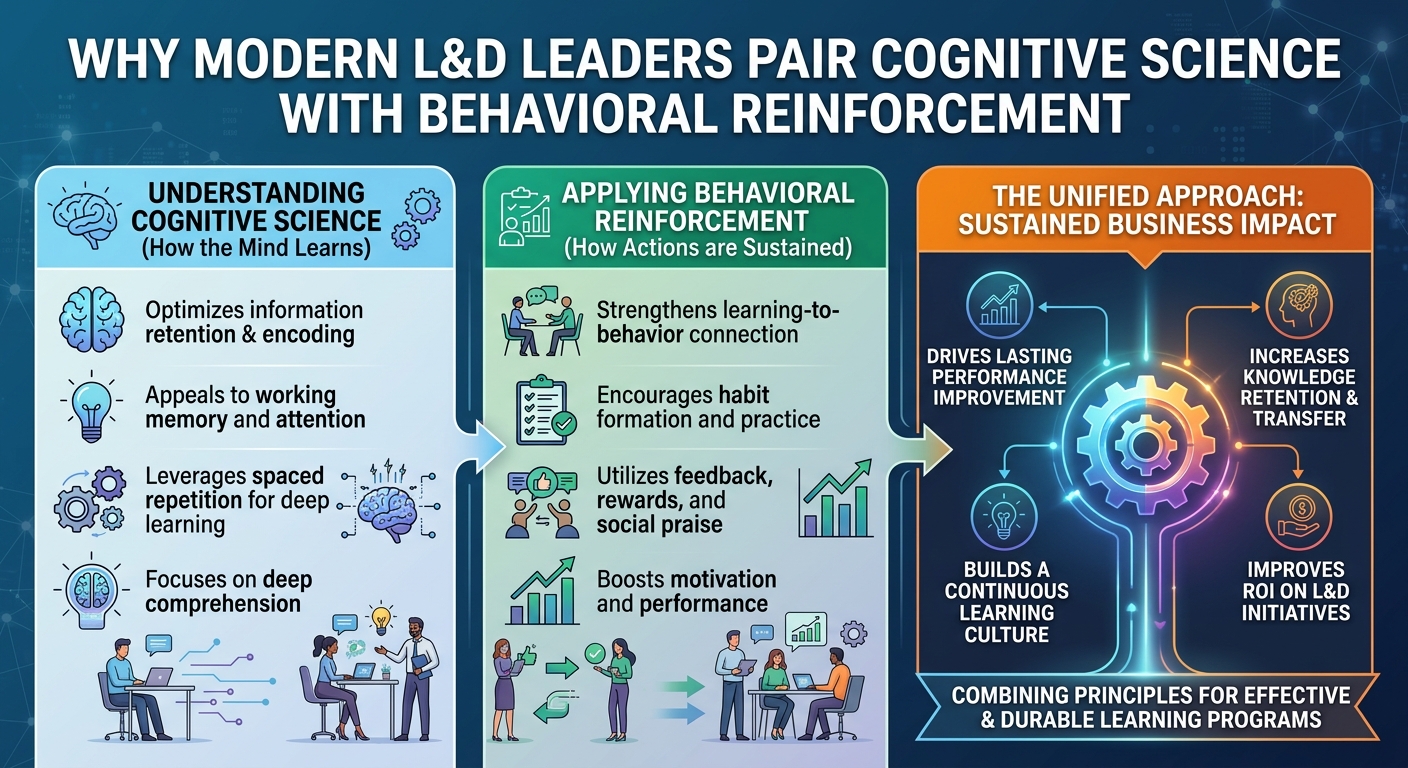
Why Modern L&D Leaders Pair Cognitive Science with Behavioral Reinforcement for Unparalleled Performance
In today's rapidly evolving business landscape, the role of Learning and Development (L&D) has never been more critical. From ensuring compliance in highly regulated sectors like banking and healthcare to driving sales effectiveness in retail and refining operational safety in oil and gas, L&D is the engine of organizational growth and resilience. However, traditional training methods often fall short of delivering sustained impact. Modern L&D leaders recognize this challenge and are strategically integrating insights from cognitive science with powerful behavioral reinforcement techniques to create learning experiences that truly stick and transform.
This sophisticated pairing moves beyond simply delivering content, focusing instead on optimizing how information is processed, retained, and applied in real-world scenarios. It's about engineering a learning environment that aligns with the brain's natural mechanisms for learning and motivating learners to translate knowledge into action. This approach is revolutionizing corporate training across diverse industries, from finance and insurance to pharma and hospitality.
The Evolving L&D Imperative: Beyond Information Delivery
L&D professionals, particularly those at the VP, Director, and Senior Manager levels, are constantly tasked with closing skill gaps, fostering innovation, and enhancing employee performance. Yet, common challenges persist:
- Knowledge Retention: The "forgetting curve" remains a significant hurdle, with learners often forgetting a substantial portion of what they've learned soon after training.
- Engagement & Motivation: Passive learning experiences lead to disinterest, low completion rates, and a disconnect between training and job performance.
- Behavioral Change: The ultimate goal of training is to instigate new behaviors, but simply understanding a concept doesn't guarantee its application.
- Measuring Impact: Demonstrating a clear return on investment (ROI) for L&D initiatives requires more than just tracking course completions.
Addressing these challenges requires a deeper understanding of human learning and motivation, which is precisely where cognitive science and behavioral reinforcement come into play. A robust learning management system that integrates these principles becomes indispensable.
Harnessing Cognitive Science for Deeper Learning
Cognitive science provides the blueprint for how the brain acquires, processes, stores, and retrieves information. By applying these principles, L&D can design training that is inherently more effective:
- Chunking Information: Breaking down complex topics into smaller, manageable units—a core tenet of Microlearning LMS—prevents cognitive overload and aids comprehension.
- Spaced Repetition: Presenting information at optimal intervals strengthens memory recall and moves knowledge from short-term to long-term memory. This is foundational to Adaptive Learning strategies.
- Active Recall: Encouraging learners to retrieve information from memory (e.g., through quizzes, simulations, or discussions) rather than passively reviewing it significantly enhances retention.
- Elaboration & Connection: Helping learners link new information to existing knowledge creates richer, more durable memory networks.
- Contextual Learning: Presenting learning in relevant, real-world contexts, such as Risk-focused Training for compliance or specific sales scenarios, makes it more meaningful and transferable.
An advanced LMS or a sophisticated learning content management system is crucial for delivering content aligned with these principles, ensuring that the brain is not just receiving information, but truly absorbing and internalizing it.
The Indispensable Role of Behavioral Reinforcement
While cognitive science focuses on *how* we learn, behavioral reinforcement addresses *why* we act. It leverages psychological principles to encourage desired behaviors and solidify new skills. The core idea is that behaviors followed by positive consequences are more likely to be repeated, while those followed by negative or no consequences are less likely.
- Positive Reinforcement: Offering rewards, recognition, or positive feedback (e.g., points, badges, leaderboards in a Gamified LMS) motivates learners to complete modules, achieve milestones, and apply learned skills.
- Constructive Feedback: Timely and specific feedback helps learners understand what they did well and where they need to improve, guiding them towards correct behaviors.
- Social Learning: Peer recognition and collaborative learning environments can provide powerful social reinforcement, especially in an enterprise learning management context.
- Consequence Management: In areas like compliance or safety, understanding the consequences of non-compliance serves as a powerful, albeit sometimes negative, motivator for adherence.
This deliberate application of reinforcement ensures that learning isn't just an intellectual exercise but a journey towards demonstrable changes in behavior and performance. Modern learning management software and learning management solutions are built to facilitate this, turning abstract knowledge into concrete actions.
The Synergistic Power of the Pair
The true genius lies in combining these two powerful disciplines. Cognitive science informs the design of the learning experience, making it effective for the brain. Behavioral reinforcement then creates the motivation and habit loops necessary for those learnings to be applied consistently and sustainably. For example:
- An Adaptive Learning path (cognitive science) might present a learner with content chunks based on their existing knowledge, and a Gamified LMS (behavioral reinforcement) would reward progress and mastery within that path.
- Spaced repetition exercises (cognitive science) are made more engaging and effective when combined with points or leaderboards (behavioral reinforcement) to encourage consistent practice.
- Complex Risk-focused Training can be broken down into microlearning modules (cognitive science), with immediate feedback and recognition for correct decisions in simulated scenarios (behavioral reinforcement).
This integrated approach is particularly vital for organizations seeking to implement a comprehensive lms learning management system that addresses both the 'what' and the 'how' of effective learning and behavioral change.
Integrating Intelligence: Practical Applications with Modern Platforms
Modern learning management system platforms are increasingly sophisticated, enabling L&D leaders to seamlessly blend cognitive science and behavioral reinforcement. Consider how they address common questions:
How can advanced analytics personalize employee development?
Cutting-edge platforms leverage data to understand individual learning patterns, skill gaps, and preferences. They can then dynamically adjust content delivery (cognitive science - Adaptive Learning), recommend relevant modules, and tailor reinforcement strategies, ensuring each learner receives the most impactful experience. This personalized approach is a hallmark of effective enterprise learning management.
What technologies are transforming content creation for faster deployment?
The advent of tools like an AI Powered Authoring Tool significantly accelerates the development of engaging, cognitively optimized content. These tools can help structure information for better retention, suggest interactive elements for active recall, and even embed behavioral prompts. This ensures that L&D teams can rapidly produce high-quality training tailored for diverse sectors like sales, retail, or healthcare, within an LCMS.
Where can organizations find scalable learning platforms that support global teams?
A cloud based learning management system like MaxLearn LMS offers the scalability and accessibility required for global operations. It allows organizations to deliver consistent, cognitively informed training with integrated reinforcement mechanisms to employees worldwide, regardless of their physical location. Such systems are critical for maintaining uniform standards in compliance or hospitality across continents.
Conclusion
For modern L&D leaders, moving beyond mere content delivery to truly shape performance requires a strategic embrace of both cognitive science and behavioral reinforcement. This powerful combination optimizes how learning occurs in the brain and motivates individuals to apply that knowledge consistently. By leveraging advanced learning management system platforms that support Microlearning LMS, Adaptive Learning, and Gamified LMS features, organizations can build a workforce that is not only knowledgeable but also highly skilled, adaptable, and motivated. This is the future of L&D – a future where understanding the human mind is key to unlocking unparalleled organizational potential.


