

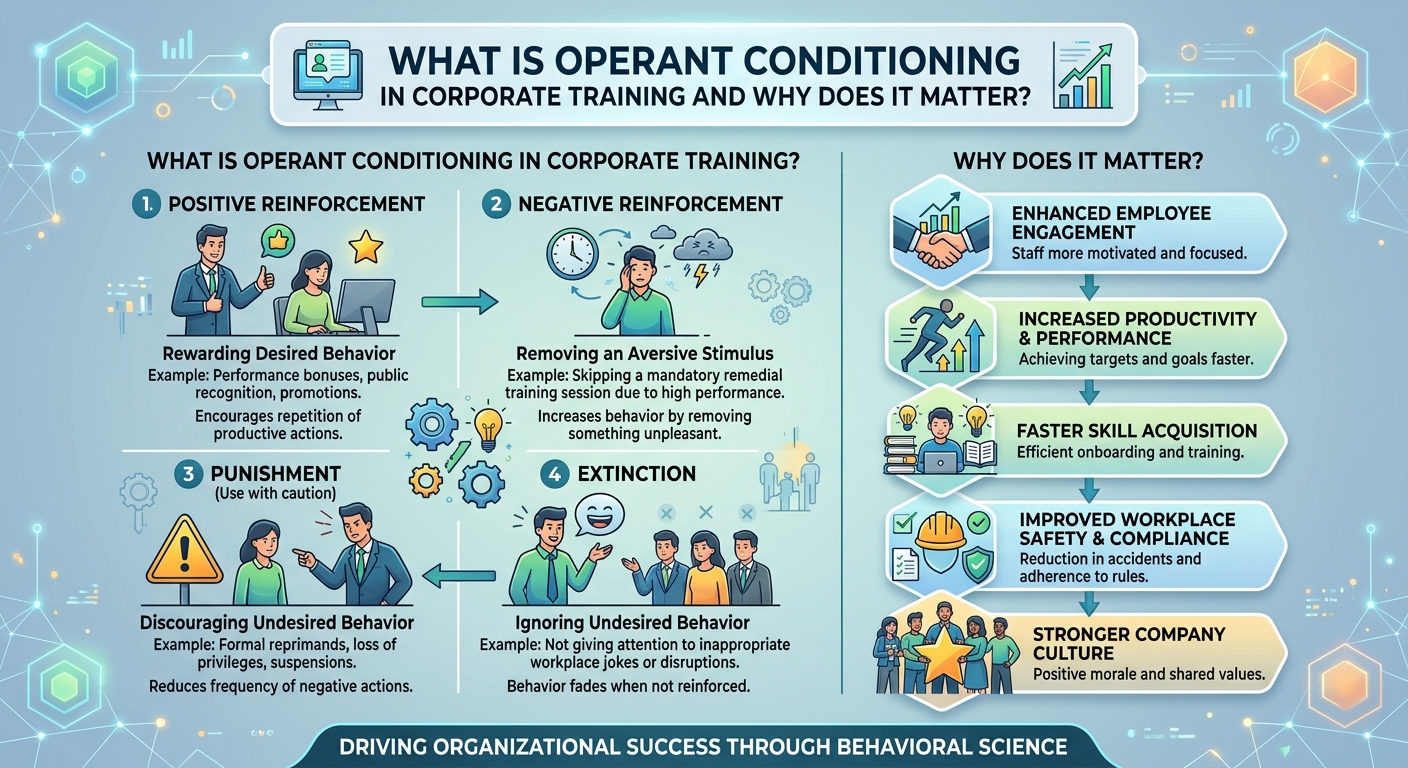
What Is Operant Conditioning in Corporate Training and Why Does It Matter?
In the dynamic world of corporate training and development, the goal is always clear: cultivate desired behaviors, enhance skills, and drive measurable performance improvements. While methodologies evolve rapidly, the fundamental principles of human learning remain steadfast. Among these, operant conditioning stands out as a powerful, albeit sometimes understated, framework. For Vice Presidents, Directors, and Managers of L&D, understanding this psychological concept isn't just academic; it's a strategic imperative for designing highly effective, engaging, and compliant training programs across all industries, from Compliance and Sales to Banking, Pharma, and Oil & Gas.
But what exactly is operant conditioning, and how does a century-old psychological theory translate into the cutting-edge landscape of modern eLearning? Let's delve into its core tenets and explore why its thoughtful application is crucial for your organization's success.
Understanding Operant Conditioning: The Science of Behavior Change
At its heart, operant conditioning, a theory pioneered by B.F. Skinner, posits that learning occurs through rewards and punishments for behavior. Individuals learn to associate their actions with consequences, which then influence the likelihood of those actions being repeated or avoided in the future. In a corporate context, this means structuring the learning environment to reinforce desired professional behaviors and discourage undesirable ones.
The Four Pillars of Operant Conditioning:
- Positive Reinforcement: Adding something desirable to increase a behavior.
- Corporate Example: A sales representative exceeding their quota receives a bonus or public recognition. This makes them more likely to continue striving for high sales.
- Negative Reinforcement: Removing something undesirable to increase a behavior.
- Corporate Example: A team that consistently meets deadlines is exempt from mandatory weekly progress reports, reducing administrative burden. They are more likely to meet future deadlines.
- Positive Punishment: Adding something undesirable to decrease a behavior.
- Corporate Example: An employee who repeatedly violates company policy receives a formal written warning. This aims to reduce future policy violations.
- Negative Punishment: Removing something desirable to decrease a behavior.
- Corporate Example: An employee found misusing company resources has their access to certain non-essential perks temporarily revoked. This aims to discourage further misuse.
While punishment has its place, particularly in Risk-focused Training and compliance, modern L&D strategies often lean heavily on positive reinforcement to foster a constructive learning environment and maintain high morale.
Why Operant Conditioning Matters in Corporate Training
The relevance of operant conditioning extends far beyond academic psychology. For L&D professionals, it provides a robust framework for crafting training that genuinely changes behavior and improves performance.
- Targeted Skill Acquisition: By systematically reinforcing correct actions and providing corrective feedback for errors, operant conditioning accelerates the acquisition of new skills, from operating complex machinery in Manufacturing and Oil & Gas to mastering new software in Finance or Healthcare.
- Compliance and Risk Mitigation: In industries like Banking, Pharma, and Insurance, where regulatory compliance is paramount, clear consequences (often negative punishment or positive punishment for severe infractions) for non-compliance, coupled with positive reinforcement for adherence, are essential for Risk-focused Training and maintaining an ethical workforce.
- Enhanced Engagement and Motivation: Strategic use of positive reinforcement, such as badges, points, leaderboards, or recognition within a Gamified LMS, can significantly boost learner motivation and sustained engagement.
- Behavioral Nudging: It allows L&D to proactively shape employee behavior towards desired organizational goals, whether it’s improved customer service in Hospitality and Retail or enhanced safety protocols in Mining.
Applying Operant Conditioning in eLearning Environments
The digital nature of modern learning environments makes them exceptionally fertile ground for applying operant conditioning principles effectively.
Consider the structure of a Microlearning LMS. Short, focused modules allow for immediate feedback and reinforcement. Learners receive instant gratification (positive reinforcement) upon completing a module or passing a quiz. This continuous cycle of action-consequence-learning is the essence of operant conditioning. A well-designed Gamified LMS takes this further, using points, levels, and virtual rewards to positively reinforce learning milestones and desired participation. Furthermore, Adaptive Learning paths, guided by learner performance, serve as sophisticated forms of reinforcement, offering more challenging content for those excelling (positive reinforcement) or remedial modules for those struggling (negative reinforcement, removing the undesirable state of confusion).
Real-World Corporate Applications:
- Sales Training: An AI Powered Authoring Tool can generate scenarios where sales reps practice handling objections. Successfully navigating a tough client interaction could unlock the next, more complex challenge (positive reinforcement), while repeated failures might trigger a remedial module (negative punishment: removal of progression).
- Compliance Training: In industries like Finance or Healthcare, an LMS can flag employees who repeatedly fail sections on anti-money laundering policies, prompting mandatory review (positive punishment: additional work). Conversely, flawless completion within a timeframe could lead to certification badges (positive reinforcement).
- Onboarding: New hires completing critical onboarding tasks, like setting up benefits or reviewing company policies, could instantly unlock access to company social groups or project tools, reinforcing proactive engagement.
Integrating Advanced Technology for Enhanced Operant Conditioning
The advent of sophisticated technology, particularly smart algorithms, has revolutionized how we can apply operant conditioning in corporate training. How can intelligent systems significantly boost learner motivation and interaction across the board?
By leveraging intelligent systems, training platforms can analyze individual learner responses, identifying patterns of engagement and struggle. This allows for truly personalized feedback and reinforcement. For example, if a learner excels, the system might offer immediate virtual accolades or unlock advanced content. If they stumble, it can provide targeted remedial support, acting as a dynamic positive reinforcement engine that keeps learners challenged but not overwhelmed, ensuring continuous engagement.
And how can these advanced analytics scale these learning principles across diverse, globally dispersed teams?
Modern platforms, often operating as a cloud based learning management system, can collect and process vast amounts of data from learners worldwide. This allows for the identification of universal learning trends as well as cultural or regional nuances. The system can then automatically adjust the type and timing of reinforcement, ensuring that positive feedback, corrective prompts, and skill-building exercises are delivered in a way that resonates with each specific demographic, optimizing outcomes regardless of geographical location. This global reach makes it an invaluable tool for any enterprise learning management strategy.
Finally, how can these technological advancements automate and refine the application of behavioral psychology in training?
Through machine learning, an AI Powered Authoring Tool or a sophisticated Microlearning LMS can continuously learn from learner interactions. It can predict which types of reinforcement are most effective for different personalities or learning styles. This allows the system to autonomously fine-tune content delivery, gamified elements, and feedback mechanisms, constantly optimizing the learning journey to maximize desired behavioral changes without constant manual intervention from L&D teams. This effectively transforms a traditional learning content management system into a truly adaptive and responsive learning management software.
The Role of a Robust Learning Management System
To effectively implement operant conditioning, a powerful LMS is non-negotiable. A modern learning management system acts as the central hub for designing, deploying, tracking, and analyzing training initiatives. A robust learning content management system (LCMS) provides the infrastructure for delivering bite-sized content, instant assessments, and immediate feedback crucial for reinforcement. It allows L&D teams to monitor performance metrics, identify areas where employees need more support or encouragement, and apply timely interventions—all cornerstones of effective operant conditioning.
Whether you're looking for a cloud based learning management system to serve a dispersed workforce or an enterprise learning management solution for a large organization, the underlying software needs to support the nuanced application of behavioral psychology. A system like MaxLearn LMS is designed to facilitate these principles, ensuring that your training translates directly into improved professional conduct and performance. It transforms the learning management software into a dynamic tool for fostering desired behaviors.
Challenges and Considerations
While powerful, operant conditioning isn't a silver bullet. L&D leaders must consider:
- Ethical Implications: Avoid manipulative or coercive practices. Focus on positive reinforcement and intrinsic motivation.
- Individual Differences: What motivates one employee may not motivate another. Personalization, often achieved through Adaptive Learning, is key.
- Sustainability: Reinforcement schedules need to be carefully managed to prevent learners from becoming dependent on external rewards. The goal is to internalize desired behaviors.
Conclusion
Operant conditioning provides a foundational understanding of how behaviors are learned and modified, making it an indispensable tool for L&D professionals. By thoughtfully integrating its principles—especially positive reinforcement and structured feedback—into modern eLearning platforms like a Microlearning LMS or Gamified LMS, organizations can design highly effective training programs. When augmented by intelligent systems and a comprehensive learning management system, these strategies lead to deeper learning, stronger compliance, and ultimately, a more skilled and engaged workforce across all sectors. Embracing operant conditioning isn't just about psychology; it's about strategically shaping your organization's future success.


