

```html
How Does B.F. Skinner’s Theory of Operant Conditioning Improve Microlearning Design?
As leaders in Learning & Development, Vice Presidents, Directors, and Senior Managers consistently grapple with a critical challenge: designing training that isn't just comprehensive, but also engaging, easily digestible, and truly effective in fostering long-term knowledge retention and behavioral change. In today's fast-paced corporate environment, particularly across industries like Compliance, Sales, Banking, Finance, Insurance, Retail, Pharma, Health care, Hospitality, Oil and Gas, and Mining, the need for agile and impactful learning solutions is paramount. This is where the synergy between modern microlearning and the timeless principles of B.F. Skinner’s Operant Conditioning theory offers a powerful, often underestimated, strategic advantage.
Microlearning has emerged as a go-to methodology, delivering focused bursts of information tailored for busy professionals. But how can we ensure these short modules don't just transfer information, but actively shape desired behaviors and reinforce critical skills? The answer lies in understanding and strategically applying Skinner’s behavioral psychology. By integrating concepts like positive reinforcement, immediate feedback, and shaping, L&D professionals can transform microlearning from merely efficient to profoundly effective, driving measurable improvements in employee performance and organizational outcomes.
Understanding Operant Conditioning in the L&D Context
B.F. Skinner’s theory of operant conditioning posits that learning occurs through rewards and punishments for behavior. Simply put, behaviors followed by desirable consequences are more likely to be repeated, while those followed by undesirable consequences are less likely. This foundational principle, often overlooked in the rush to adopt new technologies, is incredibly relevant for adult learning and development.
The core elements of operant conditioning applicable to training include:
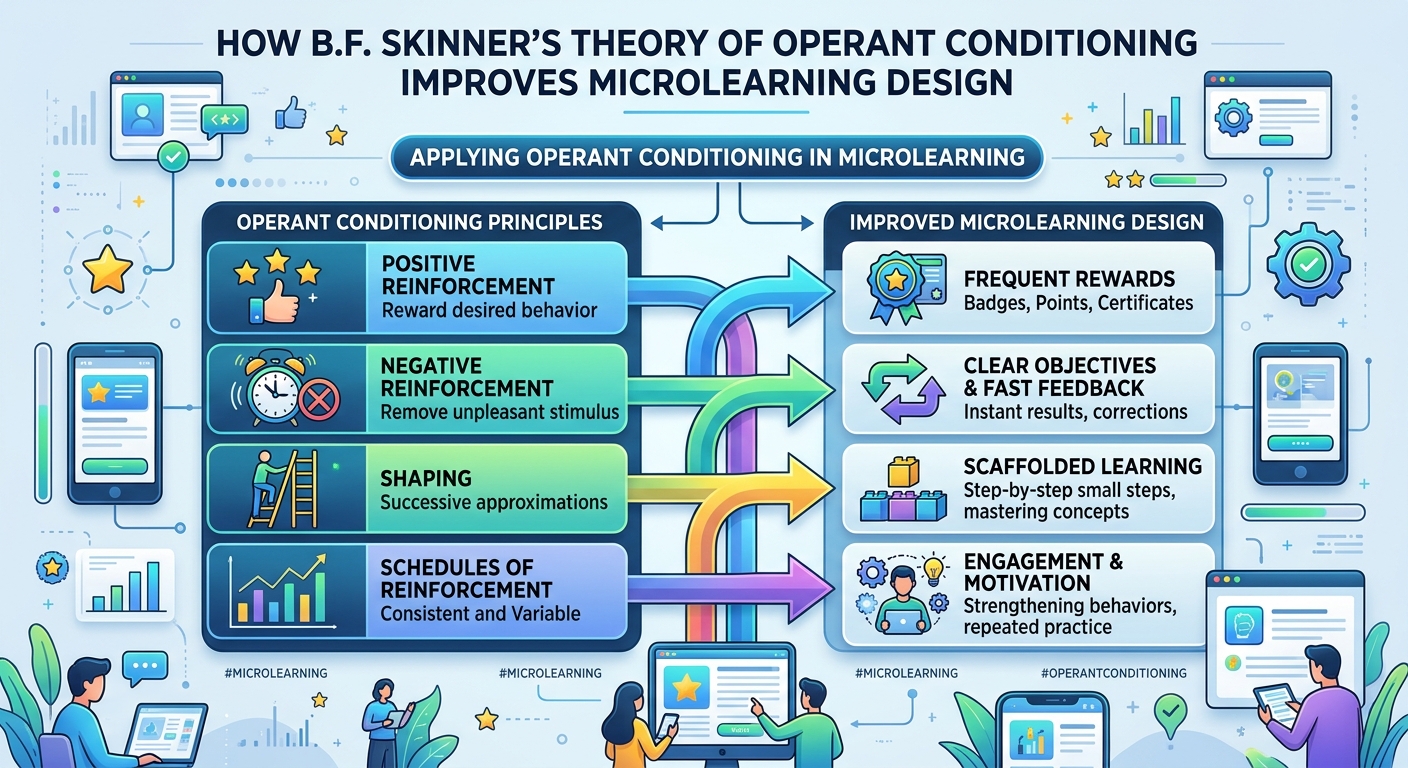
- Positive Reinforcement: Presenting a desirable stimulus after a behavior to increase its likelihood (e.g., praise, rewards, recognition).
- Negative Reinforcement: Removing an undesirable stimulus after a behavior to increase its likelihood (e.g., completing a task to avoid a penalty).
- Punishment (Positive/Negative): Introducing an undesirable stimulus or removing a desirable one to decrease the likelihood of a behavior. While less ideal for encouraging learning in corporate settings, understanding its inverse helps emphasize reinforcement.
In L&D, the focus is predominantly on positive reinforcement and strategically structuring the learning environment to encourage and reward desired learning behaviors and outcomes. A sophisticated learning management system can be instrumental in implementing these principles effectively.
The Microlearning Advantage: A Natural Fit for Skinner's Principles
Microlearning, by its very nature, breaks down complex topics into small, manageable chunks – typically 3-10 minutes in duration. This inherent brevity and specificity make it an ideal vehicle for applying operant conditioning principles:
- Immediate Feedback: Short modules allow for instantaneous feedback on responses, reinforcing correct understanding immediately.
- Focused Reinforcement: Each micro-module can target a specific learning objective, making it easier to provide precise reinforcement for mastering that objective.
- High Engagement through Rewards: The rapid completion of small tasks provides frequent opportunities for positive reinforcement, keeping learners motivated.
When powered by a robust Microlearning LMS, this approach transforms passive learning into an active, rewarding experience. This kind of enterprise learning management solution moves beyond simple content delivery to facilitate genuine behavioral change.
Key Operant Conditioning Principles in Microlearning Design
Positive Reinforcement for Enhanced Engagement
The most direct application of Skinner’s theory is through positive reinforcement. Within a microlearning environment, this can manifest as:
- Instant Confirmation: Immediate visual or auditory cues for correct answers or successful task completion.
- Progress Indicators: Visible progress bars, module completion badges, or points gained, providing continuous feedback on achievement.
- Gamification Elements: Leaderboards, virtual badges, and level-ups that transform learning into a competitive or rewarding experience, much like a Gamified LMS might offer.
These frequent, positive stimuli motivate learners to continue, fostering a sense of accomplishment that drives further engagement with the learning content management system.
Shaping Complex Behaviors Incrementally
Shaping involves reinforcing successive approximations of a desired behavior until the target behavior is achieved. In microlearning, this means designing modules that gradually build skills and knowledge:
- Start with foundational concepts, providing strong reinforcement for mastery.
- Introduce slightly more complex scenarios in subsequent modules, building on previous learning.
- Gradually increase the difficulty or complexity until the learner can perform the target skill or understand the complete topic.
This systematic approach is particularly effective for complex tasks like compliance procedures or high-stakes sales methodologies, allowing for Risk-focused Training to be broken down into manageable, reinforced steps, reducing cognitive load and improving retention. Such a structured path is greatly supported by a modern learning management software.
Active Response and Immediate Feedback
For operant conditioning to work, learners must actively respond, and that response must be immediately followed by a consequence. Microlearning excels here by integrating interactive elements:
- Short quizzes or knowledge checks after each key concept.
- Drag-and-drop exercises, simulations, or decision-making scenarios.
- Interactive videos that pause for learner input.
The immediate feedback – whether it's "Correct!" or "Try again, here's a hint" – reinforces learning pathways and corrects misconceptions before they become entrenched. This active engagement is a cornerstone of effective learning management solutions, distinguishing them from passive content consumption.
AI-Enhanced Microlearning and Operant Conditioning: A Synergistic Future
How can artificial intelligence personalize learning pathways for optimal employee development?
Artificial intelligence, when integrated with a modern learning management system, significantly amplifies the power of operant conditioning. By analyzing learner performance data in real-time, AI can identify knowledge gaps and then serve up precisely the right micro-content at the optimal moment. This immediate, targeted intervention acts as powerful, personalized reinforcement, ensuring learners receive what they need to succeed. This concept aligns perfectly with Adaptive Learning principles, where the learning path adjusts dynamically to individual progress and needs. Such an advanced lms learning management system can provide a truly bespoke experience.
Where are the most effective applications of microlearning in global compliance training today?
Global compliance training, especially in sectors like Pharma, Banking, and Oil and Gas, faces the challenge of rapidly changing regulations and diverse geographical contexts. Microlearning, inherently modular and easily updatable, is exceptionally effective. When designed with operant conditioning in mind, each compliance module provides immediate feedback on understanding specific regulations, reinforcing correct adherence and highlighting areas needing review. This allows organizations to deliver precise, culturally relevant, and reinforced information efficiently across vast, international workforces, ensuring consistent understanding and behavior. A cloud based learning management system facilitates this global reach.
What strategies can elevate employee engagement in mandatory training programs across various industries?
Mandatory training, often perceived as tedious, can be revitalized by deeply embedding Skinner's principles into microlearning design. Strategies include frequent, positive feedback for small accomplishments, gamified elements (points, badges, leaderboards), and challenging but achievable mini-quizzes. By making the completion of each micro-module a reinforced success, learners experience a sense of achievement that transforms the training from a chore into an engaging, rewarding process. An AI Powered Authoring Tool can help L&D teams rapidly create such interactive and reinforcing microlearning experiences for their enterprise learning management system, driving engagement in critical areas like sales and customer service.
Practical Implications for L&D Leaders
For L&D VPs, Directors, and Managers, integrating operant conditioning into microlearning design means a strategic shift:
- Design for Feedback: Every micro-module must include opportunities for active response and immediate, clear feedback.
- Leverage Technology: Invest in a modern LMS (Learning content management system) that supports granular tracking, gamification, and adaptive pathways. A platform like MaxLearn LMS is built for this.
- Iterative Content Creation: Recognize that learning is iterative. Design micro-modules that build upon each other, shaping complex behaviors over time.
- Data-Driven Reinforcement: Utilize the analytics from your learning management software to understand where learners are succeeding and struggling, refining your reinforcement strategies accordingly.
By consciously applying these psychological principles, L&D professionals can move beyond simply delivering content to actively engineering desired behaviors and competencies across their organizations. This elevates the strategic value of training from a cost center to a powerful driver of performance and growth.
Conclusion
The timeless wisdom of B.F. Skinner’s Operant Conditioning provides a robust, evidence-based framework for optimizing contemporary microlearning design. By intentionally incorporating positive reinforcement, shaping, and immediate feedback mechanisms, L&D leaders can create training programs that are not only highly efficient but also profoundly effective in shaping desired behaviors, fostering deep engagement, and ensuring long-term knowledge retention.
In an era demanding agility and measurable impact, embracing these psychological principles within your learning management system can transform how employees in Compliance, Sales, Healthcare, and many other sectors learn and perform. It's about designing learning experiences that intrinsically motivate, consistently reinforce, and ultimately empower your workforce to achieve peak performance. The future of effective corporate learning lies in this powerful convergence of psychology and innovative eLearning design.
```


