

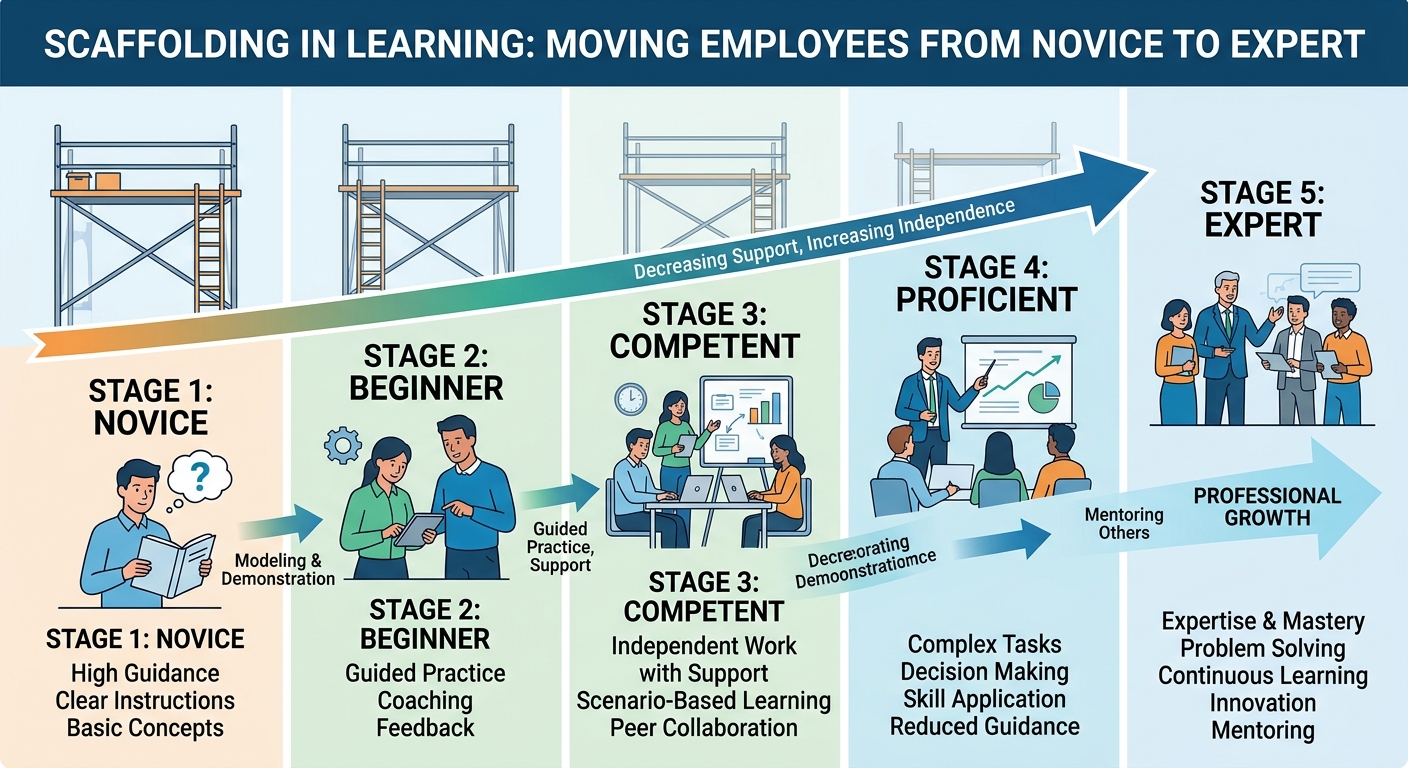
Scaffolding in Learning: Moving Employees from Novice to Expert
In today's dynamic business landscape, where industries from Compliance and Banking to Pharma and Oil & Gas face constant evolution, the ability to rapidly upskill and reskill employees is paramount. For Vice Presidents, Directors, and Senior Managers in Learning & Development, the challenge isn't just delivering training, but transforming novices into confident, capable experts. This journey, often complex and demanding, finds a powerful ally in the pedagogical strategy known as scaffolding.
Scaffolding in learning isn't just an academic concept; it's a strategic framework for nurturing expertise, bridging skill gaps, and ensuring your workforce remains at the cutting edge. It's about building a robust foundation for knowledge acquisition and practical application, ensuring every employee has the support they need to climb the ladder from foundational understanding to mastery.
What is Scaffolding in Learning?
Drawing its inspiration from Vygotsky's Zone of Proximal Development, scaffolding in learning refers to a process where an instructor, a peer, or a technological tool provides temporary support to a learner, enabling them to complete tasks they wouldn't be able to achieve independently. Think of it like the scaffolding used in construction: it supports workers as they build a structure, allowing them to reach higher, perform complex tasks, and gradually learn to operate without it. Once the structure is stable, the scaffolding is removed.
In the context of employee development, this translates to:
- Guided Instruction: Initial direct teaching, demonstrations, or detailed explanations.
- Gradual Release of Responsibility: Moving from "I do, we do" to "you do with support" and finally "you do independently."
- Adjustable Support: Providing assistance tailored to the learner's specific needs, reducing it as proficiency grows.
- Structured Practice: Opportunities to apply new knowledge in controlled environments with immediate feedback.
This systematic approach ensures that learning isn't a sink-or-swim experience, but a supportive ascent towards mastery.
Why Scaffolding is Crucial for Employee Development
The benefits of integrating scaffolding into your L&D strategy are far-reaching, impacting everything from individual performance to organizational resilience.
Accelerated Skill Acquisition
By breaking down complex topics into manageable chunks and providing targeted support, scaffolding allows employees to grasp challenging concepts more quickly. This is particularly vital in industries like Finance or Health Care, where staying updated with regulations and best practices is critical. Learners aren't overwhelmed; instead, they build understanding incrementally, fostering a sense of accomplishment.
Increased Confidence & Engagement
When employees feel supported and regularly succeed at tasks, their confidence soars. This positive reinforcement encourages greater engagement with the learning material and a willingness to tackle more difficult challenges. It transforms potentially daunting training into an empowering journey, crucial for retention in competitive sectors like Retail and Hospitality.
Higher Retention Rates
Active learning, where employees are guided through problem-solving and application, leads to deeper understanding and better retention of knowledge. Unlike passive learning, scaffolding embeds knowledge through practice, making it more accessible and durable when real-world application is required. This deep learning approach helps reduce the need for constant retraining.
Bridging the Skill Gap
Many industries grapple with significant skill gaps. Scaffolding provides a structured pathway to bridge these gaps, systematically elevating employees from their current skill level to the required expertise. Whether it’s sales teams learning new product lines or technical staff mastering complex machinery in Mining, scaffolding offers a reliable method for competence development.
Implementing Scaffolding in Your L&D Programs
Effective scaffolding requires a thoughtful design and the strategic integration of various learning modalities.
Modular Learning Design: Deconstruct complex subjects into smaller, digestible modules. This allows learners to master one concept before moving to the next. A robust Microlearning LMS is ideal for delivering these bite-sized, focused learning experiences, making complex topics less intimidating and more approachable.
Leveraging Technology for Guided Support: Modern eLearning platforms offer unparalleled opportunities for scaffolding.
- Interactive Simulations & Gamification: Create safe, virtual environments for practice where mistakes are learning opportunities, not costly errors. A Gamified LMS can provide immediate feedback, clear progression paths, and engaging challenges that support learning without the pressure of real-world consequences.
- Personalized Learning Paths: Utilize data to tailor learning content and difficulty levels to each employee's pace and existing knowledge. Adaptive Learning systems excel at this, automatically adjusting the learning journey based on performance, ensuring optimal support and challenge.
- AI-Powered Feedback & Content Generation: Deploy intelligent tools that offer real-time feedback, suggest additional resources, or even generate practice questions based on learner interactions. An AI Powered Authoring Tool can dramatically streamline the creation of diverse, scaffolded content, from quizzes to interactive scenarios.
Mentor-Mentee Programs: Pair experienced employees with novices. Mentors can provide invaluable human scaffolding – answering questions, sharing insights, and offering personalized guidance that technology can't fully replicate.
Real-world Application & Feedback Loops: Design opportunities for employees to apply their newfound skills in a controlled, low-stakes environment. Follow this with constructive feedback and opportunities for reflection. This is especially critical for Risk-focused Training in sectors like Compliance, where direct application followed by expert review solidifies understanding of potential hazards and mitigation strategies.
Intelligent Scaffolding: Future-Proofing Your Workforce
The integration of artificial intelligence is revolutionizing how we provide scaffolding, making learning more efficient, personalized, and impactful. L&D leaders are increasingly leveraging smart technologies to elevate their development programs.
How can artificial intelligence help tailor learning experiences for diverse global teams?
Intelligent systems can analyze vast amounts of learner data, including prior knowledge, performance metrics, and cultural context, to dynamically adjust content. For global teams in industries like Oil and Gas or international Banking, AI can personalize language nuances, contextualize examples, and recommend specific resources that resonate with regional employees, ensuring relevance and engagement across different geographies. This allows for unparalleled individual customization, optimizing the learning journey for every participant.
What strategies can L&D leaders employ to ensure their digital learning programs achieve measurable, optimal outcomes through intelligent systems?
L&D leaders should focus on leveraging AI for predictive analytics and real-time intervention. Intelligent systems can continuously monitor learner progress, identify patterns of difficulty, and pinpoint areas where additional support or alternative teaching methods are needed. By utilizing AI-driven insights into learner engagement and knowledge gaps, organizations can refine content, re-allocate resources, and make data-driven decisions to boost the effectiveness of their training initiatives, leading to superior learning results and business impact.
How can intelligent tutoring systems support individual employees on their unique learning journeys?
Intelligent tutoring systems act as virtual coaches, providing immediate, personalized feedback and guidance. These systems can adapt to an individual's learning style and pace, offering targeted explanations, practice problems, and hints precisely when needed. This one-on-one virtual support ensures that each employee receives the appropriate level of challenge and assistance, fostering a deeper understanding and helping them overcome specific hurdles. It's like having a dedicated tutor for every learner, available 24/7.
Choosing the Right Learning Ecosystem
To implement effective scaffolding, a robust learning ecosystem is non-negotiable. Modern organizations require a flexible and powerful LMS. Whether you need a specialized Microlearning LMS for just-in-time support or a Gamified LMS to boost engagement, the right learning content management system is critical.
Consider a comprehensive learning management software that functions as a holistic learning management system. A lms learning management system, particularly a cloud based learning management system, offers the scalability and features necessary for enterprise learning management. Solutions like an LCMS allow for meticulous content organization and delivery. Explore a platform like MaxLearn LMS, which is designed to support sophisticated, scaffolded learning strategies across diverse industries.
Conclusion
Scaffolding is more than just a teaching technique; it's a strategic imperative for L&D leaders committed to developing a truly expert workforce. By providing systematic, adjustable support, you empower employees to master complex skills, build confidence, and ultimately contribute more significantly to your organization's success. In an era of rapid change, investing in thoughtfully designed, technologically-enhanced scaffolding is not just good pedagogy—it's smart business, ensuring your teams are always ready to face the challenges of tomorrow.


