

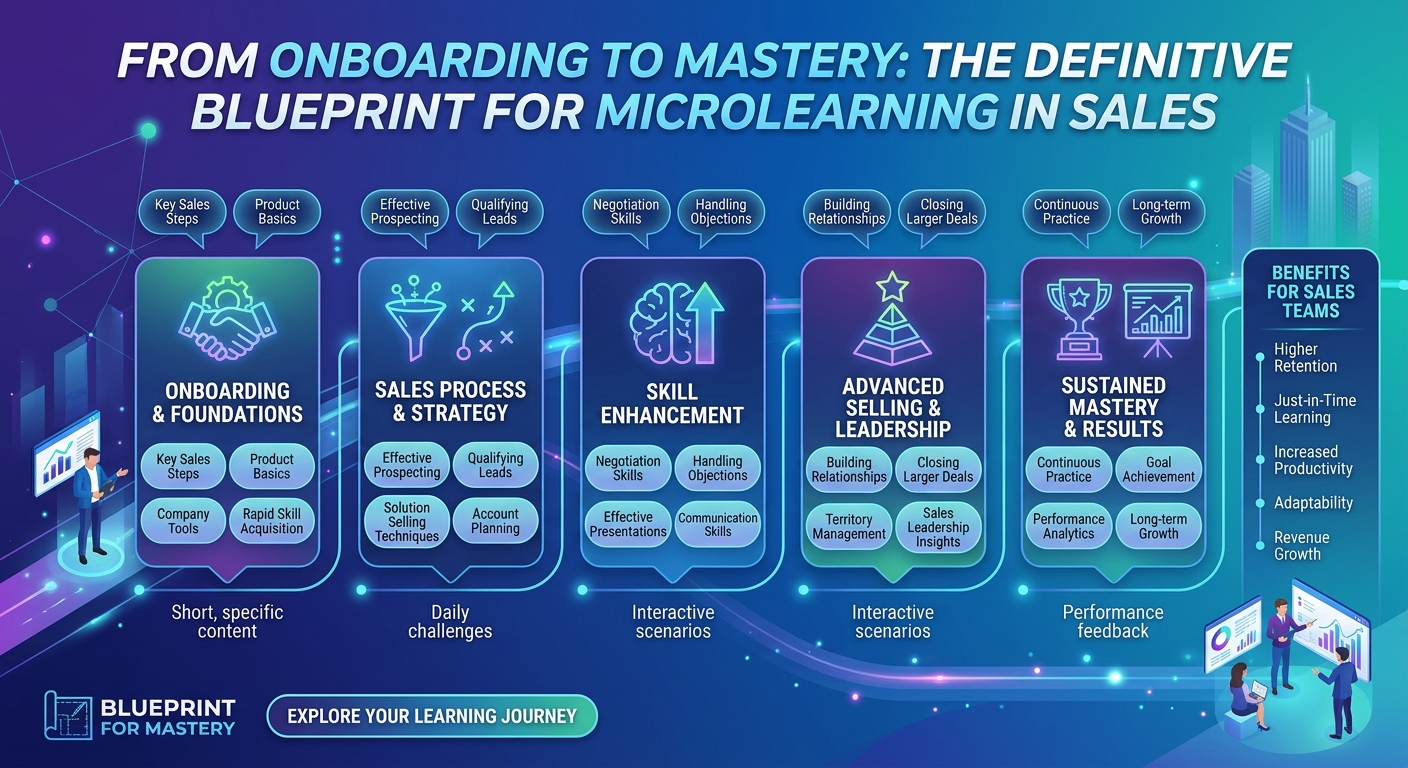
From Onboarding to Mastery: The Definitive Blueprint for Microlearning in Sales
In the high-stakes world of sales, continuous learning isn't just an advantage; it's a necessity. Sales professionals, whether in banking, retail, healthcare, or oil and gas, face an relentless barrage of new products, evolving market dynamics, and increasingly sophisticated customer expectations. Traditional, lengthy training sessions often fall short, struggling with retention rates and taking valuable time away from revenue-generating activities. This is where microlearning emerges as a powerful, strategic solution, transforming how sales teams acquire and master essential skills from their very first day through their entire career journey.
For L&D Vice Presidents, Directors, and Managers, the challenge is clear: how do we deliver impactful, agile, and measurable training that scales across diverse industries and keeps pace with the speed of business? The answer lies in a well-executed microlearning strategy, powered by a sophisticated Microlearning LMS, that moves sales professionals from foundational onboarding to unparalleled mastery.
Why Microlearning for Sales? The Untapped Potential
The modern sales landscape demands agility. Sales cycles are faster, customer attention spans are shorter, and product portfolios are ever-expanding. In such an environment, long-form courses can become outdated before completion, and the sheer volume of information can lead to cognitive overload.
The Evolving Sales Landscape
Today's sales professionals need information exactly when they need it, in a format that's easy to digest and immediately applicable. They can't afford to spend days in off-site workshops when a critical client call is on the horizon. This demand for just-in-time learning makes microlearning an ideal fit.
Benefits for Sales Teams
- Enhanced Retention: Smaller, focused chunks of information are easier to remember and recall.
- Time Efficiency: Quick modules (2-7 minutes) mean less time away from selling, improving productivity.
- Immediate Application: Learners can apply new knowledge and skills almost instantly, reinforcing learning.
- Personalization: Tailored content addresses specific skill gaps and learning preferences.
- Higher Engagement: Interactive, bite-sized modules keep learners motivated and invested.
The Microlearning Blueprint: Onboarding for Rapid Sales Readiness
Onboarding is critical. It sets the tone for a salesperson's entire tenure and determines how quickly they become productive. Traditionally, it's a firehose of information that often overwhelms new hires.
Foundation of Success
Microlearning breaks down the overwhelming onboarding process into manageable, digestible units. Instead of a week-long seminar, new hires can engage with a series of short modules covering:
- Company values and culture (e.g., a 3-minute video from the CEO).
- Core product knowledge (e.g., 5-minute interactive simulations for each product line).
- Sales process steps and methodologies (e.g., short animated guides).
- CRM basics and essential tools (e.g., click-through tutorials).
- Key compliance requirements (e.g., quick quizzes on industry regulations relevant to banking or insurance).
This structured approach, delivered via a robust learning management system, ensures new sales professionals absorb critical information without feeling overwhelmed, fostering confidence and speeding up their time to proficiency.
The Microlearning Blueprint: Continuous Development & Mastery
Onboarding is just the beginning. True mastery comes from continuous learning and skill refinement. Microlearning excels here, providing ongoing support throughout a salesperson's career.
Skill Reinforcement and Upskilling
For experienced sales professionals, microlearning addresses specific challenges and opportunities:
- Objection Handling: Short video role-plays or scenarios focusing on common objections.
- Negotiation Tactics: Quick guides on specific negotiation strategies.
- New Product Launches: Fast, focused modules detailing features, benefits, and competitive advantages.
- Market Updates: Brief summaries of industry trends or competitor analysis.
- Compliance Refreshers: Regular, targeted modules on evolving regulations for industries like pharma or finance.
An Adaptive Learning system further enhances this by personalizing learning paths, recommending specific micro-modules based on an individual's performance data, knowledge gaps, or career goals. This ensures highly relevant and impactful learning experiences.
Driving Engagement with Gamification
Engagement is paramount for continuous learning. A Gamified LMS transforms routine training into an exciting, competitive experience. Sales teams thrive on competition, and incorporating elements like points, badges, leaderboards, and challenges directly into microlearning modules fosters healthy rivalry and motivates completion. Imagine sales teams competing to earn badges for mastering "Advanced Prospecting Techniques" or climbing a leaderboard for completing the most compliance modules. This makes learning addictive and effective.
Leveraging AI for Enhanced Sales Microlearning
Artificial intelligence is not just a buzzword; it's a game-changer for microlearning in sales, offering unprecedented levels of personalization, efficiency, and predictive power within a modern learning management software.
Personalization and Content Curation
AI can analyze a salesperson's performance data, CRM activity, and learning history to identify specific knowledge gaps or areas needing improvement. It can then recommend hyper-targeted micro-modules, ensuring that each learner receives content most relevant to their individual needs. Furthermore, an AI Powered Authoring Tool can dramatically accelerate content creation, allowing L&D teams to generate interactive quizzes, short scenarios, or even adapt existing content into microlearning formats at an unprecedented pace.
Proactive Compliance and Risk-focused Training
For industries like finance, pharma, and healthcare, compliance training is non-negotiable. AI can monitor regulatory changes and automatically flag areas where sales teams might be at risk of non-compliance. It can then push targeted, bite-sized training modules to address these specific risks, ensuring that teams are always up-to-date and compliant, minimizing exposure and safeguarding business reputation. This proactive approach, supported by a robust cloud based learning management system, is invaluable.
As L&D leaders consider the future of sales enablement, critical questions arise:
How can L&D teams ensure their sales training content is easily discoverable and highly relevant to their sales professionals' immediate needs? By optimizing content for search within the learning management system, using clear tags, concise titles, and leveraging AI to suggest content based on search queries and performance data. This improves internal discoverability, much like external search engines and is a key feature of a comprehensive LCMS.
In a global sales force, how can microlearning be tailored to different regions, cultures, and market regulations effectively? Advanced learning management software can tag content by region, language, and specific compliance requirements. An enterprise learning management system allows for localized content delivery, ensuring cultural relevance and adherence to regional laws, whether it's for sales in retail, healthcare, or oil and gas.
What's the best way to deliver precise learning interventions that directly address a salesperson's specific knowledge gaps or performance challenges, right when they need it most? Through an Adaptive Learning system, AI analyzes performance data (CRM activity, sales results, quiz scores) to infer intent and then automatically push targeted micro-modules. This just-in-time, intent-driven learning ensures relevance and immediate application, maximizing impact for roles across various industries from hospitality to mining. This proactive approach makes a learning management system a powerful tool.
Implementing a Microlearning Strategy: Key Considerations
Rolling out an effective microlearning strategy requires careful planning and the right tools. For L&D professionals, selecting the appropriate learning management solutions is paramount.
Key Considerations
- Content Curation and Creation: While an AI Powered Authoring Tool can help, thoughtful content strategy remains crucial. Break down existing long-form content, identify key learning objectives, and design engaging micro-modules.
- Platform Selection: A robust lms learning management system like MaxLearn LMS is essential. It must support mobile access, offer strong analytics, integrate with other sales tools, and provide features like gamification and adaptive learning.
- Measuring Impact: Define clear KPIs. Track completion rates, knowledge retention scores, and, most importantly, correlate these with sales performance metrics such as conversion rates, deal size, and sales cycle duration.
- Leadership Buy-in: Secure executive support by demonstrating the clear ROI of microlearning in terms of increased sales productivity and efficiency.
Conclusion
Microlearning offers a definitive blueprint for sales training that transcends traditional limitations. From rapidly bringing new hires up to speed during onboarding, to providing continuous, personalized development for seasoned professionals, it fosters a culture of agile learning. By embracing a modern learning content management system that leverages AI, gamification, and adaptive learning, L&D leaders can empower their sales teams across all industries – from insurance to compliance – to not just meet but exceed their goals. It's time to transform your sales training from a periodic event into a continuous journey from onboarding to mastery.


