

```html
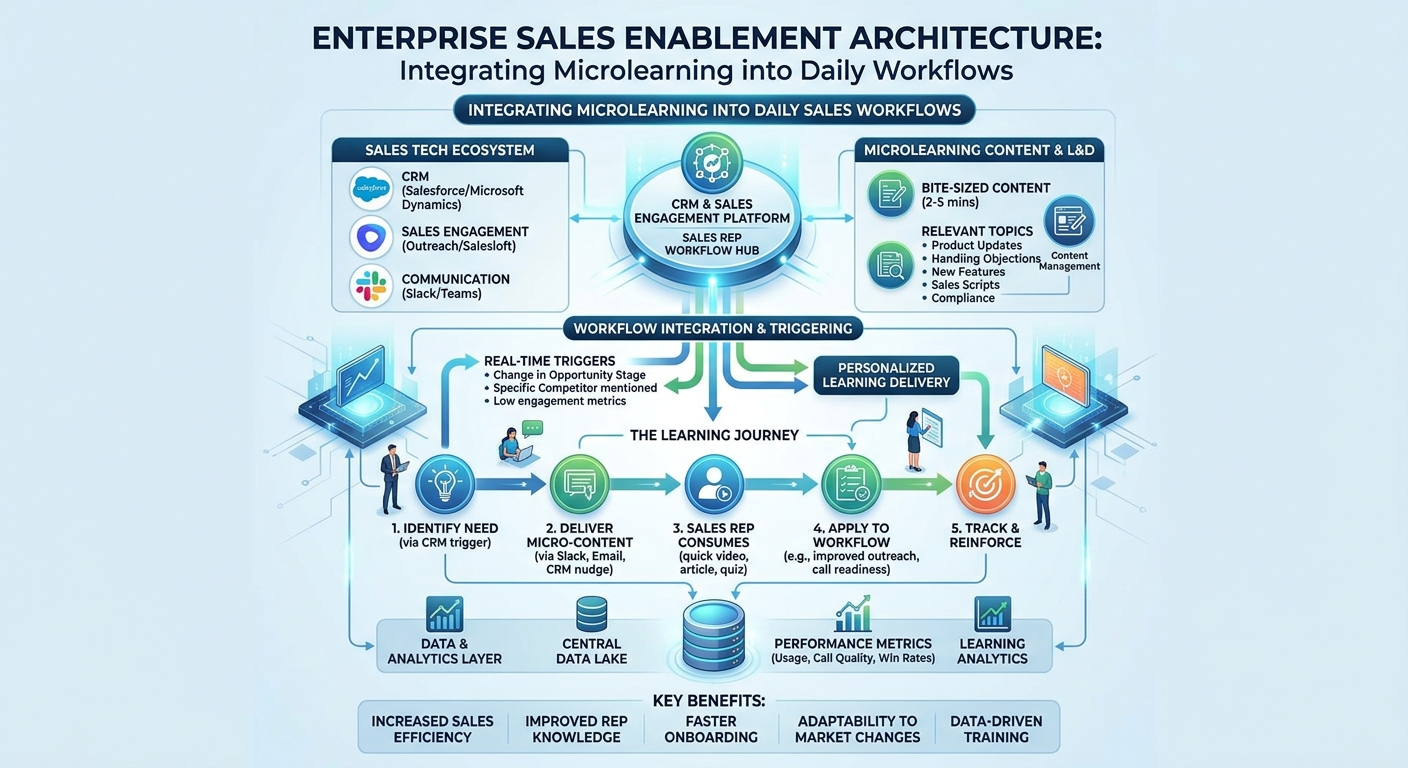
Enterprise Sales Enablement Architecture: Integrating Microlearning into Daily Workflows
In today's fast-paced business environment, staying competitive demands more than just a great product or service. For enterprise sales teams, the ability to rapidly acquire, retain, and apply knowledge is paramount. Yet, the traditional long-form training models often fall short, struggling to keep pace with evolving market demands, product updates, and compliance requirements. This is where a robust enterprise sales enablement architecture, powered by microlearning, becomes not just an advantage, but a necessity for L&D leaders.
The Evolving Landscape of Enterprise Sales
The modern sales professional navigates a complex world of informed customers, intricate product portfolios, and stringent regulations. From banking and finance to pharma and healthcare, and even retail or oil and gas, sales cycles are lengthening, and the need for deep, specialized knowledge is intensifying. Sales enablement has emerged as the strategic function designed to equip these professionals with everything they need to succeed throughout the buyer’s journey. However, the sheer volume of information can be overwhelming.
Traditional training often means lengthy workshops, dense manuals, or generic online courses. While these have their place, they often disrupt daily workflows, lead to information overload, and struggle with retention. The challenge for L&D professionals is to deliver impactful learning that fits seamlessly into the daily hustle, providing timely, relevant knowledge precisely when and where it’s needed.
What is Enterprise Sales Enablement Architecture?
At its core, enterprise sales enablement architecture is the strategic framework that integrates processes, technology, content, and training to empower sales teams. It's about building a cohesive system that supports every stage of the sales process, from lead generation to closing deals and fostering customer relationships. Key components typically include a robust learning management system (LMS), a content repository, CRM integration, and analytics tools. The goal is to optimize seller performance, reduce ramp-up time, and ultimately drive revenue growth.
For organizations dealing with high-stakes transactions or sensitive data, like those in insurance or compliance, a reliable Microlearning LMS is crucial. It ensures that critical information, such as regulatory updates or new product specifications, is absorbed and applied correctly, mitigating risks.
The Power of Microlearning in Sales Enablement
Microlearning, characterized by short, bite-sized learning units focused on specific objectives, is an ideal fit for the dynamic world of enterprise sales. Instead of hours-long modules, microlearning delivers content in minutes, making it highly digestible and easy to integrate. This approach significantly boosts knowledge retention and application, as learners can focus on one concept at a time.
- Enhanced Retention: Shorter bursts of information are easier to remember and recall.
- Improved Relevance: Content can be hyper-targeted to specific sales scenarios or product features.
- Flexibility & Accessibility: Available on-demand, allowing sales professionals to learn at their convenience, often on mobile devices.
- Faster Updates: Easier to create, deploy, and update content in response to market changes or new products.
- Reduced Disruption: Learning can occur without pulling sales teams away from their core responsibilities for extended periods.
For industries like healthcare or pharma, where product knowledge and compliance are constantly evolving, microlearning ensures that sales teams are always up-to-date without enduring lengthy, disruptive training sessions.
Integrating Microlearning into Daily Workflows
The real magic happens when microlearning becomes an invisible, integral part of a sales professional's day. This integration requires thoughtful design and a powerful Microlearning LMS.
Practical Integration Strategies:
- Pre-Call Briefs: Before a client meeting, a salesperson can quickly access a 2-minute microlearning module on specific product features, competitor analysis, or a client's industry trends.
- Post-Call Review: After a call, a short quiz or a recap video can reinforce key takeaways or highlight areas for improvement, perhaps leveraging a Gamified LMS for engagement.
- Product Updates & Launches: Instead of a single, large training session, new product features or compliance changes can be rolled out in a series of micro-modules over days or weeks, allowing for gradual absorption and practical application.
- Objection Handling: Micro-simulations or role-playing scenarios delivered via an Adaptive Learning platform can equip reps with immediate responses to common objections.
- Compliance Refreshers: For highly regulated sectors, quick, mandatory modules can ensure ongoing adherence to policies and legal requirements, often linked to Risk-focused Training.
The key is context. Microlearning should be available "in the flow of work," accessible precisely when a specific piece of information or skill is needed, making learning a performance support tool rather than a standalone event.
Building Your Microlearning-Driven Sales Enablement Architecture
Creating an effective microlearning ecosystem requires strategic investment in the right technologies and processes. At its core is a robust learning management system (LMS). This isn't just any learning management software; it needs to be an enterprise learning management solution capable of delivering granular content efficiently.
A sophisticated learning content management system (LCMS) is also vital for creating, managing, and distributing the bite-sized content. Look for cloud based learning management system options that offer scalability, security, and ease of access across diverse geographic locations and device types. An effective Microlearning LMS should seamlessly integrate with CRM systems, allowing for personalized learning paths based on sales performance data and pipeline stage.
Leveraging an AI Powered Authoring Tool can dramatically accelerate content creation, especially for rapidly changing product lines or regulatory environments. This ensures that your learning management software is always filled with up-to-date, relevant material. The right learning management solutions streamline the entire process, making continuous learning a reality. A powerful lms learning management system is the backbone of this strategy.
Overcoming Integration Challenges
While the benefits are clear, integrating microlearning into existing enterprise workflows can present challenges. These include ensuring adoption, integrating with legacy systems, and maintaining content relevance. Strategies to overcome these include:
- Pilot Programs: Start with a small, enthusiastic sales team to demonstrate success and gather feedback.
- Champions & Advocates: Identify sales leaders who can champion the new learning approach.
- Seamless Access: Ensure the learning management system is easily accessible from common sales tools (e.g., CRM, communication platforms).
- Clear Communication: Explain the "why" behind microlearning and its direct benefits to sales performance.
- Continuous Feedback: Regularly solicit input from sales teams to refine content and delivery methods.
Optimizing Sales Enablement with Advanced Strategies
For L&D professionals, the goal is not just to deliver training, but to optimize its impact. Here are insights into leveraging advanced approaches:
How can we ensure our sales teams are always engaged and absorbing critical information effectively?
By implementing a highly personalized, contextual learning experience. This means delivering bite-sized content that directly addresses a salesperson's immediate needs, whether it's understanding a new product feature before a demo or reinforcing a compliance point after a customer interaction. Platforms that offer Adaptive Learning can dynamically adjust content based on individual performance and knowledge gaps, keeping engagement high and learning efficient. Gamification elements, often found in a Gamified LMS, also play a significant role in motivating consistent learning behaviors.
In a global enterprise, how can we deliver consistent, regionally relevant sales training?
This challenge requires a scalable architecture that allows for centralized content creation with localized customization. A cloud based learning management system, coupled with an AI Powered Authoring Tool, enables L&D teams to rapidly translate, localize, and contextualize microlearning modules. This ensures that core messaging remains consistent while examples, regulations, and market nuances are tailored to specific regions, crucial for diverse industries like hospitality or mining operating across different continents. The underlying Microlearning LMS facilitates this global distribution and tracking.
What advanced strategies can optimize our sales enablement content for maximum impact and continuous improvement?
Leveraging data analytics and machine learning is key. By analyzing sales performance data alongside learning engagement metrics, L&D leaders can identify which microlearning modules correlate most strongly with successful sales outcomes. An advanced Microlearning LMS should provide these insights, helping to continuously refine content, delivery methods, and learning pathways. Furthermore, incorporating automated feedback loops and predictive analytics can anticipate training needs before they become performance issues, ensuring that sales enablement is always proactive and impactful. This forms a continuous improvement cycle for your overall learning management system and Risk-focused Training initiatives.
The MaxLearn Advantage
For L&D professionals seeking to implement a cutting-edge sales enablement architecture, a comprehensive Microlearning LMS like MaxLearn offers an integrated solution. MaxLearn LMS combines the power of microlearning with adaptive learning paths, gamification, and AI-driven insights to create an engaging and effective learning experience tailored for enterprise sales teams. It's a complete learning management solution designed to keep your sales force agile, informed, and consistently performing at their peak.
Conclusion
Integrating microlearning into an enterprise sales enablement architecture is no longer a luxury but a strategic imperative. By delivering relevant, bite-sized learning directly into daily workflows, L&D leaders can significantly enhance sales performance, improve knowledge retention, and ensure compliance across complex industries. The future of sales enablement is agile, personalized, and continuously optimized, empowering sales teams to conquer new challenges and drive sustained business growth. Embrace microlearning to transform your sales training from a periodic event into a continuous engine of success.
```


