

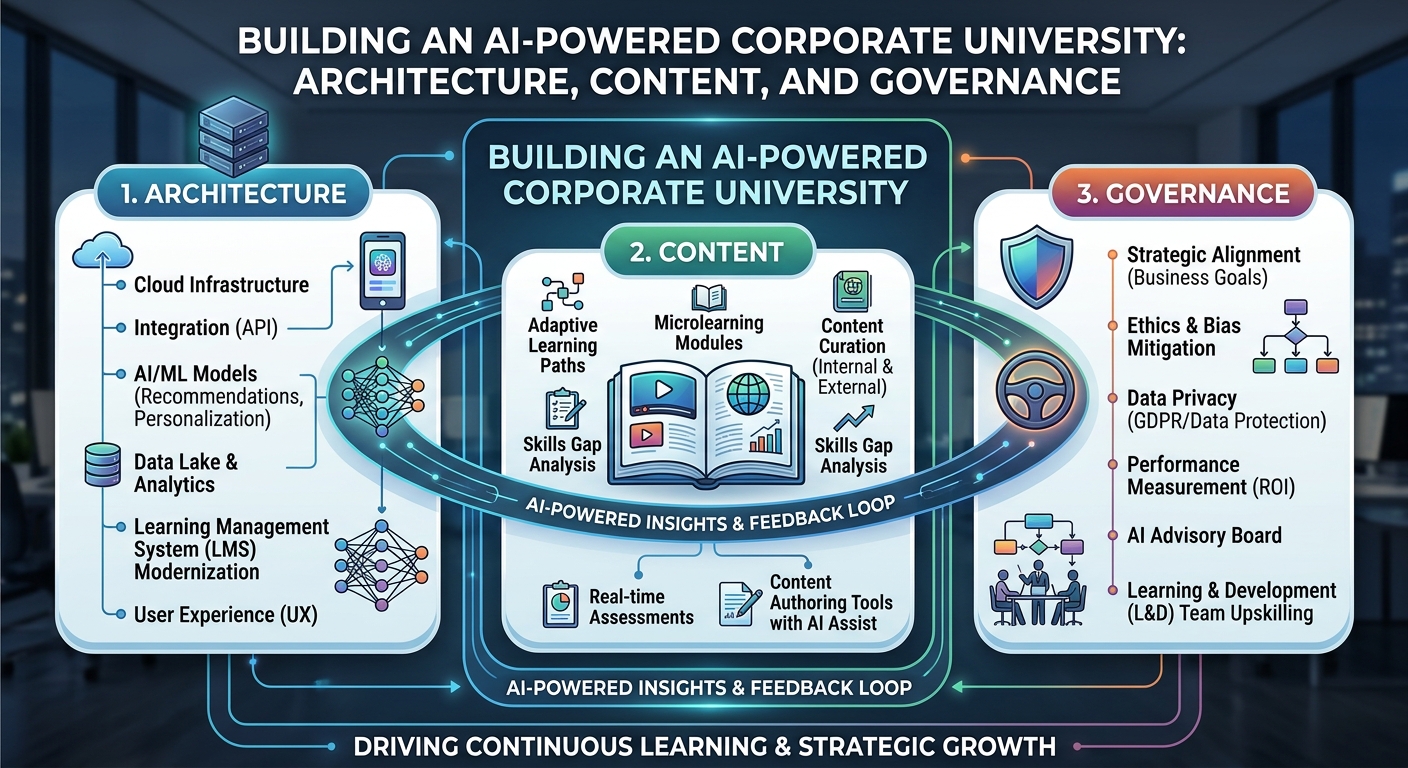
Building an AI-Powered Corporate University: Architecture, Content, and Governance
In today's rapidly evolving corporate landscape, continuous learning isn't just an advantage; it's a strategic imperative. As Vice Presidents, Directors, and Managers of Learning & Development, you understand the increasing demand for personalized, efficient, and impactful training solutions across diverse industries, from compliance and finance to healthcare and retail. The advent of Artificial Intelligence (AI) offers a transformative opportunity to elevate corporate learning beyond traditional boundaries, paving the way for the AI-Powered Corporate University.
This innovative model goes beyond a mere Microlearning LMS; it’s a dynamic ecosystem designed to anticipate skill gaps, deliver hyper-personalized content, and foster a culture of lifelong learning. But how exactly does one build such a sophisticated learning environment? This article delves into the critical pillars: architecture, content, and governance.
The Vision: Why an AI-Powered Corporate University?
The global workforce is undergoing an unprecedented shift, demanding new skills at an accelerated pace. Traditional learning management solutions often struggle to keep up, leading to generic training, low engagement, and questionable ROI. An AI-powered approach offers a paradigm shift.
What exactly defines an AI-powered corporate university?
An AI-powered corporate university integrates advanced machine learning algorithms, natural language processing, and data analytics into every facet of its operation. This means more than just a smart Gamified LMS; it's a holistic environment that leverages intelligence to predict learning needs, recommend tailored resources, automate content curation, and provide real-time performance feedback. For industries like banking, pharma, and oil and gas, where compliance and complex regulations are paramount, this intelligent system can ensure every employee is not just trained, but truly proficient and up-to-date.
Architecting the Foundation: The Technological Blueprint
The backbone of any successful AI-powered corporate university is a robust and scalable architecture. This isn't just about choosing an LMS; it’s about creating an integrated system that can handle vast amounts of data and complex AI operations.
What are the critical architectural considerations for such a system?
- Core Learning Platform: A sophisticated learning management system (LMS) or enterprise learning management platform forms the central hub. This learning management software must be capable of integrating seamlessly with other AI components, offering rich APIs and scalability. A modern MaxLearn LMS, for example, could serve as an ideal foundation.
- Data Infrastructure: This includes robust data lakes and data warehouses to store learner profiles, course interactions, performance metrics, and external industry data. The ability to collect, process, and analyze this data in real-time is crucial for AI engines.
- AI Engines and Modules: These are the intelligent components, encompassing:
- Recommendation Engines: Powered by machine learning, these suggest relevant courses, modules, and resources based on individual learning history, job role, skill gaps, and peer activity.
- Natural Language Processing (NLP): For analyzing content, learner feedback, facilitating intelligent chatbots, and supporting search functionality.
- Predictive Analytics: To identify potential skill gaps, predict training effectiveness, and anticipate future organizational needs.
- Adaptive Learning Modules: To dynamically adjust learning paths based on a learner's progress, strengths, and weaknesses, ensuring truly personalized experiences.
- Content Repository (LCMS): A dedicated learning content management system (LCMS) is essential for managing, versioning, and distributing learning assets. This system should be compatible with AI tools for automated tagging, indexing, and content assembly.
- Integration Layer: Seamless integration with existing HRIS, CRM, performance management systems, and external content providers is non-negotiable for a truly unified learning experience. Opting for a cloud based learning management system can significantly ease integration and scalability challenges.
Crafting Intelligent Content: Personalization and Engagement
Content is king, but intelligent content is paramount. An AI-powered corporate university revolutionizes how content is created, delivered, and consumed, ensuring it's always relevant and engaging.
How does AI transform content creation and delivery?
- AI-Powered Content Generation & Curation: Imagine an AI Powered Authoring Tool that can help subject matter experts convert raw information into engaging learning modules, suggesting formats, visuals, and even assessment questions. AI can also scour vast repositories to curate the most relevant and up-to-date information, drastically reducing the time and cost associated with content development.
- Personalized Learning Paths: Gone are the days of one-size-fits-all training. AI analyzes each learner's background, role, learning style, and performance data to construct unique, Adaptive Learning paths. This ensures that a sales manager in retail receives highly specific training compared to a compliance officer in banking, even within the same organization.
- Dynamic Delivery Formats: AI can recommend the optimal content format (e.g., video, interactive simulation, quick micro-lesson, or a deep dive article) based on the learner's preferences and the learning objective. Integrating Microlearning LMS principles means breaking down complex topics into digestible, bite-sized units, perfect for on-the-go learning.
- Interactive and Gamified Experiences: AI enhances engagement through intelligently designed Gamified LMS elements, personalized feedback loops, and interactive simulations that adapt to learner responses. This is particularly effective for complex skills training in sectors like healthcare or engineering.
Establishing Robust Governance: Ethics, Security, and Strategy
While AI offers immense possibilities, its successful implementation hinges on strong governance frameworks. L&D leaders must address ethical considerations, data security, and strategic oversight.
What ethical and security frameworks are vital for an AI learning environment?
- Data Privacy and Security: Handling vast amounts of personal and performance data requires stringent compliance with regulations like GDPR, CCPA, and industry-specific mandates (e.g., HIPAA in healthcare). A secure learning management system is non-negotiable.
- Ethical AI Usage: Ensure transparency in how AI makes recommendations and decisions. Guard against algorithmic bias that could inadvertently create inequities in learning opportunities. Regular audits of AI models are crucial.
- Content Quality and Accuracy: While AI can assist in content creation, human oversight remains vital to ensure accuracy, pedagogical soundness, and alignment with corporate values and regulatory requirements. This is especially critical for Risk-focused Training in sectors like finance or mining.
- Performance Monitoring and Continuous Improvement: Define clear KPIs for the AI-powered university. Continuously monitor learning outcomes, engagement rates, and skill development against business objectives. Use AI's own analytical capabilities to refine and improve the system over time. This iterative approach is key to maximizing the value of your learning management solutions.
- Stakeholder Collaboration: Establish cross-functional teams involving L&D, IT, legal, and department heads to guide the implementation and evolution of the corporate university. This collaborative approach ensures alignment with broader business goals and fosters widespread adoption of the new learning management system.
The Future is Now: Embracing Intelligent Learning
Building an AI-Powered Corporate University is a significant undertaking, requiring strategic vision, technological investment, and a commitment to continuous adaptation. However, the benefits — from unparalleled personalization and increased engagement to measurable skill uplift and reduced training costs — far outweigh the challenges. By focusing on a robust architecture, intelligent content strategies, and sound governance, L&D leaders can construct a future-proof learning ecosystem that empowers their workforce and drives organizational success.
Embrace the power of AI to transform your corporate training. The journey toward an intelligent, adaptive, and truly impactful learning environment for your organization, utilizing advanced learning management solutions like a powerful MaxLearn LMS, begins today.


