

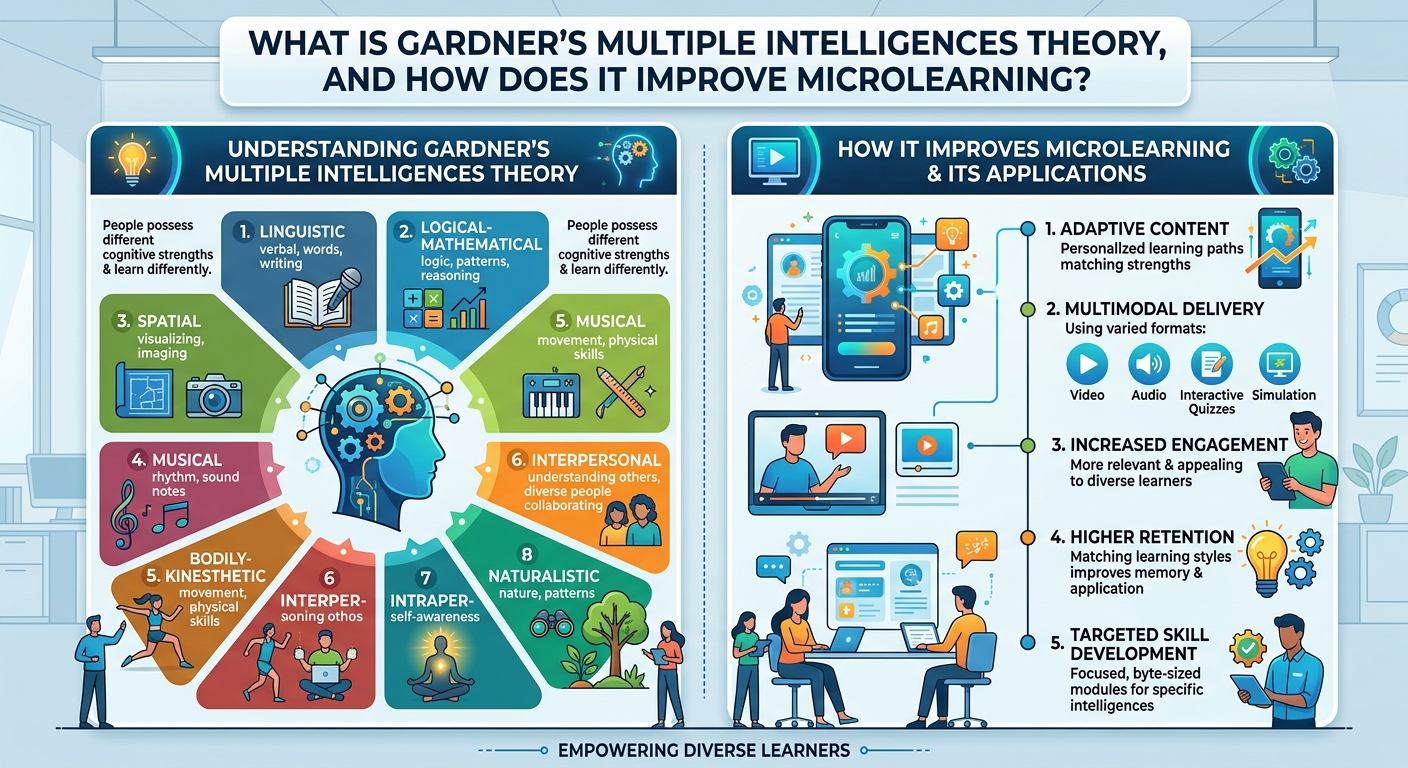
What Is Gardner’s Multiple Intelligences Theory, and How Does It Improve Microlearning?
In today's fast-paced corporate landscape, where knowledge acquisition is paramount for maintaining a competitive edge, Learning & Development (L&D) leaders face a persistent challenge: how to effectively engage a diverse workforce with varying learning preferences and cognitive strengths. Traditional one-size-fits-all training models often fall short, leading to disengagement, poor retention, and ultimately, a subpar return on investment. The solution lies not just in adopting modern delivery methods, but in grounding those methods in a profound understanding of how individuals truly learn. This is where Howard Gardner's Theory of Multiple Intelligences (MI) converges powerfully with the agile methodology of microlearning.
For L&D Vice Presidents, Directors, and Managers across sectors like compliance, sales, banking, finance, insurance, retail, pharma, healthcare, hospitality, oil and gas, and mining, understanding this synergy isn't just academic—it's strategic. It promises to unlock more effective, engaging, and impactful learning experiences that genuinely resonate with every employee.
Understanding Gardner's Multiple Intelligences Theory
Proposed by Harvard psychologist Howard Gardner in 1983, the Theory of Multiple Intelligences posits that the traditional notion of intelligence, predominantly measured by IQ tests, is too narrow. Instead, Gardner suggested that people possess at least eight distinct intelligences, each representing a different way of interacting with the world and processing information. Rather than asking "How smart are you?", Gardner encouraged us to ask, "How are you smart?"
These intelligences are not mutually exclusive; individuals typically possess a unique blend of strengths across several areas. Recognizing these diverse cognitive styles is the first step toward creating truly inclusive and effective learning environments:
- Linguistic Intelligence: The ability to use language effectively, both orally and in writing. Think writers, poets, lawyers, and communicators.
- Logical-Mathematical Intelligence: The capacity to analyze problems logically, carry out mathematical operations, and investigate issues scientifically. Common among scientists, mathematicians, and engineers.
- Spatial Intelligence: The potential to recognize and use patterns of wide space and more confined areas. Navigators, architects, sculptors, and artists often excel here.
- Bodily-Kinesthetic Intelligence: The ability to use one's own body to create products or solve problems. Dancers, athletes, surgeons, and craftspeople demonstrate high bodily-kinesthetic intelligence.
- Musical Intelligence: The capacity to discern pitch, rhythm, timbre, and tone. Composers, musicians, and sensitive listeners possess this.
- Interpersonal Intelligence: The ability to understand the intentions, motivations, and desires of other people. Leaders, teachers, counselors, and sales professionals often exhibit strong interpersonal skills.
- Intrapersonal Intelligence: The capacity to understand oneself, to appreciate one's own feelings, fears, and motivations. This intelligence involves knowing oneself deeply.
- Naturalistic Intelligence: The ability to recognize, categorize, and appreciate plants, animals, and other features of the natural environment. Biologists, conservationists, and farmers are strong in this area.
The Intersection: Gardner and Microlearning
The brilliance of microlearning lies in its bite-sized, focused nature. Delivering information in short, digestible modules, typically 3-7 minutes long, microlearning is inherently flexible and adaptable. This adaptability makes it an ideal framework for integrating Gardner's MI theory. Instead of forcing all learners through a single textual course, microlearning allows L&D professionals to present the same core concept in multiple formats, catering to different intelligences simultaneously.
By breaking down complex topics—such as new compliance regulations in finance or detailed protocols in healthcare—into smaller, manageable chunks, organizations can design learning experiences that resonate more deeply. This approach acknowledges that a sales professional might grasp a new product feature best through a short demo video (Spatial), while a banking analyst might prefer an interactive infographic with data points (Logical-Mathematical), and a healthcare worker might learn best through a simulated patient interaction (Bodily-Kinesthetic).
Practical Application: Enhancing Microlearning with MI Theory
Leveraging Gardner's theory within a microlearning framework means designing varied content for each learning objective. Here’s how you can implement this:
- For Linguistic Intelligence: Offer concise articles, executive summaries, short case studies, flashcards with key definitions, or brief audio explanations. An effective Microlearning LMS can manage and deliver these diverse content types seamlessly.
- For Logical-Mathematical Intelligence: Incorporate quick quizzes, problem-solving challenges, interactive flowcharts, data analysis mini-tasks, or logic puzzles relevant to the subject matter. These elements are crucial for sectors like banking, finance, and pharma, where precision is key.
- For Spatial Intelligence: Utilize short explainer videos, animated infographics, interactive diagrams, virtual walkthroughs of equipment (for oil and gas or manufacturing), or visual simulations.
- For Bodily-Kinesthetic Intelligence: Implement interactive simulations, drag-and-drop exercises, virtual reality snippets for hands-on experience, or scenario-based role-playing in a Gamified LMS. This is highly effective for `risk-focused training` in compliance and hospitality.
- For Musical Intelligence: While less common, short jingles or mnemonic devices set to music can aid memory for key policies or procedures. Audio snippets providing context or instructions can also be beneficial.
- For Interpersonal Intelligence: Facilitate brief peer discussions, collaborative micro-projects, or quick Q&A sessions within the learning platform. This fosters teamwork essential for retail and sales environments.
- For Intrapersonal Intelligence: Provide opportunities for self-reflection through journal prompts, personal goal-setting exercises, or self-assessment quizzes that encourage learners to connect content to their own experiences and roles.
- For Naturalistic Intelligence: Use examples and case studies that relate to observable patterns, organizational structures, or environmental factors. For instance, in `enterprise learning management`, connecting training to the company’s "ecosystem" or industry trends.
An advanced Adaptive Learning platform within a comprehensive `learning content management system` allows L&D to tag content by intelligence type. This enables the `lms learning management system` to suggest personalized learning paths based on a learner's identified strengths or expressed preferences. Such a `cloud based learning management system` ensures accessibility and flexibility for all employees, regardless of location or device.
AI's Role in Personalized Microlearning
The integration of artificial intelligence (AI) further elevates the synergy between Multiple Intelligences and microlearning, offering unprecedented levels of personalization and efficiency. AI can act as the orchestrator, making sense of vast amounts of learner data to deliver truly adaptive experiences.
How can modern learning platforms truly understand and cater to each learner's unique strengths?
AI-driven `learning management software` can analyze a learner's past performance, completion rates, engagement with different content types (videos, text, quizzes), and even explicit preferences expressed during onboarding. For instance, an AI Powered Authoring Tool can recommend specific microlearning modules that align with an individual's predominant intelligences, ensuring content is delivered in the most effective format. If a learner consistently performs well on visual tasks, the platform can prioritize infographics and video snippets for future modules. This approach is highly effective for diverse industries, from skill enhancement in retail to complex procedural training in healthcare.
In a globally distributed workforce, how can L&D ensure content is universally effective yet locally relevant?
For global organizations, a `learning management solution` equipped with AI can address the challenge of cultural and linguistic diversity. AI can assist in localizing microlearning content, suggesting culturally appropriate examples for specific regions, or even translating materials while maintaining context. By analyzing regional performance data, the `LMS` can adapt learning paths to better suit local needs or common challenges, ensuring that training for compliance in different countries, for example, is both globally consistent and locally meaningful.
Beyond immediate training needs, how can we leverage intelligence theories to guide employees toward long-term skill development and career progression?
AI can map an individual's identified intelligence profile against desired career paths or future roles within the organization. By understanding a learner’s strengths, a sophisticated `MaxLearn LMS` can recommend advanced microlearning modules or certifications that build upon those natural talents, preparing them for leadership roles or specialized positions. For instance, someone strong in Interpersonal Intelligence might be guided towards sales management training, while someone with high Logical-Mathematical intelligence could be steered towards advanced data analytics programs, ensuring `enterprise learning management` is proactive and strategic.
Benefits for L&D Leaders
Adopting an MI-informed microlearning strategy, powered by intelligent platforms, offers significant advantages for L&D leaders:
- Increased Engagement and Completion: When learning aligns with natural strengths, learners are more motivated, leading to higher participation and course completion rates.
- Improved Knowledge Retention: Content delivered in preferred formats is absorbed and retained more effectively, translating into better on-the-job performance, especially critical for Risk-focused Training and compliance.
- Enhanced ROI: More effective training means better skilled employees, reduced errors, and increased productivity across all segments, from sales to pharma to mining. This optimizes the return on your training investments.
- Cultivation of Diverse Talent: This approach celebrates individual differences, fostering an inclusive learning culture where every employee feels valued and empowered to learn in their unique way.
- Future-Proofing Workforce: By continuously developing skills tailored to individual strengths and future roles, organizations build a resilient and adaptable workforce.
Conclusion
The combination of Gardner's Multiple Intelligences Theory and the agile delivery of microlearning represents a powerful paradigm shift for corporate L&D. By recognizing and catering to the diverse ways employees learn, organizations can move beyond generic training to create highly personalized, engaging, and impactful learning journeys. Leveraging a robust `LMS` that supports Microlearning LMS capabilities, Gamified LMS elements, and Adaptive Learning powered by an AI Powered Authoring Tool, L&D leaders can optimize training for diverse industries and ensure `risk-focused training` is both effective and engaging. This strategic approach not only boosts individual performance but also drives overall organizational growth and innovation, making learning a truly transformative experience for everyone.


