

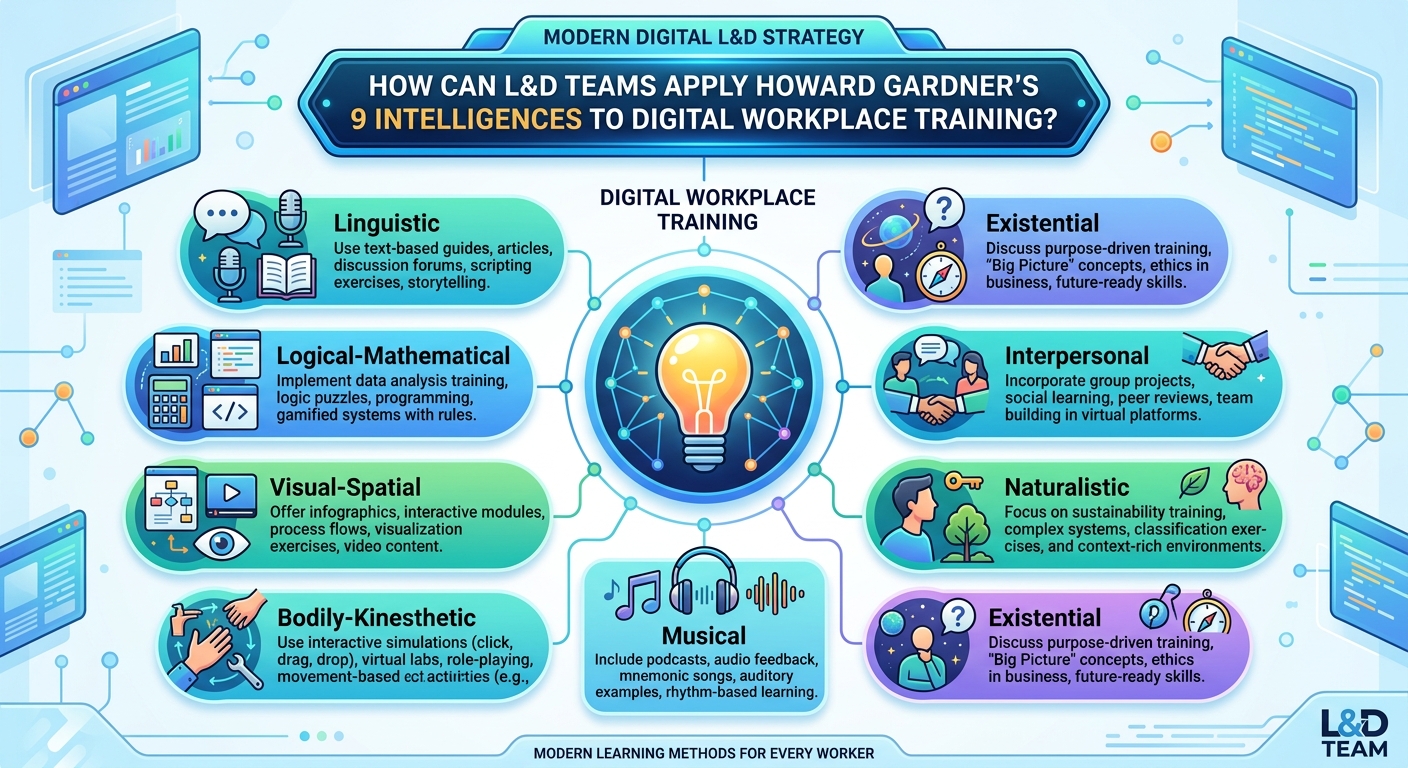
Unlocking Potential: How L&D Teams Can Apply Howard Gardner’s 9 Intelligences to Digital Workplace Training
In today’s fast-paced corporate environment, Learning & Development (L&D) teams face the constant challenge of creating engaging, effective, and scalable training programs. From ensuring compliance in banking to boosting sales performance in retail, or delivering critical healthcare protocols, the demand for versatile learning solutions is immense. The digital workplace, while offering unprecedented flexibility, also magnifies the need for highly personalized learning experiences.
Traditional, one-size-fits-all training models often fall short, leaving many learners disengaged or underperforming. This is where Howard Gardner’s groundbreaking theory of Multiple Intelligences offers a powerful framework. By recognizing that individuals possess different cognitive strengths, L&D can revolutionize digital workplace training, making it more impactful and inclusive. An advanced Microlearning LMS can be instrumental in bringing this vision to life, enabling L&D leaders to design curricula that resonate with every learner.
Gardner’s 9 Intelligences: A Quick Refresher for L&D Leaders
Howard Gardner initially proposed seven intelligences, later expanding his theory to nine. These intelligences are not fixed abilities but rather distinct ways individuals interact with and understand the world. Recognizing them is the first step towards creating truly adaptive digital learning experiences:
- Linguistic Intelligence: The ability to use language effectively, both orally and in writing.
- Logical-Mathematical Intelligence: Skill in logical reasoning, problem-solving, and numerical patterns.
- Spatial Intelligence: The capacity to think in three dimensions, visualize, and mentally manipulate objects.
- Bodily-Kinesthetic Intelligence: Expertise in using one’s body to express ideas and feelings, and a facility for hands-on activities.
- Musical Intelligence: Sensitivity to rhythm, pitch, melody, and tone.
- Interpersonal Intelligence: The ability to understand and interact effectively with others.
- Intrapersonal Intelligence: Self-knowledge and the capacity to understand one's own feelings, motivations, and goals.
- Naturalistic Intelligence: The ability to recognize, categorize, and understand features of the natural world.
- Existential Intelligence: The capacity to ponder deep questions about life, death, and existence.
Deep Dive: Applying Each Intelligence to Digital L&D
Leveraging a robust learning content management system (LCMS) and a comprehensive learning management system (LMS) allows L&D teams to craft digital content that appeals to this diverse spectrum of intelligences. Here's how:
1. Linguistic Intelligence (The Word Savvy Learner)
- Digital Application: Offer in-depth articles, interactive e-books, rich text-based case studies (ideal for compliance policies in finance or detailed pharma regulations), podcasts, and discussion forums. Ensure learning management software supports diverse document formats.
- Industry Impact: Essential for legal, compliance, and detailed policy training across banking, insurance, and healthcare.
2. Logical-Mathematical Intelligence (The Number & Problem Solver)
- Digital Application: Incorporate simulations for financial modeling, coding challenges, data analysis exercises, interactive quizzes with complex problem-solving, and logic puzzles. Use an Gamified LMS to introduce leaderboards for analytical challenges.
- Industry Impact: Critical for risk assessment in oil and gas, financial analysis in banking, and clinical trial data interpretation in pharma.
3. Spatial Intelligence (The Visual & Artistic Thinker)
- Digital Application: Utilize infographics, interactive diagrams, 3D simulations (e.g., virtual tours of a retail store layout or a manufacturing plant), video demonstrations, and virtual reality (VR) modules for hands-on practice.
- Industry Impact: Highly beneficial for architectural design, equipment operation in mining, patient anatomy in healthcare, and visualizing complex supply chains in retail.
4. Bodily-Kinesthetic Intelligence (The Hands-On Learner)
- Digital Application: Engage learners with interactive simulations requiring drag-and-drop actions, click-through scenarios (e.g., operating machinery or a point-of-sale system), augmented reality (AR) for virtual assembly, and role-playing exercises recorded for peer feedback.
- Industry Impact: Excellent for sales training (practicing pitch delivery), hospitality service scenarios, and operational procedures in healthcare or manufacturing.
5. Musical Intelligence (The Rhythm & Sound Sensitive)
- Digital Application: While less direct, digital training can incorporate background music to set a tone, use distinct audio cues for correct/incorrect answers, and even use jingles or mnemonic songs for memorizing key facts (e.g., compliance steps).
- Industry Impact: Can enhance memorization and create a pleasant learning atmosphere across all industries.
6. Interpersonal Intelligence (The People Person)
- Digital Application: Foster collaborative learning through group projects, online discussion boards, peer-to-peer feedback mechanisms, virtual team-based simulations, and social learning features within the enterprise learning management system.
- Industry Impact: Essential for leadership development, customer service training, and team collaboration initiatives in sales, healthcare, and hospitality.
7. Intrapersonal Intelligence (The Self-Reflective Learner)
- Digital Application: Provide opportunities for self-assessment, reflective journaling prompts, personalized learning paths, and scenario-based decision-making where learners reflect on their choices. Adaptive Learning technologies are key here, tailoring content based on individual progress and preferences.
- Industry Impact: Promotes personal growth, ethical decision-making (compliance), and self-directed career development across all sectors.
8. Naturalistic Intelligence (The Environment & Pattern Observer)
- Digital Application: Use real-world case studies, simulations involving natural systems (e.g., environmental impact assessments in oil and gas), digital field guides, and content exploring sustainability practices.
- Industry Impact: Crucial for environmental compliance, supply chain optimization (understanding natural resource flow), and sustainable business practices.
9. Existential Intelligence (The Big Picture Thinker)
- Digital Application: Engage learners with ethical dilemmas, strategic planning simulations, discussions on organizational purpose and values, and content that encourages critical thinking about complex, long-term industry challenges.
- Industry Impact: Highly relevant for leadership training, corporate governance, and understanding the societal impact of business decisions in industries like pharma, finance, and mining.
Leveraging Technology for Diverse Learners
Implementing a multi-intelligent approach requires more than just varied content; it demands a sophisticated learning management system (LMS) that can deliver it. Modern learning management solutions, especially a cloud based learning management system, offer the tools L&D needs:
- Content Variety: A robust LCMS (Learning Content Management System) allows for easy creation, storage, and retrieval of diverse formats—videos, simulations, interactive modules, podcasts, and text-based guides.
- Personalized Journeys: An Adaptive Learning engine within the LMS can dynamically adjust content and pathways based on learner interactions, ensuring content is always relevant to their intellectual strengths and development needs.
- Engagement Boosters: Features like gamification enhance motivation across all intelligences, turning learning into an enjoyable challenge.
- Efficient Content Creation: With an AI Powered Authoring Tool, L&D teams can rapidly develop and deploy diverse learning materials tailored to specific intelligences, significantly reducing development time and costs.
- Targeted Training: For industries like banking and healthcare, Risk-focused Training can be designed with scenarios that appeal to logical, interpersonal, and intrapersonal intelligences, ensuring thorough understanding and application of critical protocols.
Frequently Asked Questions for L&D Leaders
How can digital training effectively cater to individual learning preferences?
By applying Gardner's Multiple Intelligences, L&D teams can design varied digital content formats and learning activities that align with different cognitive strengths. This means offering a mix of visual aids, interactive simulations, collaborative projects, written analyses, and self-reflection exercises. Utilizing a flexible learning management software allows for the delivery of these diverse resources, ensuring each learner finds paths that resonate with their unique way of understanding.
What technologies best support a multi-faceted learning approach?
To truly embrace a multi-intelligent approach, L&D should leverage an advanced enterprise learning management system like MaxLearn LMS. Key features include a comprehensive LCMS for managing varied content, an adaptive learning engine for personalized paths, gamification features for engagement, and an AI-powered authoring tool for efficient content creation. These technologies enable the seamless integration of diverse learning strategies.
Why is personalizing workplace training crucial for business outcomes?
Personalized training, informed by Gardner's theory, leads to higher learner engagement, better knowledge retention, improved skill application, and ultimately, enhanced organizational performance. When training aligns with how individuals naturally learn, it fosters a stronger learning culture, reduces training fatigue, and ensures employees in diverse industries like finance, pharma, and retail are better equipped to meet their specific job demands and comply with regulations, directly impacting ROI and business growth.
Conclusion
The future of digital workplace training lies in its ability to adapt to the unique strengths of each learner. By thoughtfully applying Howard Gardner’s 9 Intelligences, L&D teams can move beyond generic courses to create deeply engaging, effective, and truly inclusive learning experiences. This strategic shift not only empowers individuals but also drives significant organizational benefits, from enhanced compliance to improved productivity and innovation.
Ready to transform your digital training strategy? Explore how an innovative MaxLearn LMS can help you implement a multi-intelligent approach, delivering personalized and impactful learning across your enterprise.


