

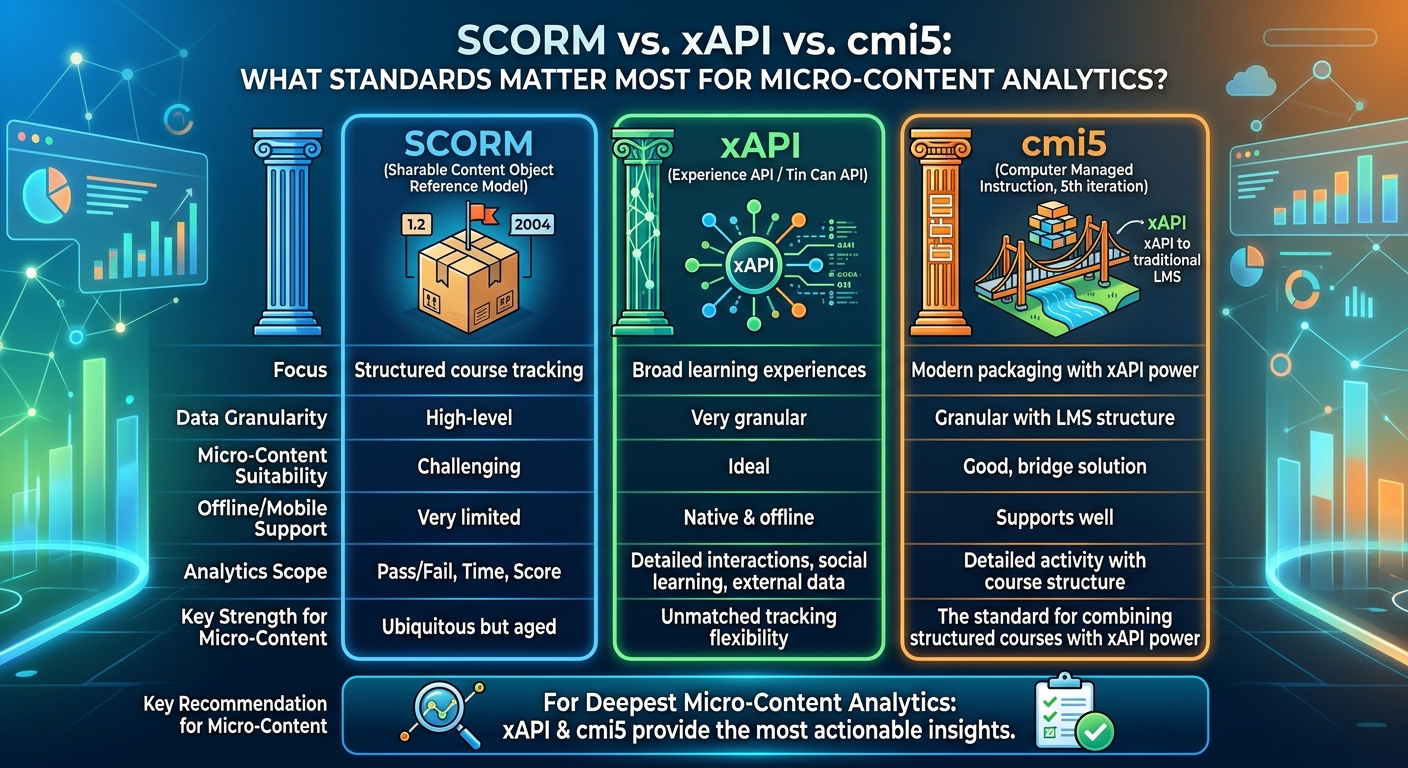
SCORM vs. xAPI vs. cmi5: What Standards Matter Most for Micro-Content Analytics?
As Vice Presidents, Directors, and Senior Managers in Learning & Development, you understand that effective training isn't just about delivering content; it's about driving performance, ensuring compliance, and fostering continuous skill development. In today's fast-paced corporate environment, micro-content has emerged as a powerful tool for achieving these goals, offering digestible, targeted learning experiences. But how do you accurately measure the impact of these bite-sized modules? The answer lies in robust data analytics, powered by the right eLearning standards.
The landscape of eLearning standards can seem complex, with acronyms like SCORM, xAPI, and cmi5 often causing confusion. Yet, choosing the appropriate standard is critical for unlocking deep insights into learner behavior, content effectiveness, and ultimately, your L&D ROI. This article will demystify these standards, focusing on their capabilities for micro-content analytics, and help you determine which best aligns with your organizational needs across industries like compliance, sales, banking, finance, insurance, retail, pharma, health care, hospitality, oil and gas, and mining.
The Foundational Standard: SCORM
SCORM (Sharable Content Object Reference Model) has been the industry workhorse for over two decades. It provides a common language for LMS and learning content to communicate, primarily defining how content is launched and how basic data—like completion status and score—is reported back to the learning management system. For many years, SCORM was synonymous with online training, ensuring interoperability between various content packages and an organization's learning management software.
SCORM's Strengths and Limitations for Micro-Content
- Strengths: Widely adopted, relatively simple to implement for traditional courses, good for tracking basic completion and assessment scores. It's excellent for legacy content that requires straightforward tracking.
- Limitations: SCORM's fundamental design is geared towards single, monolithic courses. It struggles with tracking learning experiences that occur outside the LMS, or with non-linear, multi-device interactions typical of micro-content. It offers a limited data set (e.g., "completed," "passed," "score"), providing minimal context about how learners engage with the content, what specific actions they took, or how long they spent on particular segments. This makes granular analysis of microlearning effectiveness challenging.
Embracing Flexibility: xAPI (Experience API)
Born from the limitations of SCORM, xAPI (also known as Tin Can API) represents a paradigm shift in how learning data is captured. Instead of focusing on content launching from an lms learning management system, xAPI is designed to track a wide array of learning experiences, both formal and informal, online and offline. Its core concept revolves around "statements" in the format of "Actor, Verb, Object" – for example, "Jane completed the compliance module," or "John watched the safety video on his mobile device," or even "Sarah collaborated on the project."
The Power of xAPI for Micro-Content Analytics
- Rich Data Collection: xAPI can track virtually any learning activity, regardless of where it occurs. This includes reading a document, participating in a simulation, engaging in a Gamified LMS challenge, completing a task in the real world, or interacting with a virtual mentor.
- Granular Insights: For micro-content, xAPI allows for unprecedented detail. You can track which specific parts of a 2-minute video a learner re-watched, which interactive elements they clicked, how long they paused, and even their responses in a micro-quiz. This level of detail is invaluable for understanding engagement and identifying areas for improvement in Microlearning LMS content.
- Learning Record Store (LRS): xAPI statements are stored in an LRS, which can be part of an enterprise learning management system or a standalone component. This separation allows for data aggregation from various sources, providing a holistic view of a learner's journey.
- Versatility: Its ability to track learning across multiple devices and contexts makes it ideal for modern, on-the-go learning prevalent in industries requiring continuous Risk-focused Training or rapid upskilling.
One might wonder, "How can smart platforms elevate our comprehension of learner engagement across diverse digital touchpoints?" The answer lies in standards like xAPI, which captures interaction data from almost any source, providing a unified view of the learner's journey and allowing advanced analytics to surface patterns and insights.
The Best of Both Worlds: cmi5
While xAPI offers incredible flexibility, its open-ended nature can sometimes lead to implementation complexities. This is where cmi5 comes into play. cmi5 (Computer Managed Instruction, version 5) is essentially xAPI with rules – it combines the robust tracking capabilities of xAPI with the structured launch and content delivery reliability that organizations appreciate in SCORM.
Why cmi5 is a Game-Changer for Structured Micro-Content
- xAPI + Structure: cmi5 ensures that content launched from an LMS (or cloud based learning management system) will work consistently, similar to SCORM, but it reports detailed xAPI statements back to an LRS. This means you get reliable content delivery alongside rich data.
- Assignable Units (AUs): cmi5 introduces the concept of "Assignable Units," which are discrete content packages (perfect for micro-content modules). Each AU is launched via the learning management solutions and reports specific xAPI statements upon completion, pass/fail, or other defined interactions.
- Improved User Experience: It standardizes how a learner exits content and how session state is managed, preventing the common "lost data" issues sometimes encountered with raw xAPI implementations.
- Ideal for Compliance and Certification: For industries where formal tracking is paramount (e.g., banking, pharma, healthcare), cmi5 provides the necessary structure and verifiable data for compliance training while still leveraging the deep analytics of xAPI for micro-content modules.
The Micro-Content Analytics Imperative
For L&D leaders, the goal isn't just to deliver micro-content, but to understand its impact. Does that 3-minute sales training video actually improve closing rates? Does that micro-assessment for new hires truly validate skill acquisition? SCORM offers only a superficial glance. xAPI and cmi5, on the other hand, provide the tools for true performance intelligence.
Consider the challenge of optimizing skill development across widely distributed teams. "What technological advancements are critical for optimizing skill development across diverse operational units?" The answer includes advanced learning standards like xAPI and cmi5, coupled with a powerful LCMS, which together enable a sophisticated understanding of how micro-content influences the proficiency of individuals and teams globally.
Why Modern Standards Matter Most for Micro-Content:
- Behavioral Insights: Understand not just if a learner completed content, but how they engaged with it – where they struggled, what they reviewed, and which specific micro-interactions led to understanding or frustration.
- Content Optimization: Pinpoint exactly which micro-modules are most effective and which need revision. This data-driven approach allows for agile content development, potentially using an AI Powered Authoring Tool, leading to continuous improvement.
- Personalized Learning Paths: With rich data, an enterprise learning management system can offer truly Adaptive Learning experiences, recommending relevant micro-content based on individual performance and knowledge gaps.
- ROI Justification: By connecting granular learning activities to real-world performance metrics (e.g., reduced incidents, increased sales, faster onboarding), you can build a compelling case for your L&D investments.
Choosing the Right Standard for Your L&D Strategy
The decision isn't necessarily about choosing one standard over the others; it's about understanding their strengths and applying them strategically within your overall learning management system ecosystem. Many modern MaxLearn LMS solutions support all three standards.
- Stay with SCORM if: Your primary need is basic tracking of legacy courses, and your content is mainly linear and self-contained within the LMS.
- Embrace xAPI if: You want to track diverse, informal, and experiential learning across multiple platforms and devices, gaining deep insights into every learner interaction. This is ideal for agile environments and highly personalized learning.
- Opt for cmi5 if: You need the structured launch and reliable tracking of SCORM but require the rich, granular data of xAPI, especially for formal micro-content units, certification, or compliance-driven Risk-focused Training programs. It offers the best blend of interoperability and advanced analytics for structured learning modules.
Think about your long-term vision. "What cutting-edge solutions should our organization prioritize to future-proof our educational infrastructure?" Prioritizing a cloud based learning management system that natively supports xAPI and cmi5 ensures your L&D function is ready for the next generation of learning experiences and analytical capabilities.
Leveraging Advanced Learning Platforms for Micro-Content Analytics
To truly harness the power of xAPI and cmi5 for micro-content analytics, you need an advanced learning platform. A modern learning management software solution, particularly one designed for Microlearning LMS, can integrate seamlessly with LRS technology to capture, store, and analyze vast amounts of data. Platforms like MaxLearn LMS provide the robust infrastructure required to manage, deliver, and track micro-content effectively across your enterprise.
These platforms often come equipped with features such as Adaptive Learning paths, Gamified LMS elements, and often an AI Powered Authoring Tool, all of which benefit immensely from the detailed data provided by xAPI and cmi5. This allows L&D leaders to move beyond simple completion rates to truly understand learning efficacy, skill gaps, and the precise impact of their micro-content strategy on business outcomes.
Conclusion
For L&D leaders focused on maximizing the impact of micro-content, the choice of eLearning standard significantly influences your ability to gather actionable analytics. While SCORM remains relevant for basic tracking of legacy content, xAPI and cmi5 are the clear winners for providing the deep, contextual insights necessary to optimize modern learning. By embracing these advanced standards within a powerful learning management solutions, you empower your organization to deliver more effective, personalized, and measurable micro-learning experiences, driving tangible business growth across all sectors.
It's time to move beyond simple completion checks and truly understand how your workforce learns and performs. Invest in standards and platforms that provide the intelligence you need to lead L&D into the future.
.jpg)


