

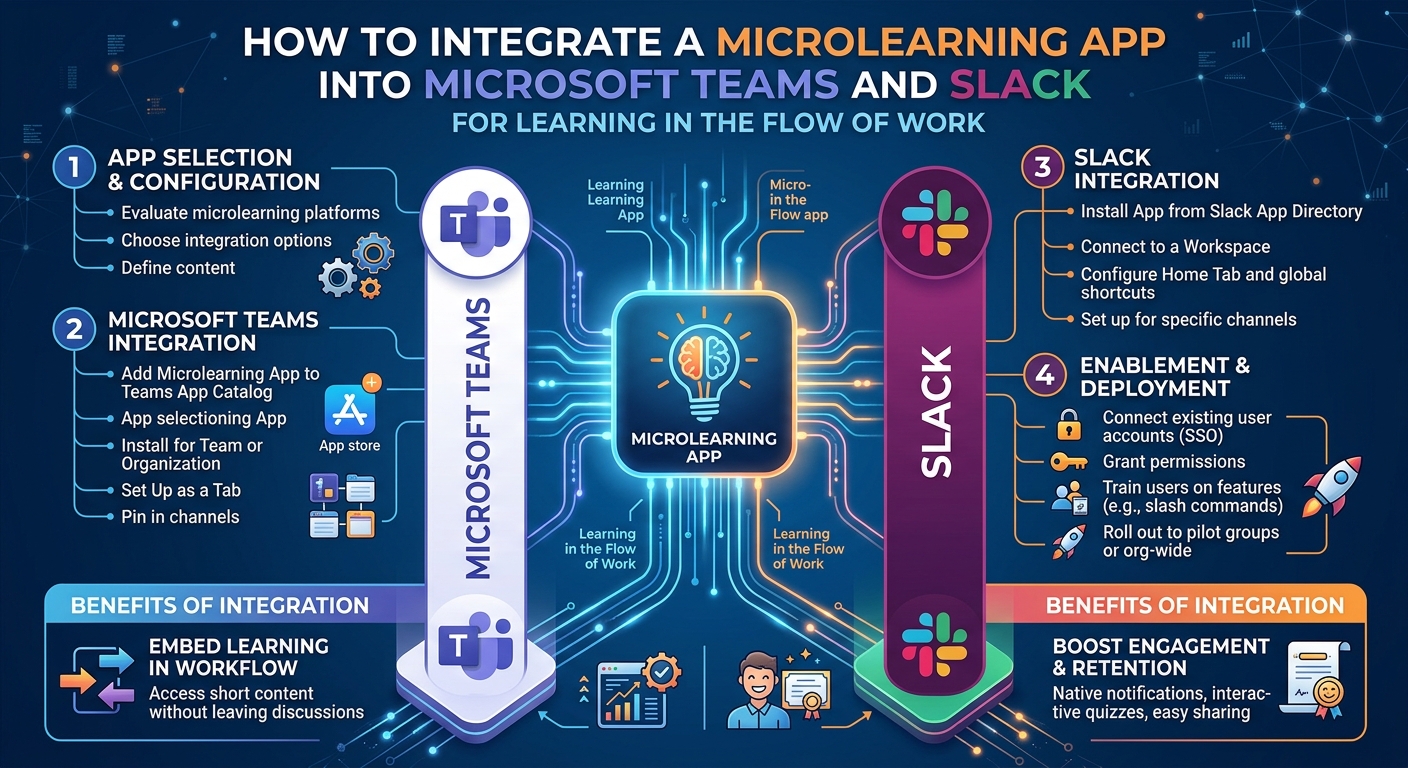
How to Integrate a Microlearning App into Microsoft Teams and Slack for Learning in the Flow of Work
In today's fast-paced business environment, the traditional approach to learning and development often struggles to keep up with the demand for immediate, relevant knowledge. Vice Presidents, Directors, and Managers of L&D across industries like Compliance, Sales, Banking, Finance, Insurance, Retail, Pharma, Healthcare, Hospitality, Oil and Gas, and Mining are constantly seeking innovative strategies to empower their workforce. The solution lies in integrating learning directly into daily workflows, a concept perfectly embodied by microlearning delivered through platforms like Microsoft Teams and Slack.
The goal is simple yet profound: enable employees to learn what they need, exactly when they need it, without disrupting their productivity. This article delves into the strategic advantages and practical steps of embedding a microlearning application within your organization's communication hubs, transforming passive training into dynamic, accessible "learning in the flow of work."
Why Microlearning is Non-Negotiable for Modern L&D Leaders
The sheer volume of information and the speed of business evolution necessitate a shift from lengthy courses to digestible, targeted learning experiences. Microlearning, characterized by short, focused bursts of content (typically 3-5 minutes), is perfectly suited for modern professional development. It addresses several critical challenges:
- Combating Information Overload: Employees are less likely to disengage when presented with bite-sized, relevant information.
- Boosting Knowledge Retention: Spaced repetition and immediate application, inherent to microlearning, significantly improve retention rates.
- Driving Agility and Adaptability: Rapidly update and deploy content to address new regulations, product launches, or market shifts.
- Meeting Diverse Needs: From sales teams needing quick product updates to healthcare professionals requiring compliance refreshers, microlearning offers tailored content on demand.
Many organizations are recognizing the value of a robust Microlearning LMS to deliver this type of training efficiently. A modern LMS provides the infrastructure to manage, distribute, and track these compact learning modules.
Leveraging Microsoft Teams and Slack for Seamless Learning
Microsoft Teams and Slack are more than just communication tools; they are the digital workspaces where most employees spend a significant portion of their day. Integrating learning directly into these platforms offers unparalleled benefits:
- Reduced Context Switching: Employees don't need to leave their primary workspace to access learning, minimizing disruption and cognitive load.
- Enhanced Collaboration: Learning can become a shared experience, with discussions and knowledge sharing happening organically within existing channels.
- Increased Accessibility: Learning content is literally at their fingertips, available on desktop or mobile devices.
- Familiar User Experience: Learners interact with content within an environment they already know and use daily, lowering the barrier to adoption.
For L&D leaders exploring new learning content management system options, the capability to integrate with these platforms is a key differentiator. The right learning management software can turn daily chatter into continuous growth.
Seamless Integration: A Step-by-Step Guide for L&D Leaders
Understanding Your Microlearning App
Before diving into integration, assess your chosen microlearning platform or learning management solutions. Look for:
- API Availability: Does the platform offer a robust API for custom integrations?
- Pre-built Integrations: Does it already have connectors or apps for Teams or Slack? Many modern lms learning management system offerings do.
- Notification Capabilities: Can it send notifications or updates to external platforms?
- Content Embeddability: Can microlearning modules be easily embedded or linked?
Opting for a cloud based learning management system often simplifies these integration aspects due to their modern architecture and focus on interoperability. Consider an enterprise learning management solution that prioritizes these features.
Integrating with Microsoft Teams
Microsoft Teams offers several avenues for integration:
- Add as an App/Tab: The simplest method is to add your microlearning app as a tab within a specific Team or Channel. This provides direct access to the learning content library or specific courses.
- Connectors and Webhooks: Utilize Teams connectors to automatically post notifications from your microlearning platform (e.g., new content available, quiz results) into relevant channels. Webhooks allow for more custom, bidirectional communication.
- Dedicated Learning Channels: Create specific channels (e.g., #compliance_updates, #sales_tips) where microlearning modules are shared and discussed.
- Bots: Develop or integrate a custom bot that can answer common learning-related questions or deliver specific microlearning content on demand.
Integrating with Slack
Slack's flexibility makes it an excellent home for microlearning:
- Add as an App: Most microlearning platforms will have a Slack app that can be installed. This usually enables direct content sharing, notifications, and sometimes even interactive elements.
- Custom Integrations/Bots: Leverage Slack's custom integration capabilities (using webhooks or the Slack API) to build bespoke solutions. A bot can be programmed to drip-feed content, administer quick quizzes, or respond to learning requests.
- Topic-Specific Channels: Similar to Teams, create channels for specific learning topics. For example, a #new_hire_onboarding channel can receive daily microlearning modules during the onboarding period.
- Scheduled Messages: Use Slack's built-in scheduling or a bot to deliver microlearning prompts or challenges at optimal times.
Best Practices for Deployment
- Start Small, Pilot, and Iterate: Begin with a pilot group or a specific learning objective to gather feedback and refine your approach.
- Communicate Value: Clearly articulate the benefits to learners and managers. Emphasize how this integration saves time and enhances performance.
- Curate Content Strategically: Don't just dump content. Curate relevant microlearning paths that directly support daily tasks or strategic objectives.
- Measure Engagement and Impact: Utilize the analytics from your LCMS and feedback from Teams/Slack to continuously optimize. A Gamified LMS can significantly boost engagement metrics.
Unlocking Advanced Insights with Integrated Learning
The synergy between microlearning apps and communication platforms, amplified by advanced analytical capabilities, opens new frontiers for L&D. Consider how intelligent systems can transform your strategy:
How can intelligent algorithms enhance the discovery of relevant learning snippets?
By analyzing user interaction data within Teams or Slack (e.g., frequently asked questions, shared articles, project topics) alongside learning platform usage, intelligent algorithms can proactively suggest highly relevant microlearning content. This moves beyond simple recommendations, offering hyper-personalized learning pathways that anticipate skill gaps and support real-time problem-solving, ensuring that the right information reaches the right person at the optimal moment.
What role does advanced analytics play in understanding global learning adoption across different business units?
Integrating learning data with communication patterns allows L&D leaders to gain a holistic view of engagement. Advanced analytics can pinpoint which microlearning modules resonate most within specific geographical regions or departments, identify knowledge diffusion patterns, and highlight areas where adoption is lagging. This rich dataset enables precise interventions, optimizing content distribution and tailoring support to meet the unique learning needs and cultural nuances of diverse teams worldwide. MaxLearn LMS provides robust reporting to facilitate this.
How might cognitive tools predict individual learner needs and adapt content delivery in real-time?
Cognitive tools, driven by sophisticated machine learning, can process a learner's past performance, in-app interactions, and even their current project context (gleaned from their communications). This allows the system to predict future learning needs, identify potential skill deficiencies, and dynamically adjust the delivery of microlearning content. Such Adaptive Learning ensures that each individual receives precisely what they need to excel, making learning a truly personalized and responsive experience. Furthermore, an AI Powered Authoring Tool can help create this dynamic, personalized content efficiently.
Real-World Impact and Business Growth
The ultimate goal of integrating a microlearning app into Microsoft Teams and Slack is not just about convenience; it's about driving tangible business outcomes. For organizations in compliance-heavy sectors like banking and healthcare, this means rapid dissemination of crucial updates and verifiable knowledge checks, significantly mitigating risks. For sales teams, it translates to instant access to product knowledge and objection handling techniques, directly impacting revenue. For retail, it means quick refreshers on customer service standards or new POS systems, enhancing the customer experience.
By embracing this integrated approach, L&D leaders can:
- Improve employee performance and productivity.
- Accelerate onboarding and time-to-competency.
- Ensure consistent compliance and reduce organizational risk through targeted, Risk-focused Training.
- Foster a culture of continuous learning and innovation.
- Reduce traditional training costs and logistical burdens.
Conclusion
Integrating a microlearning app into Microsoft Teams and Slack is no longer a luxury but a strategic imperative for forward-thinking L&D leaders. It represents a paradigm shift from conventional training models to dynamic, employee-centric learning that truly fits into the "flow of work." By leveraging existing communication channels and the power of microlearning, organizations can cultivate a more knowledgeable, adaptable, and engaged workforce, ready to tackle the challenges of tomorrow.
Take the leap and transform your learning landscape. Explore modern MaxLearn LMS solutions that prioritize seamless integration and empower your teams to learn, grow, and succeed in the environments they already inhabit.
.jpg)


