

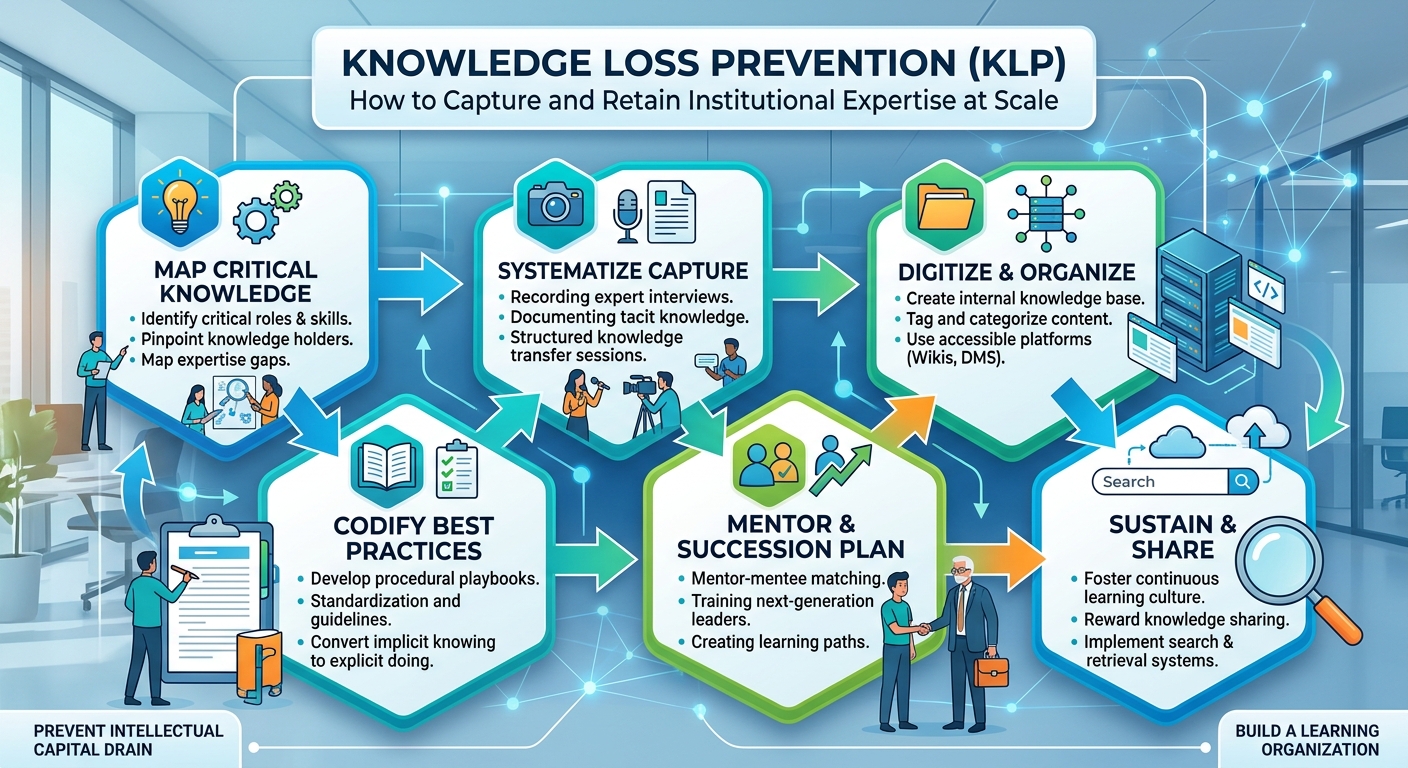
Knowledge Loss Prevention (KLP): How to Capture and Retain Institutional Expertise at Scale
In today's fast-evolving business landscape, institutional knowledge is an organization's most valuable, yet often most vulnerable, asset. The departure of an experienced employee, a shift in market dynamics, or simply the passage of time can lead to significant "brain drain," where critical expertise walks out the door. For L&D leaders across compliance, sales, banking, finance, insurance, retail, pharma, healthcare, hospitality, oil and gas, and mining sectors, proactive Knowledge Loss Prevention (KLP) isn't just a best practice—it's an urgent strategic imperative for sustaining growth, ensuring regulatory adherence, and maintaining a competitive edge.
This article delves into how your organization can effectively capture, retain, and scale institutional expertise, transforming a potential vulnerability into a powerful, enduring strength.
The Imperative of Preventing Knowledge Erosion
The "great resignation" amplified a long-standing challenge: high employee turnover. Combine this with a significant portion of the workforce nearing retirement, and the risk of losing invaluable tacit knowledge becomes alarming. Imagine the impact on a pharmaceutical company losing a lead researcher's decades of project insights, or a financial institution struggling to recall historical compliance precedents without a seasoned veteran. The costs are profound:
- Increased Rework and Errors: Teams spend more time reinventing the wheel or making mistakes due to a lack of shared past learnings.
- Slowed Onboarding and Productivity: New hires take longer to become fully productive without easily accessible expert guidance.
- Lost Innovation and Competitive Edge: The ability to learn from past successes and failures is hampered, stifling future breakthroughs.
- Compliance and Risk Exposure: In regulated industries, lost knowledge about procedures and historical decisions can lead to non-compliance and significant penalties.
Addressing these challenges requires a comprehensive approach, integrating both strategic processes and powerful technological solutions.
Foundational Pillars of Effective KLP
Identifying Critical Knowledge & Experts
The first step in any KLP strategy is to pinpoint exactly what knowledge is most critical and who holds it. This isn't just about job roles but about unique skills, problem-solving approaches, and historical context.
- Knowledge Mapping: Conduct interviews, surveys, and workflow analyses to identify key processes, unique competencies, and individuals who are repositories of institutional memory.
- Risk Assessment: Prioritize knowledge areas where loss would have the most significant impact on operations, compliance, or innovation.
Strategies for Knowledge Capture
Once identified, the next challenge is to extract and document this often-tacit knowledge in a structured, accessible format.
- Structured Documentation: Develop clear SOPs, technical manuals, internal wikis, and best practice guides. Ensure these are regularly updated and easily searchable within a robust learning content management system.
- Mentorship and Peer Learning Programs: Formalize knowledge transfer through mentorship relationships, reverse mentoring, and job shadowing.
- Exit Interviews and Knowledge Transfer Checklists: Implement structured processes for departing employees to document key insights, contacts, and ongoing projects.
- Storytelling and Case Studies: Encourage experts to share their experiences and lessons learned through narratives, which can be highly engaging and memorable.
- Video and Audio Recordings: Capture expert interviews, presentations, and process walkthroughs, making complex information easier to digest.
Leveraging Technology for Scalable Knowledge Retention
While traditional methods are vital, scaling KLP across a large enterprise with diverse needs requires sophisticated technology, particularly a modern LMS. An advanced learning management system (LMS) can centralize, organize, and deliver institutional knowledge efficiently.
Question: How can data-driven insights enhance our institutional memory efforts?
Answer: Data analytics within an enterprise learning management system can pinpoint knowledge gaps, track learner engagement with critical content, and even predict areas where expertise might be thinning. By analyzing user behavior and performance, you can optimize content delivery, personalize learning paths, and proactively address emerging knowledge needs, ensuring that valuable insights are not only captured but effectively absorbed and applied.
Dynamic Content Delivery with Microlearning
For busy professionals, lengthy training modules can be a barrier. Microlearning LMS platforms break down complex topics into bite-sized, digestible modules. This approach is perfect for delivering just-in-time information on compliance regulations, sales techniques, or product specifications in sectors like retail or banking, making knowledge accessible and actionable when it's most needed.
Engaging Learners with Gamification and Adaptive Paths
Retention isn't just about access; it's about engagement. A Gamified LMS injects elements of challenge, competition, and reward, motivating employees to interact with learning content. Combined with Adaptive Learning, which tailors content based on an individual's existing knowledge and learning style, expertise transfer becomes more efficient and effective, speeding up proficiency in complex areas like healthcare protocols or oil and gas safety procedures.
Intelligent Content Creation and Management
Question: Can artificial intelligence truly revolutionize how we maintain and share expert knowledge?
Answer: Absolutely. Artificial intelligence is a game-changer for KLP. AI-powered tools can analyze vast amounts of internal documentation to identify key concepts and relationships, automatically suggest relevant learning paths, and even help generate initial drafts of new training content from existing resources. An AI Powered Authoring Tool can dramatically reduce the time and effort required to transform raw institutional data into polished, engaging learning modules, ensuring that your learning management solutions are always up-to-date and relevant.
Fostering a Culture of Continuous Learning and Sharing
Technology is a powerful enabler, but KLP ultimately thrives in a culture that values and rewards continuous learning and knowledge sharing.
Encouraging Peer-to-Peer Exchange
- Internal Forums and Communities of Practice: Create digital spaces for employees to ask questions, share insights, and collaborate on challenges.
- Collaborative Projects: Structure projects to encourage cross-functional knowledge sharing and mentorship.
Integrating Learning into Workflow
Make learning a natural part of daily operations, not a separate event. This could involve embedding short learning modules directly into operational software or providing quick access to critical information through an LMS learning management system.
Prioritizing Risk-Focused Knowledge
In industries like banking, finance, pharma, and healthcare, identifying and preserving knowledge related to compliance, safety, and regulatory requirements is paramount. Implementing Risk-focused Training ensures that critical guidelines and historical risk assessments are continuously understood and applied, minimizing potential exposure.
Scaling KLP Across Geographies and Divisions
Question: What are the most effective ways to ensure consistent knowledge across a geographically dispersed workforce?
Answer: For organizations operating across multiple regions or with diverse business units, a centralized cloud based learning management system is indispensable. This allows for the standardization of core training modules while also enabling localized content and cultural adaptations. By leveraging an enterprise learning management solution, you can ensure that every employee, regardless of their location, has equitable access to the same high-quality institutional knowledge, fostering consistency in operations, compliance, and service delivery.
The MaxLearn Advantage: Your Partner in KLP
Implementing a robust KLP strategy requires a platform that's not only powerful but also intuitive and scalable. MaxLearn LMS provides a comprehensive suite of features—from AI-powered authoring and adaptive learning to microlearning and gamification—designed to help L&D leaders capture, manage, and distribute institutional knowledge effectively, preventing loss and empowering your workforce.
Conclusion: Safeguarding Your Most Valuable Asset
Knowledge Loss Prevention is no longer an optional add-on; it's a strategic imperative for any forward-thinking organization. By combining systematic capture processes, advanced learning technologies like a modern learning management software, and a culture of continuous learning, L&D leaders can transform the threat of knowledge erosion into an opportunity for sustained growth, innovation, and resilience. Invest in your institutional memory today, and safeguard your future.


