

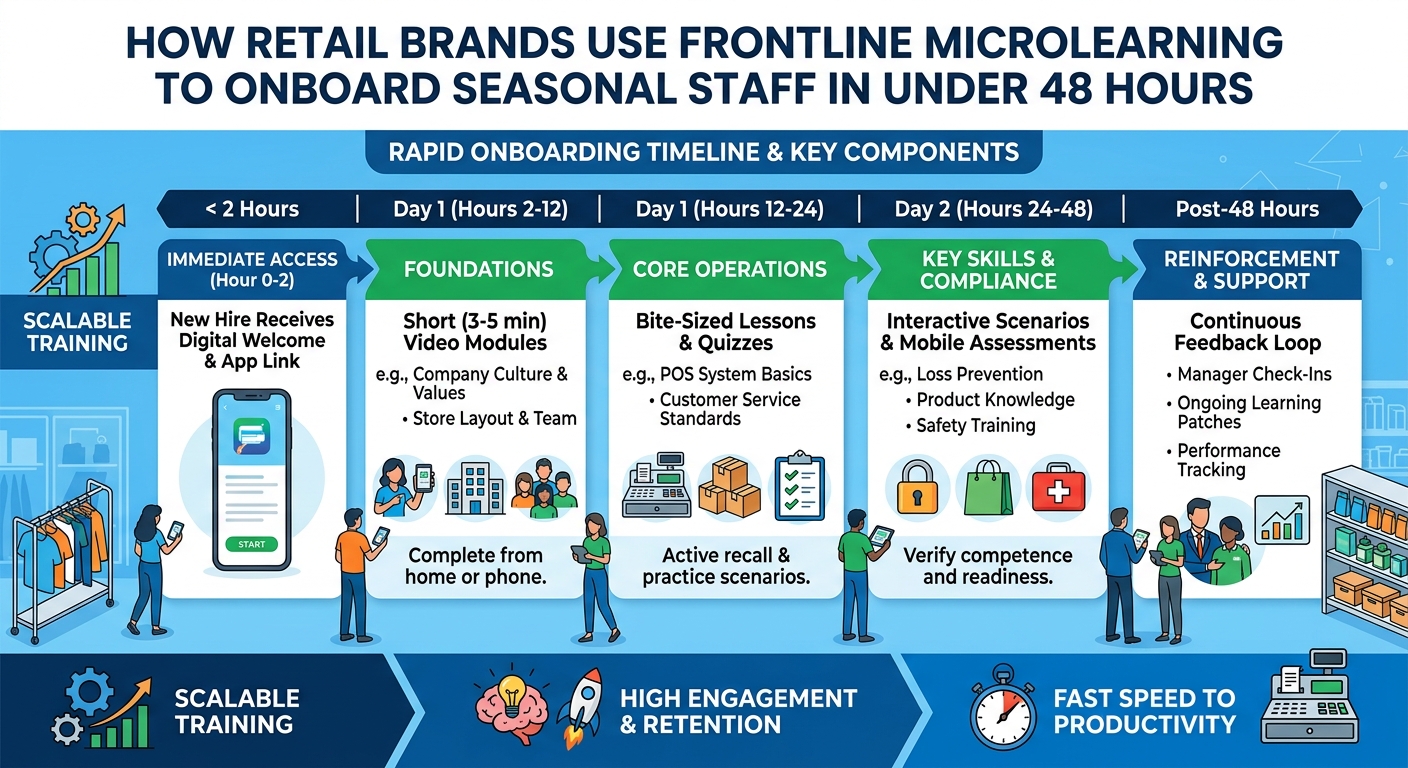
How Retail Brands Use Frontline Microlearning to Onboard Seasonal Staff in Under 48 Hours
The holiday rush, back-to-school season, or sudden promotional events can transform the calm waters of retail into a tempest. Retail brands frequently face the daunting task of rapidly expanding their workforce with seasonal staff, often needing them to be customer-ready in a matter of hours, not days or weeks. For L&D leaders across industries from retail to hospitality, and even sectors like healthcare dealing with temporary staff surges, this presents a significant challenge: how to deliver effective, compliant, and engaging onboarding at lightning speed?
The traditional onboarding model – lengthy manuals, classroom sessions, and shadowed shifts – simply doesn't cut it. It's time-consuming, expensive, and often overwhelming for new hires. This is where frontline microlearning emerges as a powerful, transformative solution, enabling retail brands to onboard seasonal staff in under 48 hours, ensuring they are productive, confident, and brand-aligned from day one.
The Urgency of Rapid Onboarding in Retail
Retail operations demand agility. When seasonal staff are hired, there's an immediate need for them to understand product knowledge, sales processes, point-of-sale (POS) systems, customer service standards, and crucial compliance protocols. Delays in getting new hires up to speed can lead to:
- Lost sales opportunities due to uninformed staff.
- Negative customer experiences from poorly trained employees.
- Increased training costs and resources.
- Higher turnover rates among overwhelmed seasonal workers.
- Potential compliance breaches and associated Risk-focused Training gaps.
L&D professionals are under pressure to devise an onboarding strategy that is not only fast but also effective, engaging, and scalable. This is precisely where the capabilities of a modern Microlearning LMS shine.
What is Frontline Microlearning and Why Does It Work?
Frontline microlearning involves delivering bite-sized, focused learning modules directly to employees, typically on their mobile devices. Each module addresses a single learning objective and can be completed in minutes, often ranging from 2-10 minutes. This approach is highly effective for seasonal staff because it:
- Matches Attention Spans: In a fast-paced retail environment, short bursts of information are easier to digest and retain.
- Is Immediately Applicable: Learners can acquire a skill or piece of knowledge and apply it on the sales floor almost instantly.
- Reduces Cognitive Overload: Instead of a deluge of information, new hires receive digestible chunks, preventing overwhelm.
- Promotes Self-Directed Learning: Staff can access modules when and where it suits them, reinforcing learning on the go.
A robust learning management system that supports microlearning becomes the backbone of such an efficient onboarding process, especially for the high-volume, rapid training needs of retail.
Achieving 48-Hour Onboarding with Microlearning
To onboard seasonal staff efficiently, retail brands leverage several microlearning strategies and technological advantages:
1. Essential Skill Prioritization
Instead of covering everything, L&D teams identify the absolute critical knowledge and skills seasonal staff need to be operational: basic POS usage, greeting customers, locating popular items, handling returns, and key safety/compliance procedures. These become the core microlearning modules.
2. Content Segmentation and Creation
Complex topics are broken down into short videos, interactive quizzes, infographics, and quick reference guides. With an AI Powered Authoring Tool, L&D teams can rapidly create and update these engaging pieces of content, ensuring relevance and quality. This significantly streamlines the content creation phase, which is often a bottleneck in traditional training.
3. Leveraging an Engaging Gamified LMS
Seasonal staff often need extra motivation. A Gamified LMS incorporates elements like points, badges, leaderboards, and challenges into the learning experience. This transforms mandatory training into an enjoyable competition, boosting engagement and completion rates, and making the onboarding process feel less like a chore and more like a game.
4. Adaptive Learning Paths
Not all learners are the same. An Adaptive Learning system within an LMS identifies knowledge gaps and personalizes the learning journey. For seasonal staff, this means they spend time only on topics where they need improvement, accelerating their path to competence. Some might need more help with the POS, others with specific product lines; adaptive paths cater to individual needs efficiently.
5. Mobile-First Accessibility
Most seasonal retail staff are digital natives comfortable with smartphones. Delivering training via a mobile-optimized learning management software ensures they can access modules during downtime, on their commute, or even quickly review a procedure on the sales floor. This flexibility is critical for quick integration.
The combination of these elements within an effective lms learning management system, particularly a cloud based learning management system, allows retail brands to deploy training quickly and consistently across all locations.
Real-World Impact and Benefits
The adoption of microlearning for seasonal staff onboarding yields significant advantages for retail brands and other industries facing similar challenges:
- Faster Time-to-Productivity: Staff are ready to serve customers and operate systems in hours, not days.
- Consistent Brand Experience: Every new hire receives the same, high-quality training, ensuring uniform service standards.
- Reduced Training Costs: Less instructor time, fewer classroom resources, and lower logistics overhead.
- Enhanced Employee Confidence: Well-trained staff feel more capable and comfortable in their roles, reducing stress and improving job satisfaction.
- Improved Compliance: Critical safety, security, and policy training can be delivered and tracked efficiently, minimizing risks.
This approach moves beyond mere training to build a strong foundation for operational excellence, even with a transient workforce. An enterprise learning management system or LCMS becomes indispensable here for managing the diverse learning content and user base.
Addressing Key Questions About Rapid Onboarding
As L&D leaders consider this paradigm shift, certain questions naturally arise:
How quickly can retail staff truly become productive with this approach?
Many brands report staff being able to perform core tasks, like operating a POS system, understanding basic product placement, and initiating customer interactions, within their first 24-48 hours. Mastery of advanced sales techniques or complex troubleshooting may take longer, but the foundation for productivity is established swiftly.
What specific topics are best suited for microlearning in a retail environment?
Ideal topics include product feature highlights, quick service procedures, common FAQs, health and safety protocols, basic system navigation, specific promotional offers, and customer service greetings. Any core task that can be broken down into discrete steps works well.
Can this methodology be scaled across multiple store locations or global operations?
Absolutely. A cloud based learning management system ensures that all training content is accessible globally, consistently, and instantly. Local teams can also use an AI Powered Authoring Tool to adapt modules for local regulations or product variations, maintaining global consistency while allowing for local relevance.
What kind of technology infrastructure is needed for successful implementation?
The primary requirement is a robust learning management solutions platform, preferably a Microlearning LMS that offers mobile accessibility, gamification, and analytics. Staff will need access to smartphones or tablets, which are often already standard equipment in modern retail settings.
How does this impact employee engagement and turnover rates?
Engaging, relevant, and accessible training significantly boosts employee confidence and satisfaction. When new hires feel supported and quickly competent, they are less likely to feel overwhelmed and more likely to remain with the company for their full seasonal tenure. This directly contributes to lower turnover.
The Future of Frontline Onboarding with MaxLearn LMS
The demand for rapid, effective onboarding isn't limited to retail. Industries like hospitality, healthcare, and even manufacturing frequently face the need to quickly integrate new or temporary staff. A comprehensive MaxLearn LMS offers the robust features necessary for this agile approach. From its intuitive content creation tools to its engaging delivery mechanisms, it empowers organizations to transform their onboarding processes.
Investing in a modern learning content management system is no longer just about compliance; it's about competitive advantage. It ensures that every seasonal hire, from their first hour on the job, is an asset to your brand, ready to contribute positively to the customer experience and the bottom line.
Conclusion
The challenge of onboarding seasonal staff swiftly and effectively is a universal pain point for many organizations. Frontline microlearning, supported by a powerful and flexible LMS, offers a compelling solution. By breaking down complex training into digestible, engaging, and accessible modules, retail brands can achieve the seemingly impossible: fully equipping their seasonal workforce in under 48 hours. For L&D leaders looking to drive efficiency, enhance employee performance, and secure a competitive edge, embracing microlearning for rapid onboarding is not just an option—it’s a strategic imperative.


