

How Does Microlearning Solve the Ebbinghaus Forgetting Curve in Corporate Training?
For Learning & Development (L&D) leaders, the challenge of ensuring knowledge retention and skill application long after a training session concludes is a perpetual one. It's a battle against a formidable foe: the Ebbinghaus Forgetting Curve. This scientific principle, demonstrating how quickly newly acquired information slips from our memory, has profound implications for corporate training effectiveness and return on investment. Traditional, lengthy training programs often fall victim to this curve, leaving employees with rapidly diminishing recall and underutilized skills. However, a modern, agile approach is emerging as the ultimate antidote: microlearning.
As VPs, Directors, Senior Managers, and Managers of L&D, your primary goal is to foster a highly skilled, adaptable, and compliant workforce across industries like Compliance, Sales, Banking, Finance, Insurance, Retail, Pharma, Healthcare, Hospitality, Oil and Gas, and Mining. This requires training solutions that not only impart knowledge but also ensure its lasting impact. Microlearning, delivered through an effective Microlearning LMS, presents a powerful strategy to overcome the inherent limitations of human memory and maximize training efficacy.
Understanding the Ebbinghaus Forgetting Curve
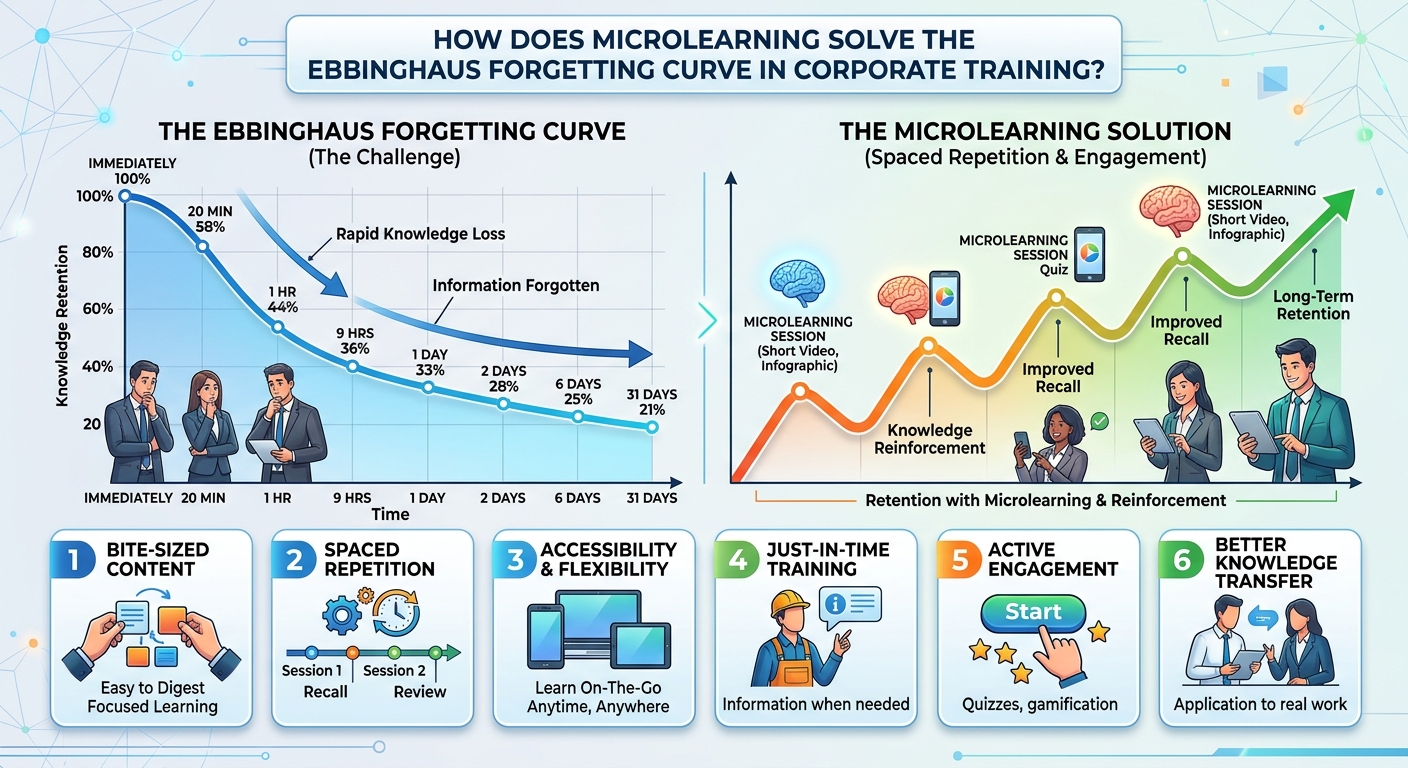
In the late 19th century, German psychologist Hermann Ebbinghaus conducted pioneering research on memory, revealing a startling truth: we forget most new information within days, or even hours, if it's not reinforced. His "forgetting curve" illustrates a sharp initial drop in retention, followed by a more gradual decline. Within just one hour, we might forget 50% of what we learned. By day seven, that figure can reach 90%.
For corporate training, this phenomenon is critical. Imagine the resources poured into a multi-day workshop on compliance regulations, sales techniques, or new software only for employees to forget half of it by lunch. This isn't a failure of the learner; it's a fundamental challenge of how our brains process and store information. Traditional corporate training, with its emphasis on information dumps and infrequent, extended sessions, is particularly vulnerable to the Ebbinghaus effect. Learners become overwhelmed, engagement wanes, and the vast majority of the content never makes it into long-term memory.
The Microlearning Antidote: How it Reverses the Curve
Microlearning is an approach to learning that delivers content in small, focused bursts, typically lasting from a few seconds to 15 minutes. It's designed to be digestible, on-demand, and easily accessible. Unlike traditional training, microlearning doesn't attempt to cram vast amounts of information at once. Instead, it strategically counters the forgetting curve through several core principles:
- Bite-sized Content: By breaking down complex topics into short, manageable modules, microlearning reduces cognitive load. Learners can focus on one concept at a time, making it easier to absorb and retain. This directly tackles the initial steep drop of the forgetting curve by enhancing initial encoding.
- Spaced Repetition: One of microlearning's most powerful mechanisms is spaced repetition. Instead of a single, long exposure, key concepts are revisited over time at increasing intervals. A learner might encounter a concept today, then again in three days, then a week, then a month. This systematic reinforcement strengthens neural pathways and actively pushes information from short-term to long-term memory, effectively flattening the forgetting curve.
- Relevance and Context: Microlearning modules are often highly specific and relevant to immediate job tasks or learning objectives. When information is directly applicable, it's more likely to be retained because learners understand its value and can immediately apply it, leading to stronger encoding.
- Engagement and Accessibility: Short, interactive formats like quizzes, short videos, infographics, and simulations keep learners engaged. Furthermore, being accessible anytime, anywhere via a cloud based learning management system means employees can access content precisely when they need it, whether to prepare for a customer call in sales or refresh a safety procedure in oil and gas. This on-demand access turns learning into a performance support tool, bolstering recall just before application.
How Microlearning Directly Addresses Forgetting Stages
Microlearning doesn't just chip away at the forgetting curve; it systematically dismantles it at every stage:
Initial Learning (Retention): Short, focused modules prevent cognitive overload, ensuring that the initial learning experience is efficient and effective. Learners can fully grasp one concept before moving to the next, enhancing their initial retention.
Reinforcement (Recall): Through spaced repetition, quizzes, and scenario-based challenges embedded within a Gamified LMS, microlearning actively prompts learners to recall information. Each successful recall attempt strengthens the memory trace, pushing information deeper into long-term memory. This continuous reinforcement is crucial for preventing the sharp decline in retention.
Application (Long-term Memory): By providing just-in-time access to critical information and incorporating practical, scenario-based exercises, microlearning bridges the gap between learning and application. When learners immediately apply what they've learned, the knowledge becomes more deeply embedded and less susceptible to the forgetting curve. For industries like banking and finance, this means crucial compliance knowledge is not just memorized but internalized and applied correctly.
Leveraging Technology for Superior Microlearning Effectiveness
The true power of microlearning in combating the forgetting curve is amplified by an advanced learning management system (LMS). A modern Microlearning LMS serves as the backbone, providing the infrastructure for content delivery, learner tracking, and performance analytics. Such a learning management system is more than just a repository; it's a dynamic platform for continuous learning.
- Adaptive Learning Paths: An enterprise learning management solution with Adaptive Learning capabilities can personalize the learning experience. It assesses a learner's prior knowledge and performance, then tailors the delivery of micro-modules and spaced repetition intervals, making the reinforcement process even more efficient and targeted. This ensures that each learner receives the right content at the right time, optimizing retention.
- AI-Powered Content Creation and Curation: An AI Powered Authoring Tool dramatically speeds up the creation of engaging microlearning content. AI can analyze existing knowledge bases, suggest micro-content ideas, and even help generate interactive quizzes and scenarios, ensuring a steady stream of fresh and relevant material to fuel spaced repetition. This transforms the LCMS into a more agile and responsive tool.
- Gamification for Engagement: Incorporating elements of a Gamified LMS — such as points, badges, leaderboards, and challenges — motivates learners to engage consistently with microlearning modules. This increased engagement translates directly into more frequent interaction with content, reinforcing memory and flattening the forgetting curve.
- Risk-focused Training & Compliance: For sectors like healthcare and insurance, where compliance and risk mitigation are paramount, Risk-focused Training delivered via microlearning ensures critical information is not just learned but deeply ingrained. By breaking down complex regulations into digestible, frequently reinforced segments, organizations significantly reduce the likelihood of costly errors due to forgetfulness. This is where a robust learning management software truly shines.
Exploring the Digital Edge in Learning
Question: How can smart algorithms enhance the impact of learning initiatives?
Answer: Intelligent algorithms within a modern learning management system (LMS) can revolutionize training by analyzing vast amounts of learner data. They identify individual learning patterns, pinpoint knowledge gaps, and predict areas where learners might struggle or excel. This enables the platform to recommend personalized microlearning content, optimize spaced repetition schedules, and even suggest career development paths. By intelligently adapting the learning journey, these systems ensure maximum engagement and retention, significantly boosting the overall efficacy of a learning management solution.
Question: What considerations are paramount for deploying effective learning solutions across diverse global teams?
Answer: When implementing training for a global workforce, cultural relevance, language localization, and accessibility are critical. A robust learning content management system (LCMS) must support multi-language content, offer culturally sensitive scenarios, and be accessible on various devices and internet speeds. Microlearning, with its adaptable format, is ideal for global deployment, allowing for rapid localization and ensuring that learners in pharma in Japan, or retail in the US, receive training that resonates and is easily consumable, regardless of their geographical location or technical infrastructure.
Question: How can organizations ensure that training investments yield measurable improvements in performance and productivity?
Answer: Ensuring a strong return on training investment hinges on continuous monitoring, data analytics, and a feedback-driven approach. An advanced enterprise learning management system provides detailed insights into learner progress, completion rates, and post-training performance. By correlating these metrics with business outcomes – such as reduced errors in finance, improved sales figures, or enhanced safety records in mining – organizations can directly measure the impact. Iterative refinement of microlearning content based on this data ensures continuous optimization, transforming the lms learning management system from a simple delivery tool into a strategic performance driver.
Beyond Memory: The Broader Benefits of Microlearning
While solving the Ebbinghaus Forgetting Curve is a monumental achievement, microlearning offers additional benefits for L&D leaders:
- Increased Engagement: Learners prefer short, focused content that fits into their busy schedules.
- Cost-Effectiveness: Easier to update and deploy, microlearning reduces the time and cost associated with traditional training.
- Agility: Rapidly develop and deploy training for new products, compliance changes, or market shifts, keeping your workforce always up-to-date.
- Improved Performance: Just-in-time learning acts as performance support, empowering employees to apply knowledge precisely when needed.
Conclusion
The Ebbinghaus Forgetting Curve is a fundamental challenge to human learning, but it is not insurmountable. For L&D leaders striving for excellence in corporate training across diverse industries, microlearning, powered by a sophisticated learning management software like MaxLearn LMS, offers a scientific and practical solution. By breaking down content, reinforcing knowledge through spaced repetition, and leveraging advanced technological features such as adaptive learning and gamification, microlearning transforms how employees learn and retain information.
Moving beyond information dumps to sustained, engaging, and memorable learning experiences is no longer a luxury; it's a necessity for fostering a highly competent and resilient workforce. Embrace microlearning to ensure your training investments truly stick, driving measurable improvements in performance, productivity, and compliance throughout your organization.


