

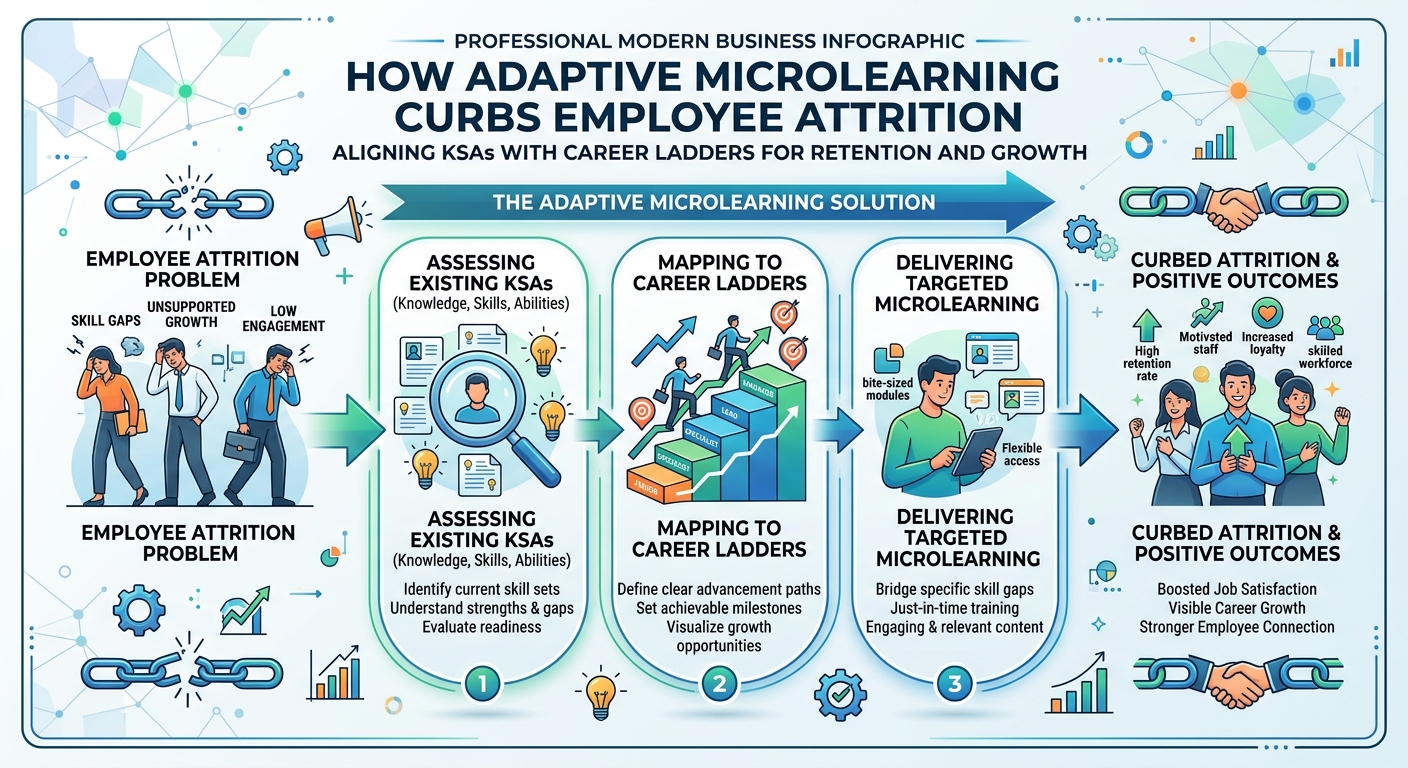
How Adaptive Microlearning Curbs Employee Attrition by Aligning KSAs with Career Ladders
In today's dynamic corporate landscape, employee attrition remains a formidable challenge for organizations across all sectors, from Banking and Finance to Pharma, Retail, and Hospitality. The cost of losing talented individuals — including recruitment, onboarding, and lost productivity — can significantly impact a company's bottom line and morale. For Vice Presidents, Directors, and Senior Managers of Learning & Development (L&D), finding effective strategies to retain valuable employees is paramount. This is where adaptive microlearning emerges as a powerful solution, strategically aligning employee Knowledge, Skills, and Abilities (KSAs) with clear career progression paths.
The Unseen Costs of Employee Turnover and Stagnation
Employee turnover isn't just a number; it's a drain on resources. Beyond the direct financial implications, high attrition rates lead to a loss of institutional knowledge, decreased team cohesion, and a potential dip in customer satisfaction. Industries like Oil and Gas, Mining, and Health care, where specialized skills are critical, feel this impact profoundly. The traditional "one-size-fits-all" training models often fail to address individual learning needs or demonstrate a clear link between learning and career growth, leaving employees feeling stagnant and undervalued. This gap often leads them to seek opportunities elsewhere, turning what could be an internal growth story into an external loss.
Bridging the Gap: KSA Alignment with Defined Career Ladders
At its core, employee retention hinges on perceived value and growth opportunities. Employees want to know that their current contributions are recognized and that their professional development is supported. A well-defined career ladder provides this roadmap, outlining the various roles, responsibilities, and requisite KSAs for advancement within an organization. The challenge lies in equipping employees with these specific KSAs effectively and efficiently. This is where adaptive microlearning shines, leveraging a modern learning management system (LMS) to create highly personalized, relevant, and engaging learning experiences. This approach is fundamental for any forward-thinking enterprise learning management strategy.
What Defines Adaptive Microlearning?
Adaptive microlearning combines two powerful concepts that are revolutionizing corporate training: microlearning and adaptive learning. Microlearning delivers bite-sized, focused content modules, typically ranging from 3-7 minutes, making learning digestible and easily integrated into busy work schedules. Adaptive learning, powered by advanced algorithms and often housed within a robust learning content management system (LCMS), dynamically adjusts the learning path based on an individual's performance, preferences, and existing knowledge. It ensures that each learner receives the most relevant content at the optimal time, eliminating redundancy and maximizing engagement. This results in a highly efficient and effective learning management software experience.
How Adaptive Microlearning Curbs Attrition by Empowering Growth
By personalizing the learning journey and directly linking it to career growth, adaptive microlearning addresses several root causes of employee attrition:
- Personalized Skill Development: Instead of generic courses, employees receive training precisely tailored to the KSAs required for their next career step. An adaptive learning management system identifies skill gaps and delivers targeted micro-modules to close them, making every learning interaction count. This ensures every employee's development is purposeful.
- Increased Engagement and Motivation: The short, focused nature of microlearning, especially when delivered through a Gamified LMS, keeps learners engaged. Success and progress are immediately visible, fostering a sense of accomplishment and motivating employees to continue their development. This active engagement is crucial for long-term retention.
- Clear Career Progression: When training is explicitly tied to career ladders, employees see a direct correlation between their learning efforts and their advancement prospects. This transparency instills confidence and loyalty, reducing the inclination to seek growth opportunities externally. It transforms training into a clear path forward.
- Improved Job Satisfaction: Empowered with the right skills and a clear path forward, employees feel more competent, valued, and satisfied in their roles. They are better equipped to handle complex tasks, contribute meaningfully, and even take on Risk-focused Training to mitigate critical business exposures in sectors like Compliance and Insurance.
- Efficient Learning & Development: A cloud based learning management system utilizing adaptive microlearning streamlines L&D efforts. It reduces time away from core duties and provides real-time data on skill proficiency, allowing L&D managers to allocate resources more effectively. This efficiency benefits both the employee and the organization.
The Pivotal Role of Technology: Intelligent Learning Management Solutions
Implementing effective adaptive microlearning requires sophisticated technology. A modern learning management system (LMS) acts as the backbone, hosting content, tracking progress, and delivering personalized paths. An Adaptive Learning methodology thrives on intelligent algorithms that analyze learner data to recommend the next best learning step. Furthermore, an AI Powered Authoring Tool can significantly accelerate the creation and updating of microlearning content, ensuring that KSAs taught are always current and relevant to evolving industry demands, whether in Sales, Pharma, or other dynamic sectors. This comprehensive approach establishes a powerful lms learning management system.
Addressing Common Questions with Intelligent Solutions
L&D leaders often seek innovative approaches to enhance learning and retention. Here are some frequently asked questions about leveraging technology for employee development:
How can artificial intelligence personalize employee development?
Artificial intelligence, when integrated into a cutting-edge learning management software, analyzes an individual's performance data, learning preferences, and career aspirations. It then curates a unique learning path, recommending specific micro-modules, assessments, and resources to efficiently close skill gaps and align with their desired career ladder. This hyper-personalization ensures relevance and maximizes engagement, a key driver in reducing turnover, making every minute of learning productive and meaningful.
What is the impact of advanced algorithms on corporate training across diverse industries and regions?
Advanced algorithms, foundational to modern enterprise learning management and a robust learning content management system, revolutionize corporate training by optimizing content delivery and relevance. Across diverse industries like Banking, Healthcare, and Retail, these algorithms ensure that training is not only personalized but also dynamically adapted to reflect regional nuances or industry-specific challenges. They identify emerging skill trends and predict future learning needs, leading to highly effective and impactful learning experiences globally, regardless of geographical location or sector specifics.
Where can L&D leaders find proven strategies to reduce staff turnover using technology?
L&D leaders can find proven strategies by exploring providers of specialized learning management solutions that focus on adaptive and microlearning methodologies. Platforms like MaxLearn LMS offer comprehensive toolkits, including an intuitive Microlearning LMS, Gamified LMS features, and robust reporting, all designed to foster continuous skill development and career progression. Case studies and industry reports from these providers often highlight successful implementations in various sectors like Sales and Compliance, demonstrating clear ROI in retention.
What are the best practices for implementing intelligent learning solutions to boost retention?
Best practices for implementing intelligent learning solutions to boost retention include: 1) Clearly defining career ladders and their associated KSAs, 2) Utilizing an Adaptive Learning platform that can truly personalize content, 3) Integrating an AI Powered Authoring Tool for agile content creation and updates, 4) Incorporating elements of a Gamified LMS to enhance engagement, and 5) Regularly reviewing learning analytics to refine strategies and demonstrate ROI. Furthermore, focusing on Risk-focused Training ensures employees are equipped with critical skills for business continuity and risk mitigation, adding another layer of value to their roles and fostering job security.
Conclusion: Invest in Growth, Not Just Training
For L&D professionals tasked with cultivating talent and safeguarding organizational stability, adaptive microlearning is not merely a training method; it’s a strategic investment in employee growth and retention. By leveraging a sophisticated learning management system to deliver personalized, relevant, and engaging learning experiences, organizations can effectively align individual KSAs with predefined career ladders. This approach empowers employees, fosters a culture of continuous development, and ultimately creates a workforce that is not only highly skilled but also deeply committed and less likely to seek opportunities elsewhere. Embrace the future of employee development, and transform your attrition rates into retention success stories with intelligent learning solutions.
.jpg)


