

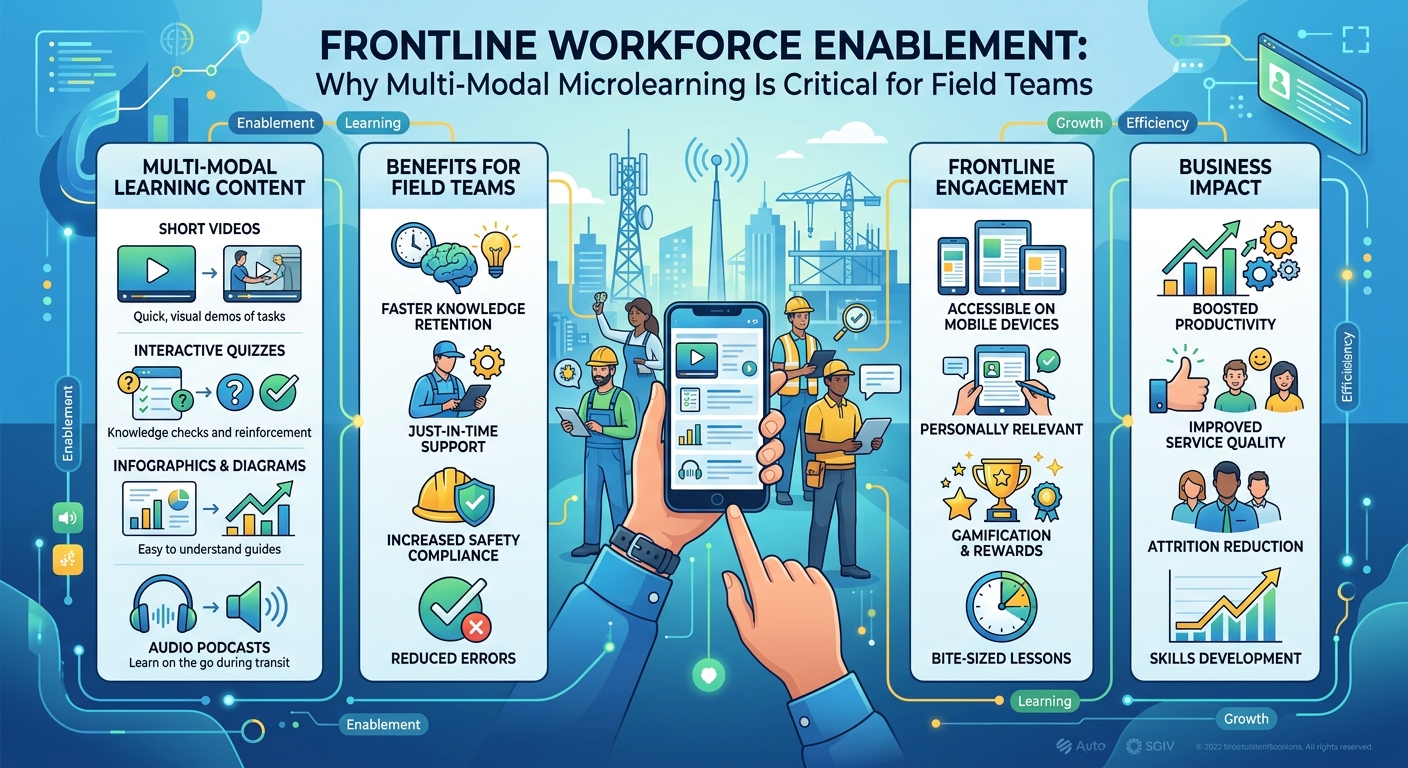
Frontline Workforce Enablement: Why Multi-Modal Microlearning Is Critical for Field Teams
In today's fast-paced business environment, the success of an organization increasingly hinges on the agility, knowledge, and performance of its frontline workforce. From sales representatives closing deals on the go to technicians maintaining complex machinery in remote locations, and customer service agents providing critical support, these field teams are the direct interface between your company and its customers. Yet, empowering these dynamic professionals with effective, timely, and relevant training presents a unique set of challenges for L&D leaders.
Traditional, lengthy training programs often fall short for individuals who are constantly on the move, facing unpredictable schedules, and operating in diverse environments. This is where multi-modal microlearning emerges not just as an innovative approach, but as a critical strategy for genuine frontline workforce enablement.
The Unique Challenges Facing Your Frontline Workforce
Before diving into the solution, it's essential to understand the specific hurdles your field teams encounter:
- Time Scarcity and On-the-Go Demands: Field professionals rarely have dedicated blocks of time for training. Their work demands immediate attention, leaving little room for lengthy classroom sessions or desktop-bound eLearning modules.
- Diverse Roles and Skill Gaps: A single frontline team might encompass a wide array of roles, each requiring distinct skill sets and knowledge. Generic training often fails to address these specific needs.
- High Turnover and Rapid Onboarding Needs: Industries like retail and hospitality often experience higher turnover, necessitating efficient and swift onboarding processes to get new hires productive quickly.
- Ensuring Compliance and Safety: In regulated sectors such as finance, healthcare, and oil & gas, compliance training is non-negotiable. Field teams must be consistently up-to-date with evolving regulations, safety protocols, and product knowledge.
- Access to Information: When a question arises on site, field teams need immediate access to accurate, concise information, not a cumbersome learning management software they can't navigate easily.
What is Multi-Modal Microlearning, and Why Does it Matter Now?
Multi-modal microlearning delivers bite-sized, focused learning content through a variety of formats (video, audio, text, infographics, quizzes, simulations). Each module typically takes just a few minutes to complete, making it perfectly suited for the "just-in-time" and "just-enough" learning needs of frontline workers. This approach is intrinsically linked to modern learning management system (LMS) capabilities that support flexible content delivery.
How does modern training support a geographically dispersed workforce?
For a workforce spread across different regions or countries, multi-modal microlearning delivered via a robust Microlearning LMS offers unparalleled flexibility. It allows learners to access content from anywhere, at any time, on any device. This means a sales rep can review product features before a client meeting, a technician can troubleshoot an issue with a quick video tutorial on site, or a compliance officer can complete a mandatory module during a short break, all without disrupting their workflow. This seamless accessibility is a hallmark of effective enterprise learning management.
The Power of Multi-Modal Microlearning for Field Teams
Implementing a multi-modal microlearning strategy offers significant benefits that directly address the challenges of frontline enablement:
Enhanced Engagement and Knowledge Retention
Short, engaging content delivered through various formats prevents cognitive overload and keeps learners motivated. Studies show that people retain information better when it's consumed in smaller, more frequent doses. An integrated Gamified LMS further amplifies engagement through points, badges, leaderboards, and challenges, making learning an enjoyable and competitive experience.
Real-Time Skill Application and Performance Improvement
Microlearning provides "performance support" exactly when it's needed. Field teams can quickly access relevant information to apply new skills or refresh existing knowledge immediately. This direct link between learning and doing translates into measurable improvements in productivity, customer satisfaction, and operational efficiency. It's about empowering your workforce with knowledge that has immediate, practical value.
Ensuring Unwavering Compliance and Mitigating Risk
In highly regulated industries such as banking, insurance, pharma, and healthcare, consistent compliance is paramount. Multi-modal microlearning makes it easier to distribute crucial updates on regulations, new policies, or safety procedures. Its rapid deployment capabilities mean your teams can be informed and compliant instantly, significantly reducing organizational risk. For critical areas, deploying Risk-focused Training through a microlearning framework ensures that essential information is not only delivered but also absorbed and understood, protecting both the employees and the organization.
Scalability and Consistency Across Vast Operations
Imagine the challenge of training thousands of frontline employees across different regions or even continents with traditional methods. A cloud based learning management system leveraging multi-modal microlearning simplifies this immensely. It ensures that every team member, regardless of their location, receives the same high-quality, consistent training, fostering a unified brand experience and operational standard. This scalability is a key advantage for any large organization aiming for consistent performance.
Leveraging Technology for Optimal Frontline Enablement
The effectiveness of multi-modal microlearning is amplified by the right technological infrastructure, particularly a robust learning content management system (LCMS) or a specialized learning management system (LMS). Modern solutions, like a MaxLearn LMS, offer features crucial for frontline enablement.
What technology can personalize learning for field professionals?
The answer lies in the intelligent application of data and artificial intelligence. Adaptive Learning technologies, often powered by AI, can analyze a learner's performance, preferences, and knowledge gaps to deliver highly personalized content paths. This ensures that each field professional receives training that is most relevant to their specific role and current skill level, maximizing efficiency and impact. Furthermore, an AI Powered Authoring Tool can significantly streamline the creation and updating of diverse training materials, making it easier for L&D teams to keep content fresh and relevant without extensive manual effort. This type of learning management software revolutionizes how content is developed and delivered.
How can learning solutions drive immediate impact for remote teams?
Modern learning management solutions integrate mobile accessibility and offline capabilities, allowing frontline teams to download content for areas with poor connectivity. Push notifications can alert them to urgent updates or new training modules. Built-in analytics provide L&D managers with real-time insights into completion rates, performance metrics, and knowledge gaps, enabling quick adjustments to training strategies. This immediate feedback loop is vital for driving continuous improvement and ensuring that the training provided is truly effective.
Implementing a Winning Strategy: Key Considerations
For L&D leaders looking to deploy multi-modal microlearning for their frontline teams, consider these critical elements:
- Content Strategy: Focus on breaking down complex topics into digestible, actionable micro-modules. Utilize a mix of videos, quizzes, infographics, and interactive simulations tailored to the field context.
- Platform Selection: Invest in a specialized Microlearning LMS that supports multi-modal content delivery, mobile access, gamification, and robust analytics. Ensure it functions as an effective learning content management system, capable of housing and distributing all your diverse learning assets.
- Integration: Ensure your chosen LMS learning management system can integrate with other business systems (e.g., CRM, HRIS) to streamline data flow and provide a holistic view of employee performance.
- Measurement and Iteration: Continuously monitor engagement, completion rates, and performance improvements. Use this data to refine content and delivery methods, ensuring the training remains effective and impactful.
Conclusion
For Vice Presidents, Directors, and Managers of L&D across industries ranging from sales and banking to healthcare and oil & gas, enabling your frontline workforce is no longer a luxury—it's a strategic imperative. Multi-modal microlearning, supported by advanced learning management solutions, offers the agility, engagement, and effectiveness required to empower field teams, ensure compliance, and drive measurable business results. By embracing this approach, you can transform your frontline into a highly skilled, motivated, and responsive asset, ready to tackle any challenge and seize every opportunity in the field.
.jpg)


