

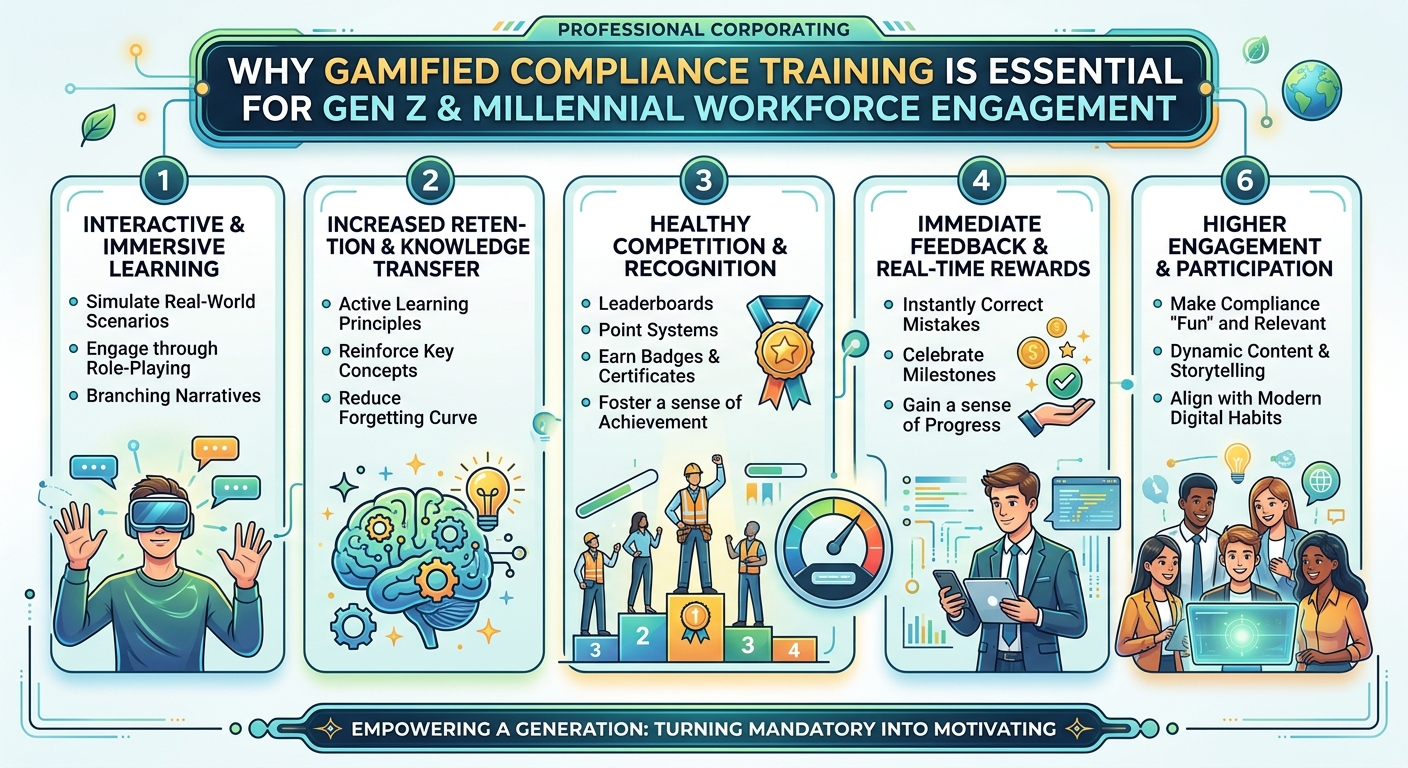
Why Gamified Compliance Training Is Essential for Gen Z and Millennial Workforce Engagement
In today's rapidly evolving corporate landscape, ensuring compliance is more critical than ever. From data privacy regulations in finance to ethical guidelines in healthcare and safety protocols in manufacturing, the stakes are high. Yet, traditional compliance training methods often fall short, struggling to capture the attention and truly embed critical information within the modern workforce. For organizations aiming to cultivate a compliant, engaged, and high-performing team, especially with the rising influence of Gen Z and Millennials, a paradigm shift is necessary. This shift points decisively towards gamified compliance training.
The Shifting Demographics: Understanding Gen Z and Millennials
Gen Z and Millennials now constitute the largest segments of the global workforce. These generations are digital natives, characterized by their comfort with technology, desire for immediate feedback, preference for interactive experiences, and an innate drive for purpose and impact. Traditional, passive learning approaches – think lengthy slide decks, monotonous lectures, or dense policy documents – are not just ineffective; they actively disengage these cohorts. They expect learning to be dynamic, personalized, and relevant, much like the digital experiences they encounter daily outside of work.
The challenge for Learning & Development (L&D) leaders, VPs, Directors, and Managers across industries such as Banking, Pharma, Retail, Healthcare, and Oil & Gas, is clear: how do you transform often dry, critical compliance content into an engaging experience that resonates with this tech-savvy, feedback-driven demographic? The answer lies in leveraging the power of gamification within your Microlearning LMS.
The Pitfalls of Traditional Compliance Training
For decades, compliance training has often been viewed as a necessary evil – a box to check rather than an opportunity for genuine learning and behavioral change. The consequences of this approach are severe:
- Low Engagement: Monotony leads to disinterest, with employees rushing through modules without true comprehension.
- Poor Retention: Information presented passively is quickly forgotten, leading to a gap between knowing and doing.
- Perceived Irrelevance: Employees may not connect the training to their daily roles, reducing its perceived value.
- Increased Risk: A lack of understanding or adherence to policies can result in costly penalties, reputational damage, and operational failures.
A modern learning management system that is merely a repository for static content is insufficient. What's needed is a dynamic learning management software that actively fosters participation and deep learning.
Why Gamification is the Ultimate Game-Changer for Compliance
Gamification applies game-design elements and game principles in non-game contexts. When integrated into compliance training, it transforms a mundane task into an immersive, interactive, and memorable experience. Here’s why it’s essential:
Enhanced Engagement and Motivation
Gen Z and Millennials thrive on interaction. A Gamified LMS introduces elements like points, badges, leaderboards, levels, and challenges, turning compliance modules into quests. This immediate gratification and visible progress tap into intrinsic motivators, driving participation and encouraging completion. Employees are no longer just passive recipients; they are active participants striving for mastery.
Improved Retention and Recall
Unlike passive learning, gamified training demands active participation. Interactive scenarios, quizzes, and simulations force learners to apply knowledge, not just absorb it. This active recall strengthens memory pathways, ensuring critical compliance information is not just learned but deeply understood and retained for longer periods. Practical application within a safe, simulated environment prepares employees for real-world scenarios, reducing errors and increasing adherence to protocols, which is vital for Risk-focused Training.
Fostering Behavioral Change
Compliance isn't just about knowing rules; it's about acting ethically and responsibly. Gamification allows for the creation of realistic scenarios where employees must make decisions, experience the consequences (virtually), and learn from mistakes without real-world repercussions. This experiential learning is far more effective at instilling desired behaviors than simply reading about them. For industries like Finance or Pharma, where regulatory compliance is paramount, this capability is invaluable.
Immediate Feedback and Progress Tracking
Digital natives expect instant feedback. Gamified training provides immediate insights into performance, highlighting areas of strength and weakness. This continuous feedback loop helps learners understand where they stand and what they need to improve, fostering a growth mindset. Furthermore, the inherent analytics within a robust lms learning management system allows L&D teams to track engagement, completion rates, and proficiency levels across the organization, demonstrating ROI.
Key Elements of an Effective Gamified Compliance Program
To maximize the impact of gamification, consider integrating these elements:
- Microlearning Modules: Break down complex compliance topics into bite-sized, digestible modules. This caters to shorter attention spans and allows for learning in the flow of work. MaxLearn LMS excels in this area.
- Adaptive Learning Paths: Personalize the learning journey based on an individual’s prior knowledge and performance. An intelligent enterprise learning management system can dynamically adjust content difficulty and progression, ensuring relevance.
- Scenario-Based Challenges: Develop interactive simulations that mirror real-world ethical dilemmas or regulatory situations employees might face.
- Clear Objectives and Meaningful Rewards: Beyond points and badges, link achievements to professional development, recognition, or even charitable contributions to align with the Gen Z/Millennial desire for purpose.
- Social Learning: Incorporate team-based challenges or leaderboards that foster healthy competition and peer-to-peer learning.
Leveraging Technology: The Role of a Modern Learning Content Management System
Implementing effective gamified compliance training requires a sophisticated learning content management system. A modern cloud based learning management system offers the scalability and flexibility needed for diverse workforces across global operations. Platforms like MaxLearn LMS provide a comprehensive suite of tools designed for this purpose. From an AI Powered Authoring Tool that streamlines the creation of interactive content to robust analytics for tracking learner progress, the right LCMS is the backbone of successful digital learning initiatives.
Addressing Key Questions for L&D Leaders:
L&D leaders often grapple with how to future-proof their training strategies. Here are some critical considerations:
What cutting-edge technologies are transforming compliance content creation?
Modern learning platforms are integrating advanced capabilities, including natural language processing and machine learning, to assist in content generation, personalization, and translation. An AI Powered Authoring Tool can dramatically reduce the time and resources needed to develop highly interactive and engaging compliance modules, ensuring consistency and accuracy across all materials. This allows L&D teams to focus more on strategic design rather than manual content creation.
How can organizations ensure compliance training is relevant globally and locally?
Scalability and localization are paramount for multinational corporations. A robust cloud based learning management system facilitates the deployment of training across different regions, often supporting multiple languages and regulatory frameworks. The use of scenario-based training that can be adapted to specific regional contexts, combined with an Adaptive Learning engine, ensures that while core principles are consistent, examples and challenges are locally relevant. This fosters a sense of ownership and applicability for employees, regardless of their geographical location.
Beyond basic knowledge, how does modern training impact long-term employee behavior and organizational culture?
Effective gamified compliance training moves beyond rote memorization to cultivate a culture of ethical conduct and vigilance. By simulating real-world dilemmas, employees develop critical thinking skills and learn to apply compliance principles in complex situations. This consistent practice, combined with a positive and engaging learning experience, reinforces desired behaviors and instills a proactive approach to risk management. It transforms compliance from a burden into a shared responsibility, contributing to stronger ethical foundations and a resilient organizational culture, especially when integrated with Risk-focused Training.
Conclusion
The imperative for engaging and effective compliance training has never been stronger. For Gen Z and Millennial workforces, traditional methods are obsolete. Gamified compliance training, supported by a powerful LMS like MaxLearn LMS, offers a transformative solution. It enhances engagement, boosts retention, fosters behavioral change, and provides the invaluable data L&D leaders need to demonstrate impact. By embracing this innovative approach, organizations across all sectors – from Finance to Hospitality, and from Healthcare to Mining – can ensure compliance isn't just met, but actively championed, safeguarding their future and empowering their most valuable asset: their people.
.jpg)


